Environment Steering: Enhancing AI Agent Safety and Utility Through Data Flow Control

Environment Steering uses data flow tracking and declarative policies to safely redirect LLM agents at runtime while boosting task success.
This arXiv paper introduces Environment Steering, a runtime safety framework for LLM-powered agents. Existing defenses — pre-execution constraints, tool I/O modification, and LLM judges — all share a structural flaw: they either depend on model reliability or simply block violations without helping the agent recover. Environment Steering models execution state as database tables, tracks data flow at record granularity, and validates it with declarative policies; when a violation is detected, the system provides context-aware feedback to redirect the agent toward a safe path rather than halting it. On the AgentDyn benchmark, the approach achieves both a task success rate above the no-defense baseline and a 0% attack success rate, breaking the assumed trade-off between safety and utility.
The Safety Dilemma of LLM Agents
Large language model (LLM)-powered agents are rapidly taking over more and more automation tasks — from calling external tools to executing multi-step operations. But a persistent real-world problem remains: even when you explicitly instruct an agent to "act safely," it can still initiate unsafe tool calls. Instruction-level constraints are simply not enough to guarantee safe behavior.
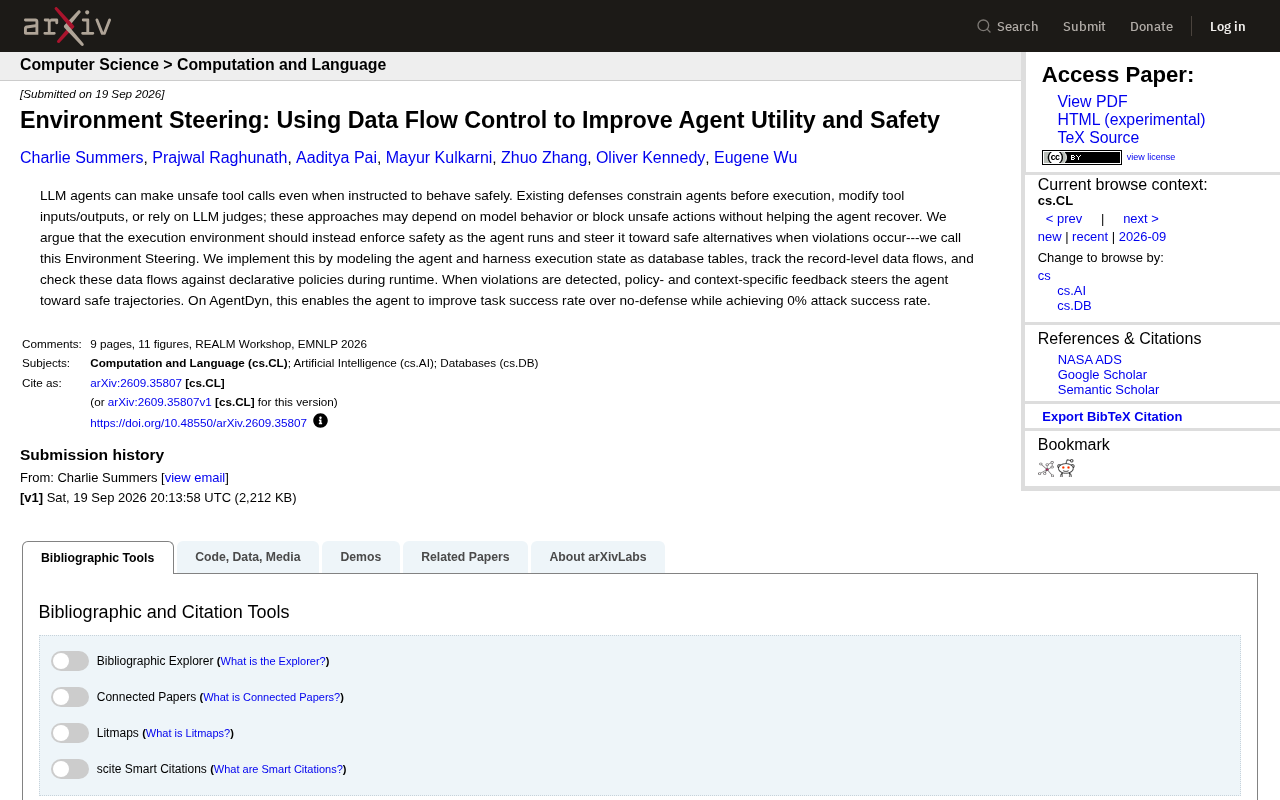
This research published on arXiv (arXiv:2609.35807v1) addresses exactly this pain point with a new approach. The authors argue that existing defense mechanisms all suffer from structural flaws, and what's needed is a mechanism that can genuinely intervene at runtime to steer the agent — which they call Environment Steering.
Why Existing Defenses Fall Short
The paper surveys three mainstream defense approaches and identifies the limitations of each:
Pre-Execution Constraints
The first approach imposes constraints before the agent executes an action, attempting to preemptively block unsafe behavior paths. The problem is that such static constraints rely on predicting model behavior — once the agent's actual decisions deviate from expectations, the constraints may fail.
Modifying Tool Inputs and Outputs
The second approach filters risks by rewriting tool inputs or outputs. While direct, this method doesn't understand how data flows through the entire execution chain, making it prone to false positives on legitimate tasks and difficult to cover complex multi-step scenarios.
Relying on an LLM Judge
The third approach introduces an additional LLM as a "judge" to determine whether a given action is safe. This essentially circles back to relying on model behavior — the judge itself is a model that can make mistakes, and its reliability cannot be hard-guaranteed.
The authors' core criticism is this: these methods either depend on the model's own behavioral reliability, or they simply stop after intercepting an unsafe action. They don't help the agent recover from mistakes — they "block" rather than "steer."
The Core Idea Behind Environment Steering
The researchers propose a perspective shift: safety shouldn't be handled solely inside the agent, but should be enforced at runtime by the execution environment, which actively steers the agent toward safe alternative paths when violations occur.
The implementation is elegant, and can be broken down into three key components:
- State modeled as database tables: The runtime state of both the agent and the execution harness is modeled as database tables, turning an otherwise abstract execution process into something structured and queryable.
- Record-level data flow tracking: Data flow is tracked at the record granularity, giving the system precise knowledge of where each piece of data comes from and where it's headed.
- Declarative policy validation: Declarative policies are used at runtime to check these data flows and determine whether violations exist.
When a violation is detected, the system doesn't simply terminate the operation — it provides policy- and context-aware feedback that steers the agent toward a safe execution trajectory. This is the essence of the word "steering" — not blocking, but correcting course.
Experimental Results: Safety and Utility Aren't Mutually Exclusive
The most common cost of a safety defense is sacrificing the agent's ability to complete tasks. Add too many restrictions, and the agent can barely do its job. Environment Steering delivers a compelling answer on exactly this point.
On the AgentDyn benchmark, Environment Steering achieves two seemingly contradictory goals:
- Task success rate exceeds the no-defense baseline: In other words, adding this safety mechanism doesn't make the agent less capable — it actually performs better at completing tasks.
- Attack success rate drops to 0%: Against adversarial attacks, the defense achieves its theoretical maximum.
The significance of this result lies in breaking the conventional assumption that safety and utility are a zero-sum trade-off. By providing targeted feedback at runtime, Environment Steering allows the agent to be corrected while continuing to make progress on the task, rather than being stopped cold.
AgentDyn is a benchmark framework specifically designed to evaluate LLM agents' dynamic task execution capabilities, focusing on task success rates in multi-step, tool-calling chain scenarios, while also supporting adversarial attack injection to assess defense effectiveness. "Attack success rate" in this context typically refers to the proportion of attacks — such as prompt injection — that successfully bypass safety constraints and induce the agent to execute malicious operations. Prompt injection is one of the core threats in current agent security: attackers embed malicious instructions in tool return values, web page text, or environment data, tricking the LLM into treating them as legitimate commands. The fact that Environment Steering brings the attack success rate to 0% while simultaneously improving task success is a strong experimental signal for the prompt injection defense field, suggesting that its feedback mechanism not only corrects malicious inductions but also provides sufficient context to help the agent continue legitimate tasks.
Implications of This Research
Environment Steering represents a conceptual shift from "external constraints" to "environment-level governance." It transplants data flow control — a mature concept in database and information security — into the runtime governance of LLM agents.
For developers building agent systems, several points are worth noting: structuring execution state into a queryable data model; expressing safety constraints through declarative policies rather than hardcoded rules; and treating "recovery steering" as part of the defense rather than just interception. These design principles have direct practical value for building agent frameworks that are both reliable and useful.
It's worth noting that this article is based on the paper's abstract. The specific policy language design, performance overhead of data flow tracking, and generalization capabilities on broader benchmarks still await disclosure in the full paper.
Background
Data Flow Tracking (also known as Taint Analysis) is a classic technique in information security. Its core idea is to tag data and track the propagation paths of those tagged data through a system, thereby determining whether untrusted data has contaminated sensitive operations. In traditional software security, this technique is commonly used to detect vulnerabilities like SQL injection and XSS. Bringing it into the LLM agent context means the system needs to track how each piece of input — such as user instructions or tool return values — flows through various processing steps to ultimately affect which tool calls or outputs. The "record-level" granularity emphasizes that the tracking unit is a specific data entry rather than a general data type. This enables the system to distinguish between "content from an external webpage triggered a file write" and "a write operation explicitly authorized by the user," enabling precise security validation in complex agent tasks involving multiple steps and multiple tools.
Declarative Policies are a way of expressing rules that describe "desired outcomes" rather than "execution procedures," in contrast to imperative programming. In the database world, SQL itself is declarative — you simply specify "which records satisfying a condition to query" without specifying how to traverse the data. In security policy, a typical declarative rule might look like: "data originating from an external tool's return value must not be passed directly into a tool that executes system commands." The advantage of this approach is that the policies themselves are easy to audit and maintain, are not coupled to business logic, and can be defined and modified by domain experts rather than programmers. By contrast, hardcoded rules (e.g., if tool_name == 'shell_exec': block written directly in code) are difficult to cover unforeseen scenarios and are scattered throughout the codebase, making them hard to manage centrally. Environment Steering applies declarative policies to runtime data flow validation — essentially transplanting the mature paradigm of database access control into the execution governance layer of agents.
Related articles

Automate Job Search with AI Agents and Residential Proxies for Precise Matching
Build an AI Agent with MCP and residential proxies to bypass recruitment site anti-scraping and geo-restrictions, scrape thousands of DevOps jobs, then have Claude score and rank each against your resume. Includes proxy comparison experiments, project structure, and cost analysis—filtering only, no auto-submission.

The AI Task Assistant That Knows When to Back Off: A Cure for Activation Struggles
One Small Step is an AI assistant for task initiation struggles, using agentic decisions for guilt-free reminders, timely retreat, and cross-platform task management. The developer shares real test results on 13 tasks and architectural trade-offs.

FastAPI: A High-Performance Python Framework and a Production-Ready API Development Powerhouse
FastAPI is a high-performance web framework based on Python type hints, supporting async and automatic OpenAPI docs. With over 100k GitHub stars, this article analyzes its core strengths, production readiness, and selection advice.