Error Rate Isn't Enough: The Hidden Costs of Data Augmentation in Low-Resource Speech Recognition

Phoneme-level analysis reveals complementary mechanisms and superadditive gains from combined ASR data augmentation in low-resource settings.
This study challenges the ASR field's reliance on aggregate error rates to evaluate data augmentation. Through cross-experiments across four low-resource languages, English, and five data scales, phoneme-level analysis reveals that SpecAugment and text-based augmentation have complementary side effects — the former worsens tone and palatalization errors, the latter introduces consonant insertions — and each fixes what the other breaks. This complementarity is predictable: tone and palatalization rely on single acoustic cues and have low training exposure, and text augmentation raises their frequency by ~37%, reversing SpecAugment's regression. Combined use yields superadditive gains, but only below 100 hours of training data. Training exposure and acoustic properties can both be measured before training, offering a principled framework for augmentation strategy selection.
Why Relying Solely on Error Rate Misleads Researchers
Data augmentation has long been standard practice in low-resource automatic speech recognition (ASR), and nearly every related study reports gains from it. The problem is that these gains are typically presented only as aggregate error rates — for example, an overall word error rate dropping by a few percentage points. This obscures a critical question: why does a given augmentation method work, and under what conditions?
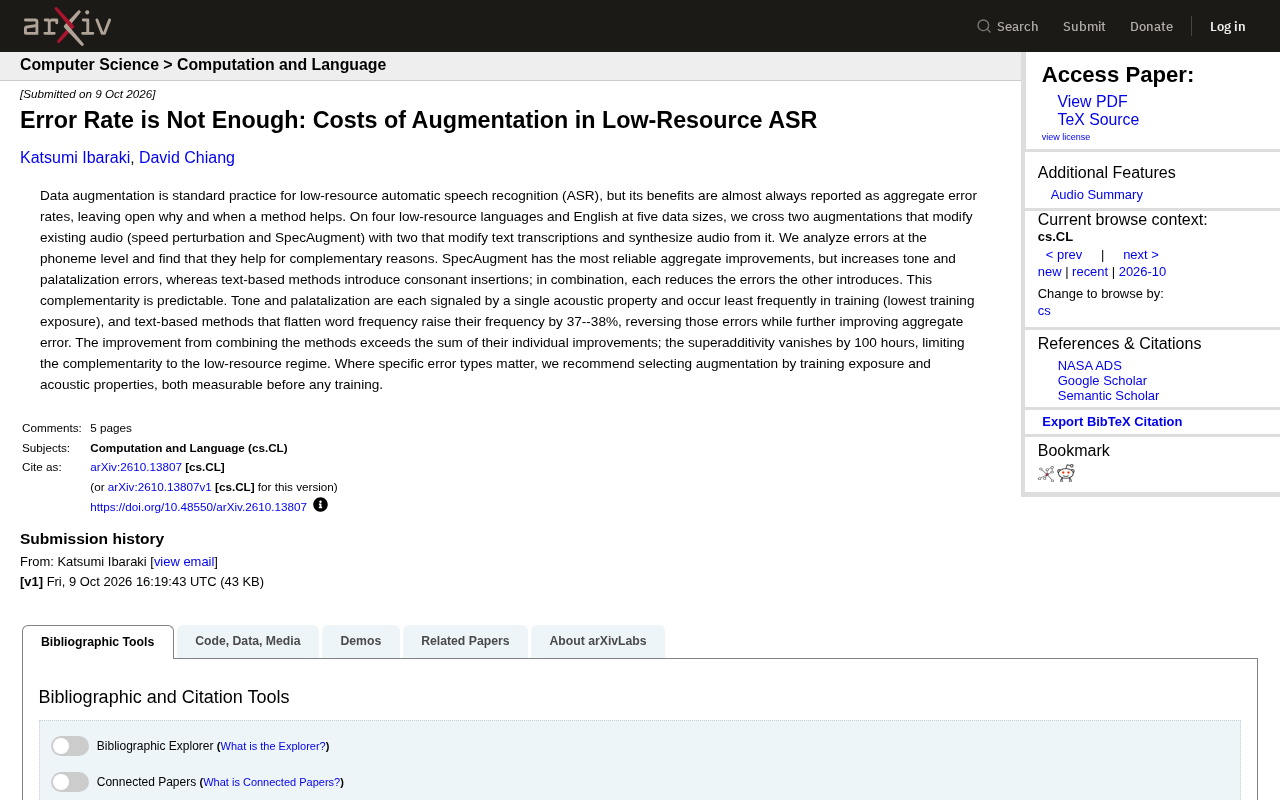
A new study confronts this blind spot head-on. The research team systematically compared two categories of data augmentation across four low-resource languages plus English, at five different data scales, drilling the analysis down to the phoneme level — revealing the real costs and complementary mechanisms hidden beneath aggregate metrics.
A 2×2 Cross-Experiment Design
At the core of the study is a two-by-two cross comparison. One category modifies existing audio, including speed perturbation and SpecAugment. The other modifies text transcriptions and synthesizes audio accordingly. These two categories are crossed at five data scales to observe which types of errors each introduces and eliminates.
The key finding: the two categories work for complementary reasons. SpecAugment delivers the most consistent improvement on aggregate metrics, but it increases tone and palatalization errors; text-based methods, meanwhile, introduce consonant insertion errors. In other words, each has its own side effects — and those side effects happen to be exactly what the other can fix.
Speed perturbation is one of the most classic audio augmentation techniques: audio is resampled at rates like 0.9× or 1.1× to produce slower or faster speech, artificially expanding the training set and improving model robustness to speaking rate variation. SpecAugment, introduced by Google in 2019, applies random masking directly to the Mel spectrogram — masking both contiguous time frames (time masking) and contiguous frequency bands (frequency masking). The core idea is to force the model to make predictions under incomplete information, simulating real-world noise and dropout. Neither method alters the original text labels, so neither introduces new vocabulary or linguistic patterns. Text-based augmentation, by contrast, resamples or rewrites text first, then synthesizes audio via a TTS system — essentially expanding acoustic training data through manipulation on the language side. This fundamental difference — "manipulating audio" versus "manipulating text" — is precisely what determines the blind spots of each approach.
The Complementarity Is Predictable
The most valuable insight from this study is that the complementarity is not coincidental — it is predictable.
Tone and palatalization are each marked by a single acoustic cue, and they appear least frequently in training data — meaning they have the lowest training exposure. Precisely because the model sees them so rarely, methods like SpecAugment that only perturb audio are more prone to errors on these rare features.
Text-based methods flatten word frequency distributions, causing the occurrence of these low-frequency features to increase by 37% to 38%. This frequency boost directly reverses the errors on tone and palatalization, while further improving overall error rates. When both methods are used together, each plugs the holes the other creates.
Tone and palatalization occupy a central role in this framework because they are both linguistically "sparse single-cue" features. Tone uses fundamental frequency (F0) contour to distinguish word meaning — in tonal languages like Mandarin, Cantonese, and Vietnamese, it can determine meaning entirely. Palatalization involves raising the tongue blade toward the hard palate during consonant articulation, changing the perceptual category of the phoneme. What these two features share is that each relies on a single acoustic dimension to convey contrastive information. Once that dimension is partially erased by SpecAugment's frequency masking, the model struggles to recover from other cues. By contrast, most consonant and vowel distinctions rely on multiple formant cues — even if some are masked, redundant information remains, making them inherently more robust.
Superadditivity and the Low-Resource Boundary
A particularly striking phenomenon in the study is superadditivity: combining the two methods yields improvement that exceeds the sum of their individual contributions. One plus one is greater than two.
But this dividend has a clear boundary — at 100 hours of training data, superadditivity disappears. This means the complementary gain is strictly confined to genuinely low-resource settings. Once enough data is available, the model has naturally encountered enough rare features that the complementarity between augmentation methods loses its significance. This finding has direct practical value for determining when combined augmentation is worth the investment.
Superadditivity in statistics and combinatorial optimization refers to a scenario where the joint effect of two variables strictly exceeds the sum of their independent effects: f(A+B) > f(A) + f(B). In machine learning augmentation research, this is relatively rare — more commonly, combining two methods yields gains close to their sum (additivity), or they even cancel each other out due to overfitting risk (subadditivity). The mechanism behind the superadditivity observed here is that the error types produced by the two methods form exact complements: SpecAugment suppresses recognition of low-frequency features, while text augmentation raises training exposure for those same features. Combined, they not only eliminate each other's side effects but produce synergistic gains neither can achieve alone. The 100-hour threshold marks a tipping point: once the training set is large enough that the model has developed sufficient natural coverage of low-frequency features, the "complementary gap" between augmentation methods simply ceases to exist.
Actionable Guidance for Practitioners
If you care about specific error types rather than just overall error rate, this study provides a clear selection framework:
- Choose augmentation methods based on training exposure — which features appear rarely in the training data;
- Assess based on acoustic properties — whether the feature is marked by a single acoustic cue.
The most practical takeaway: both of these indicators can be measured before any training begins. This means researchers can anticipate the likely benefits and side effects of a given augmentation strategy without trial-and-error training runs, enabling more targeted configuration.
Closing Thoughts
The real contribution of this work is not a new augmentation technique — it is a reminder to the entire ASR community that error rate isn't enough. When we focus on a single aggregate number, it's easy to develop a false intuition about why a method works. Drilling the analysis down to the phoneme level, and explaining gains through training exposure and acoustic properties, is what transforms data augmentation from "educated guessing" into "predictable engineering decisions." For building speech technology in under-resourced languages, that kind of interpretability has more long-term value than simply pushing error rates lower.
Related articles

Amphibious Transforming Drone: Beyond 100x Power Savings, What Are the Real Needs?
Is the amphibious transforming drone just a gimmick? Starting from the 100x power difference of the M4 Morphobot, explore real application scenarios and thesis topic ideas, analyzing boundary conditions where pure drones and pure ground robots both fail.

Warhound Raises $200 Million: Genetically Engineered "War Dogs" Paired with Anduril Gear
Warhound raises $200M, backed by Ben Lamm and Palmer Luckey, to genetically engineer dogs for military and law enforcement use and equip them with Anduril gear. This article analyzes its technology direction, funding logic, and ethical controversy.

Claude API Comes to Google Cloud: IAM Integration and SDK Access Guide
Anthropic hosts the full Claude API on Google Cloud with IAM-controlled permissions and unified billing. This guide covers the Vertex AI and Anthropic-hosted entry points, IAM role configuration, and SDK access.