Escaping Tutorial Hell: A Deep Learning Approach from Watching Videos to Reading Documentation and Papers

Escape Tutorial Hell by breaking code on purpose, reading primary sources, and rebuilding ML architectures from scratch.
A machine learning self-learner shares their journey from Tutorial Hell to deep understanding. By reading Hands-On Machine Learning, deliberately breaking and debugging code, and rebuilding architectures like CNN, Transformer, and GAN from scratch, they transitioned from passive video consumption to actively reading documentation and research papers — developing true, lasting expertise.
The Shift from "Watching Videos" to "Actually Learning"
On the path to learning machine learning, many people fall into a common trap known as "Tutorial Hell." This is a real learning journey shared by a Reddit user, and it speaks to the experience of countless self-learners.
Tutorial Hell is a widely discussed phenomenon in programming and tech learning communities, referring to the cycle where learners endlessly watch tutorials but can't independently complete projects. Cognitive science research shows this phenomenon is closely related to the "Illusion of Fluency" — when information is presented in a clear, organized manner, the brain mistakenly believes it has already mastered the knowledge. In reality, watching someone else code activates the "observational learning" pathway in the mirror neuron system, rather than deep procedural memory encoding. Only when learners face cognitive conflict (such as code errors) and actively resolve them does knowledge transfer from working memory to long-term memory.
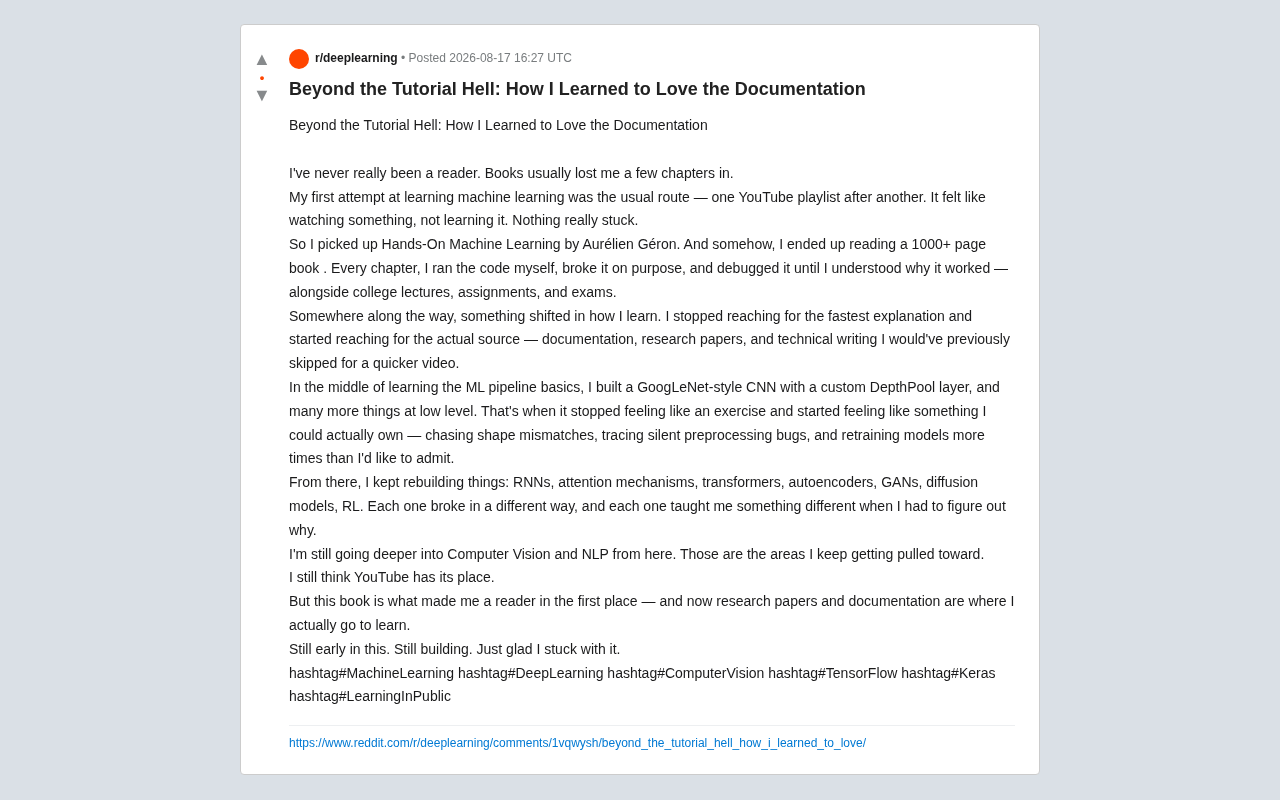
This learner admitted he was never a bookworm — "books usually get abandoned after a few chapters." His first attempt at machine learning followed the most common route: one YouTube playlist after another. But the results were frustrating — "it felt like I was watching things, not learning things. Nothing really stuck."
This state of "watching a lot but learning little" is the core symptom of Tutorial Hell. Video tutorials provide instant gratification and a false illusion of progress, but knowledge often evaporates the moment you close the video.
How a Thousand-Page Book Changed the Learning Approach
The real turning point came from Aurélien Géron's classic book Hands-On Machine Learning. This technical book of over 1,000 pages became the starting point for his transformation in learning approach.
First published in 2017 by O'Reilly and now in its third edition (2022), this book has become a classic for machine learning beginners due to its unique pedagogical design — each chapter revolves around a practical project, from California housing price prediction to image classification, requiring readers to personally handle the complete workflow of data cleaning, feature engineering, model selection, and hyperparameter tuning. The book covers the full technology stack from traditional machine learning (decision trees, ensemble methods, SVM) to deep learning (CNN, RNN, Transformer, GAN, reinforcement learning), with all code open-sourced as Jupyter Notebooks on GitHub, accumulating over 35,000 stars.
Active Practice vs. Passive Watching
The key isn't "finishing" the book, but how you read it. This learner described his method:
"Every chapter, I ran the code myself, deliberately broke it, then debugged until I understood why it worked — all while juggling university courses, assignments, and exams."
This "deliberately break then fix" learning method is known in educational psychology as "Productive Struggle" or "Desirable Difficulties." The theory, proposed by UCLA cognitive psychologist Robert Bjork, demonstrates that moderate difficulty and errors during learning actually strengthen memory durability and transfer ability. In programming, this manifests specifically as: modifying hyperparameters to observe model collapse, deleting key code lines to understand each line's purpose, and deliberately introducing dimension errors to deeply understand tensor operations. Research shows this method is 40-80% more efficient than smoothly running code, because errors trigger the brain's "prediction error" signals, prompting the neural network (the brain's neural network) to readjust its internal model.
When passively watching videos, you follow the instructor's train of thought and everything appears smooth; but when you personally make code throw errors, trace bugs, and understand underlying mechanisms, knowledge truly internalizes into your own capability.
From Consumer Mindset to Researcher Mindset
More importantly is the shift in mindset. He wrote: "I stopped reaching for the fastest explanation and started reaching for the real source — documentation, research papers, and the kind of technical writing I used to skip in favor of faster videos."
This is the leap from "consumer mindset" to "researcher mindset." When you develop the habit of consulting primary sources — official documentation, original papers, source code — you gain the ability to continuously go deeper into any field, rather than depending on pre-digested second-hand content.
In AI, primary sources mainly include: preprint papers on arXiv (hundreds of new AI papers daily), official framework documentation (PyTorch, TensorFlow, JAX, etc.), and open-source project source code. The ability to read papers is critical because there's typically a 6-18 month delay from paper publication to tutorial coverage, while AI's technology iteration cycle is far faster than that. Having paper-reading ability means you can understand new technologies and reproduce the latest results in real time. Common paper-reading frameworks include: first reading the abstract and conclusion to understand contributions, then examining figures and experimental results to judge value, and finally closely reading the methods section to understand technical details.
Truly Mastering Knowledge Through Rebuilding Projects
While learning the fundamentals of machine learning workflows, he built a GoogLeNet-style CNN with a custom DepthPool layer, along with lots of low-level implementation work.
GoogLeNet (also known as Inception v1) is the convolutional neural network architecture that won Google's team the 2014 ImageNet challenge. Its core innovation is the Inception module — using different-sized convolution kernels (1×1, 3×3, 5×5) and pooling operations in parallel within the same layer, then concatenating the results. This design allows the network to capture features at different scales simultaneously. The DepthPool layer is an operation that pools along the channel dimension rather than spatial dimensions, reducing the number of feature map channels while preserving spatial information. Custom implementing such a layer requires deep understanding of the framework's low-level APIs (such as TensorFlow's tf.keras.layers.Layer base class or PyTorch's nn.Module), involving core concepts like forward propagation computation, automatic gradient differentiation, and tensor shape management.
He said it was at this point that learning "stopped feeling like exercises and started feeling like something I could actually own."
Learning Through "Breaking"
This process of rebuilding from scratch was full of challenges:
- Tracking down shape mismatch issues
- Debugging silent preprocessing bugs
- Retraining models again and again
Shape mismatches are among the most common and educational error types in deep learning practice. In neural networks, data flows as multi-dimensional tensors, and each layer has strict dimensional requirements for inputs and outputs. For example, a CNN expecting (batch_size, 224, 224, 3) input will throw an error if it receives (batch_size, 3, 224, 224) (different channel dimension position). These errors force learners to understand: how convolution kernels slide across spatial dimensions, how fully connected layers flatten features, the dimensional relationships of Q/K/V matrices in attention mechanisms, and different frameworks' tensor layout conventions (NHWC vs NCHW). Solving these problems essentially builds spatial intuition for data flow.
He then continuously rebuilt various architectures: RNN, attention mechanisms, Transformer, autoencoders, GAN, diffusion models, reinforcement learning. This architecture sequence precisely reflects the technological evolution of deep learning: RNN (Recurrent Neural Networks) process sequential data through hidden states but face gradient vanishing and parallelization difficulties; attention mechanisms were initially proposed as supplements to RNN, allowing models to "attend" to different parts of the input sequence when generating each output; Google's 2017 "Attention is All You Need" paper pushed attention to its extreme, completely abandoning recurrent structures to give birth to the Transformer architecture; autoencoders learn compressed representations of data; GANs generate realistic data through adversarial training between generators and discriminators; diffusion models generate high-quality samples through a gradual denoising process and are the current mainstream method for image generation (e.g., Stable Diffusion, DALL-E); reinforcement learning lets agents learn optimal strategies through interaction with environments.
His summary is incisive and profound:
"Each one broke in a different way, and each one taught me something different when I had to figure out why."
This statement reveals a truth many people overlook: Debugging itself is the best teacher. Every error message is a targeted knowledge quiz, forcing you to understand the details that would be skipped when following along with tutorials.
Practical Insights for Machine Learning Self-Learners
This learner is currently diving deep into Computer Vision and Natural Language Processing (NLP), admitting these are the directions he's constantly drawn to. Computer Vision encompasses tasks like image classification, object detection, semantic segmentation, and image generation, while NLP handles text understanding, machine translation, question-answering systems, and text generation. Under the unification of the Transformer architecture, these two fields are rapidly converging — Vision Transformer (ViT) brings attention mechanisms from NLP into the visual domain, while multimodal models (like GPT-4V, Gemini) process both text and images simultaneously. His experience offers several thought-provoking insights for all AI self-learners.
Video Tutorials Have Value but Aren't the Destination
Notably, he didn't completely dismiss video tutorials: "I still think YouTube has its place." Videos are suitable for building initial intuition and overall frameworks, but true deep learning requires going further. Quality video resources (like 3Blue1Brown's math visualizations, Andrej Karpathy's build-from-scratch series) can build intuition at the conceptual level, but their value lies in "initiating" the learning process, not replacing hands-on practice.
Documentation and Papers Are the Deep End
His conclusion is emphatic: "That book was the starting point to making me a reader — and now, research papers and documentation are where I actually learn."
For those who want to go further in the AI field, this pathway is highly instructive:
- Build intuition from videos — understand the rough outlines of concepts
- Solidify foundations with systematic books — paired with hands-on practice
- Transition to primary sources — learn to read official documentation and research papers
- Rebuild projects — transform knowledge into capabilities that truly belong to you
The Power of Keeping Building
Finally, he humbly stated: "Still early. Still building. Just glad I stuck with it." This attitude of "keep building" and "Learning in Public" is perhaps the most valuable quality in any technical learning journey. The concept of Learning in Public, advocated by developers like Shawn Wang, centers on externalizing the learning process — writing blogs, open-sourcing code, sharing notes — which not only generates community feedback but more importantly practices the "Feynman Learning Method": when you need to explain a concept to others, your understanding is forced to reach a deeper level.
In this era flooded with AI tools and crash courses, learners willing to settle down and read a thousand-page book, debug code line by line, and dive into primary sources actually possess the scarcest competitive advantage. When large language models can instantly generate code, the people who truly understand the underlying principles — those who know why a model works this way, when it will fail, and how to improve it — are the irreplaceable ones.
Related articles

United Airlines CEO Calls for a National Wealth Tax: A Tech and Business Perspective
United Airlines CEO Scott Kirby calls for a national wealth tax, sparking Hacker News discussion. A tech and business analysis of the debate's core divides, tech industry reactions, and potential impact on aviation.

High School Student Builds 3D Open-World Game Hedra from Scratch
High school student builds 3D open-world game Hedra from scratch, drawing attention on Hacker News. This article analyzes its technical challenges, indie dev insights, and lessons for the AI coding era.

AI and the Enclosure of the Scientific Commons
Starting from a Hacker News discussion, this article analyzes how AI is changing the public nature of scientific knowledge, exploring enclosure risks facing the scientific commons and possible institutional responses across data privatization, model opacity, and evaluation shifts.