High School Student Builds 3D Open-World Game Hedra from Scratch

High school student writes 3D open-world game Hedra from scratch, showcasing the value and challenges of low-level practice.
A project called Hedra on Hacker News was written from scratch by a high school student as a 3D open-world game. The article analyzes the technical barriers to independently developing such a game, including core challenges like graphics rendering and world building, and notes that from-scratch implementation helps deepen understanding of computer graphics and real-time systems. The low-poly style reduces art asset requirements, allowing developers to focus on system implementation. The article also explores how AI programming tools affect development efficiency, arguing that AI can lower barriers but cannot replace systems thinking. Hedra demonstrates the importance of project-based learning and low-level practice for young developers, reminding readers that mastering underlying principles is the source of long-term competitiveness.
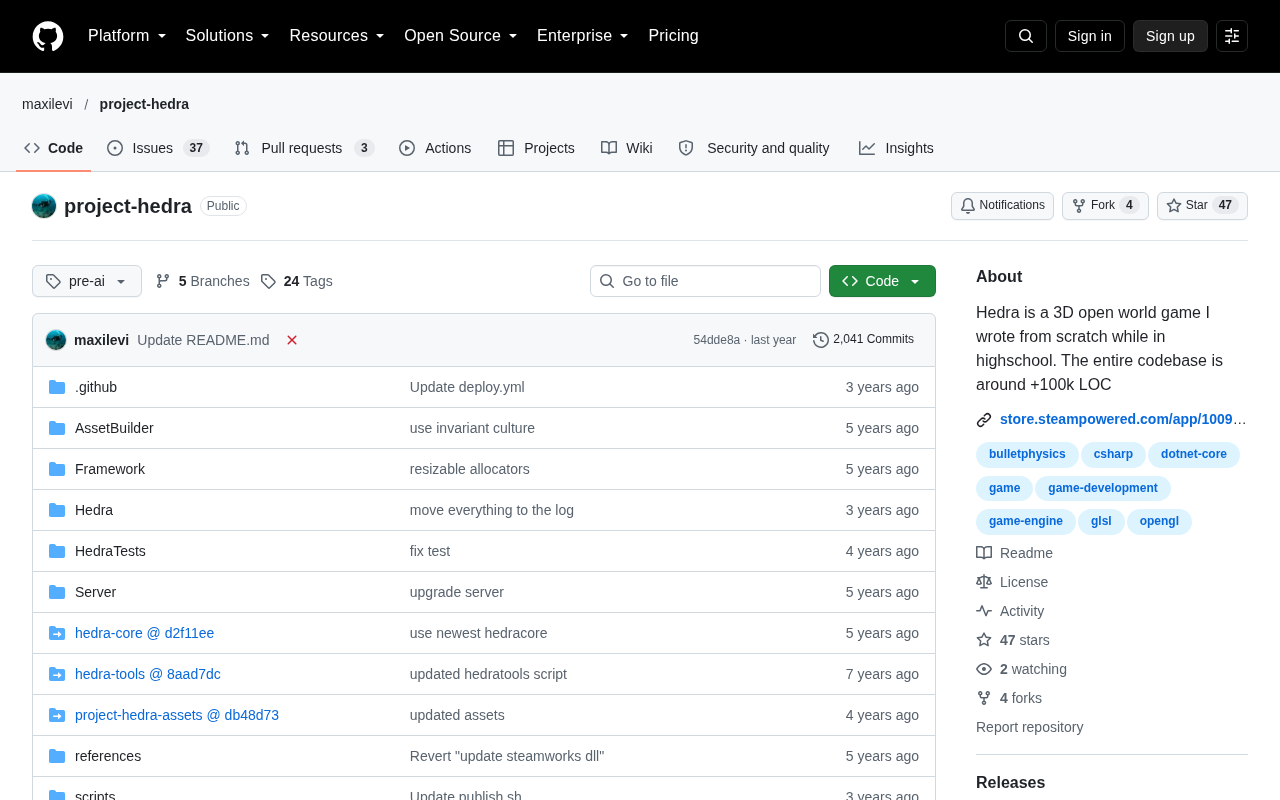
On Hacker News, a project called Hedra has drawn attention. The author claims to have written a 3D open-world game from scratch during high school and shared related screenshots. Although the post didn't gain much traction (10 points, 3 comments), the label "high school student independently develops a 3D open world" is itself compelling enough.
The Barrier to Independent Development and What Hedra Teaches Us
Independently developing a 3D open-world game is a massive undertaking for most adults. An open world means dealing with terrain generation, object rendering, collision detection, character control, asset management, and a whole series of complex systems. The fact that Hedra's author completed a from-scratch implementation in high school reflects the maturity of modern game development toolchains and the shortening of the developer learning path.
According to the Hacker News post, Hedra is implemented "from scratch," meaning the author likely did not rely on commercial engines like Unity or Unreal, but instead built the rendering pipeline and game loop themselves. This kind of low-level practice is enormously helpful for understanding computer graphics, memory management, and real-time systems. For students who want to go deep into game development, this is a path worth considering—build the wheel first, then use the wheel.
"From scratch" in the game development context usually means not relying on commercial engines like Unity or Unreal, or even ready-made graphics libraries (such as OpenGL wrapper libraries), but implementing the core systems oneself. This includes window creation, input handling, the rendering loop, resource loading, and more. Compared with using an engine, from-scratch development requires developers to face low-level APIs and hardware details directly—for example, manually managing memory, writing shaders, and handling each stage of the graphics pipeline. Although time-consuming, this practice allows one to deeply understand the principles of computer graphics and how real-time systems operate, and is an effective way to learn the low-level techniques of game development.
Core Challenges of Writing a 3D Game from Scratch
Graphics Rendering and Performance Optimization
The most direct challenge of a 3D open world is rendering. The author needs to implement basic graphics features such as camera projection, lighting calculations, and texture mapping. If starting completely from scratch, they may also need to handle vertex buffers, shader compilation, and even window system integration. Completing this in high school means the author invested substantial time in mathematics (linear algebra, geometry) and the use of low-level APIs.
Low-poly is an art style that deliberately uses fewer polygon faces to build 3D models. It is common in indie games and early 3D games because it significantly reduces rendering load while conveying a distinctive visual aesthetic through simple geometric shapes and vivid colors. For individuals developing 3D games from scratch, the low-poly style not only reduces the need for complex art assets but also simplifies lighting and texture processing, allowing developers to focus more on core gameplay and system implementation.
World Building and Content Production
The "open" in open world is reflected in explorable maps and interactive elements. Judging from the screenshots, Hedra presents a low-poly 3D scene. This style is common in indie games because it has low art asset requirements while still conveying a sense of space. The author needs to design terrain generation algorithms, place objects, and implement basic physical interactions. Content production is often the most time-consuming part of independent development; the fact that a high school student could carve out the time to complete a playable version also speaks well of their time management skills.
Implications for AI Programming and Game Development
Today's AI programming tools are changing the efficiency boundaries of independent development. Tools like GitHub Copilot and Cursor can help developers quickly generate boilerplate code, debug errors, and even explain graphics concepts. If Hedra's author were starting over today, AI assistance might further lower the barrier to low-level implementation. But on the other hand, the systems thinking cultivated by writing a game from scratch is something AI cannot replace—only by understanding the principles behind every line of code can one independently solve performance bottlenecks or bizarre bugs.
For education, Hedra is a vivid case: project-based learning in high school can spark deep interest. Although the Hacker News community didn't discuss it much, projects like this often spark debates about whether modern computer science education relies too heavily on frameworks. Hedra's existence proves that with enough passion and patience, young developers can absolutely build complex systems from the ground up.
GitHub Copilot and Cursor are AI programming assistants based on large language models that can automatically complete code based on context, generate function suggestions, and even explain code logic. They learn programming patterns by analyzing massive amounts of open-source code, and can significantly boost development efficiency when encountering common tasks (such as boilerplate code and API calls). For independent developers, such tools can reduce the burden of repetitive work, but they cannot replace a deep understanding of system principles—especially when debugging complex problems or performing performance optimization, developers still need solid low-level knowledge.
Conclusion
Hedra may not be commercially remarkable, but it represents a rare spirit of practice: choosing to write a 3D open-world game from scratch in high school rather than stopping at following tutorials. This experience is enormously valuable for the author's future technical growth. For readers, Hedra reminds us that while tools and engines are powerful, mastering underlying principles is the source of long-term competitiveness. If you're also interested in game development, why not start with a minimal playable prototype and gradually expand your own world.
Related articles

Uber Deploys ChatGPT Work Company-Wide: AI in the Workplace Enters the Scaled Implementation Phase
Uber deploys ChatGPT Work to 30,000+ employees, extending it from engineering to all roles. We analyze its expert-engineer pairing, end-to-end automation, and questions of AI control and power concentration—insights for scaling AI in the workplace.

Shift at Midnight Hands-On: When "ID Verification" Becomes Alien Hunting
Shift at Midnight blends ID verification with horror survival in a four-player co-op game. We break down its inspection mechanics and chaotic humor.

Zelensky Recounts the Outbreak of War: I Need Ammunition, Not a Ride
Zelensky recalls the first day of war in a YouTube interview: farewell to family, rejecting Biden's evacuation offer with "I need ammunition, not a ride," and how Bucha shaped his stance on compromise and peace talks.