EU's Digital Fairness Act Targets Loot Boxes, Influencer Marketing, and Addictive Design

EU proposes Digital Fairness Act to regulate loot boxes, influencer marketing, and addictive design.
The European Commission has unveiled the Digital Fairness Act proposal to address designs in gaming, social media, and e-commerce platforms that exploit consumers' psychological vulnerabilities. The legislation targets loot box random reward mechanics, lack of disclosure in influencer marketing, and addictive features like infinite scroll, requiring platforms to improve transparency, restrict sales to minors, and provide opt-out options. This marks the EU's further regulation of dark patterns after the Digital Services Act and Digital Markets Act, signaling a shift from 'notice-and-consent' to 'design-for-fairness.' The gaming industry is most directly affected, while social and e-commerce platforms must adjust ad labeling and recommendation mechanisms. The bill is still at the proposal stage, with vague definitions and enforcement standards being the main points of contention.
The European Commission unveiled its proposal for the Digital Fairness Act (DFA) on Wednesday, aiming to make "your online experience fairer." The legislation takes direct aim at addictive design, loot box mechanics, and misleading influencer marketing practices in gaming, social media, and e-commerce platforms that exploit consumers' time and money. It represents the EU's latest systematic regulatory effort targeting "dark patterns" in the platform economy, following the Digital Services Act and the Digital Markets Act.
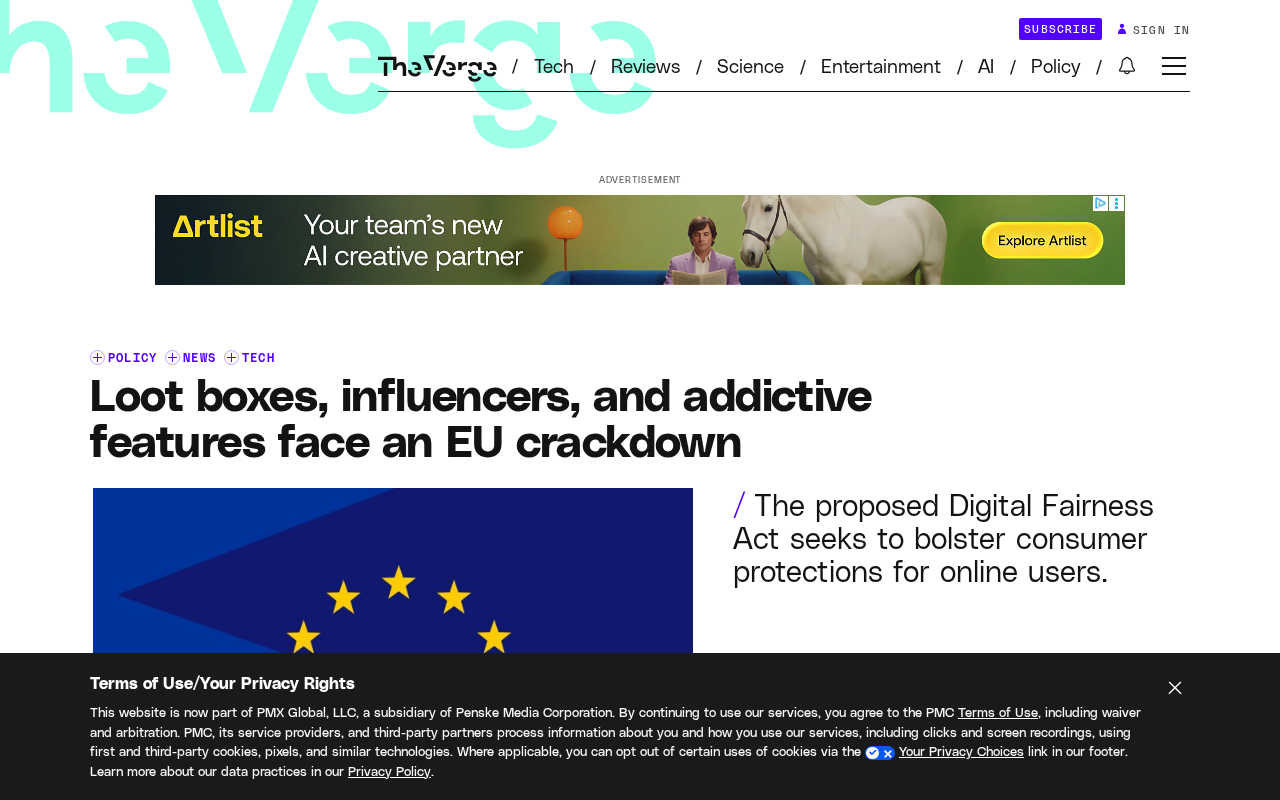
I. Three Categories of "Unfair" Practices Targeted by the DFA
According to the European Commission's announcement, the DFA's core objective is to address designs that "exploit consumers' psychological vulnerabilities." The proposal explicitly identifies several key areas:
- Loot Boxes: Random reward mechanics in games are questioned for their gambling-like nature, particularly posing risks to minors. The DFA may require platforms to disclose drop rates, restrict sales to minors, and potentially ban paid loot boxes in certain circumstances.
- Influencer Marketing: Paid promotions on social media often lack clear labeling, making it difficult for consumers to distinguish ads from genuine content. The DFA will strengthen disclosure obligations, requiring influencers and platforms to clearly mark commercial partnerships.
- Addictive Features: Mechanisms such as infinite scroll, autoplay, and consecutive check-in rewards are accused of deliberately extending user dwell time. The DFA plans to require platforms to offer "opt-out" options or limit such features by default, giving users more control.
These measures are consistent with the EU's earlier focus on dark patterns in the Digital Services Act, but the DFA goes further by directly targeting specific design patterns rather than abstract platform responsibilities.
Dark Patterns are key background for understanding the DFA's legislative logic. This concept was introduced around 2010 by UX design scholar Harry Brignull, referring to how platforms use interface design, copywriting, and interaction flows to induce users into making decisions that benefit the platform against their true intentions. Common types include: pre-checked boxes, "cancel" traps disguised as close buttons, manufactured false urgency (such as "only 2 left"), and "roach motel" patterns that make unsubscribing unusually cumbersome. The EU already explicitly prohibited "deceptive or manipulative" interfaces in Article 25 of the Digital Services Act, but did not provide an exhaustive list at the time. The DFA's advancement means regulation is moving from abstract principles to the enumeration and standardization of specific design patterns, requiring platform compliance departments to establish design review processes rather than relying solely on legal text interpretation.
II. Why Now? Background and Drivers
The EU's legislative push for digital fairness is not an isolated event. In recent years, consumer organizations, research institutions, and regulators have repeatedly pointed out that platforms manipulate user behavior through carefully designed interfaces and algorithms, leading to excessive consumption, wasted time, and mental health issues. For example, the European Consumer Organisation (BEUC) has filed complaints with the European Commission about misleading pricing of in-game currencies and loot boxes.
The DFA's proposal also echoes the EU's commitments to consumer protection in its "Digital Decade" strategy. Following the AI Act and the Data Act, the DFA completes the puzzle piece of "behavioral fairness." Interestingly, the proposal is currently only at the publication stage and still needs to go through the European Parliament and member states for review, with the final form potentially subject to adjustment.
The "Notice-and-Consent" Paradigm has been the mainstream framework for digital privacy and consumer protection over the past two decades. Its core assumption is that as long as information is fully disclosed and user consent obtained, a transaction is legitimate. Consent mechanisms in the GDPR and cookie banners all fall under this category. However, behavioral economics research has repeatedly demonstrated that users experience "consent fatigue" and cognitive biases when facing complex interfaces, and disclosure alone cannot achieve substantive fairness. The "Design-for-Fairness" paradigm represented by the DFA requires regulators to directly intervene in product default settings and interaction architecture, no longer shifting responsibility entirely to users. This shift echoes the prohibition of "manipulative AI practices" in the EU's AI Act, marking a regulatory focus moving from information transparency to fairness of behavioral outcomes.
III. Impact on Gaming, Social Media, and E-commerce Platforms
If the DFA takes effect as proposed, platforms will face dual adjustments in compliance costs and product logic.
The gaming industry is likely to be the most directly affected sector. Loot boxes have already faced legal challenges in many countries (Belgium and the Netherlands have ruled certain loot boxes illegal), and if the DFA imposes restrictions at the pan-European level, gaming companies will need to redesign their monetization models, especially free-to-play games that rely on microtransactions and random rewards.
Social media and e-commerce platforms will need to review recommendation algorithms, notification systems, and user interfaces. Disclosure requirements for influencer marketing will affect brand collaboration processes, and platforms may need to develop more prominent advertising labeling tools.
From a broader perspective, the DFA represents a shift in regulatory thinking: from the "notice-and-consent" paradigm to the "design-for-fairness" paradigm, requiring platforms to embed fairness principles at the product design stage rather than relying solely on user choice.
Loot Boxes are controversial because their psychological mechanisms closely resemble gambling: paying for a random outcome, with rewards often having virtual economic value. Belgium classified paid loot boxes as illegal gambling in 2018, and Dutch courts have made similar rulings, but there has long been a lack of unified stance at the EU level. Academic research shows a statistical correlation between loot box exposure and problem gambling behavior, with particularly significant effects on adolescent players. If the DFA requires disclosure of drop rates, it will directly impact gaming companies' revenue models—the "variable ratio reinforcement" of random rewards is precisely the key to microtransaction profitability. Some companies may shift to direct sales or battle pass models, but these models also face scrutiny over "addictive design."
IV. Controversies and Uncertainties
The DFA's advancement will not be smooth sailing. Industry groups may argue that addictive design is difficult to define precisely and that over-regulation would stifle innovation. There are also disagreements over how to characterize loot boxes: supporters view them as part of gaming entertainment, while opponents emphasize their similarity to gambling. Additionally, how to define "addictive" and "misleading" at the enforcement level still requires refined standards.
The European Commission has not yet published full legislative text details, but it is foreseeable that lobbying and debate around the DFA will heat up in the coming months. For professionals following tech policy and product compliance, the DFA is a signal worth tracking closely.
V. Conclusion: From "Dark Patterns" to "Digital Fairness"
The proposal of the Digital Fairness Act marks a new phase in EU regulation of the platform economy—no longer focused solely on market competition and data protection, but directly intervening in behavioral manipulation in product design. Regardless of the final text, the DFA has already put "digital fairness" on the legislative agenda, and gaming, social media, and e-commerce platforms need to think ahead: when "user dwell time" is no longer the only metric, what should products rely on to retain people?
Related articles

Replit at Web Summit Lisbon: AI Coding Platform Accelerates European Expansion
Replit participated in Web Summit Lisbon 2026 Day 1 as Replit Live. This article examines its transition from an online IDE to an AI app-building platform and analyzes its European market opportunities and compliance challenges.

Codex Integrates with Zotero: Batch Literature Review and Deep-Read Tools Tested
Hands-on testing of two new Codex functions for Zotero: batch literature reviews by collection and screening key papers for deep reading. Covers comparison tables, citation verification, the three-layer method and experiment analysis, plus a complete workflow.

Codex + Obsidian + Zotero: An AI-Powered Automated Paper Reading Workflow
A Codex + Obsidian + Zotero paper management and retrieval workflow: Zotero manages references, Codex calls GPT for close reading and notes, Obsidian with DataView builds indexes, enabling Q&A with your paper library and quick literature review material — includes close-reading template and two Skill setup steps.