Europe's First Commercial Orbital Rocket Reaches Orbit: Isar Aerospace Spectrum Reshapes the Space Landscape
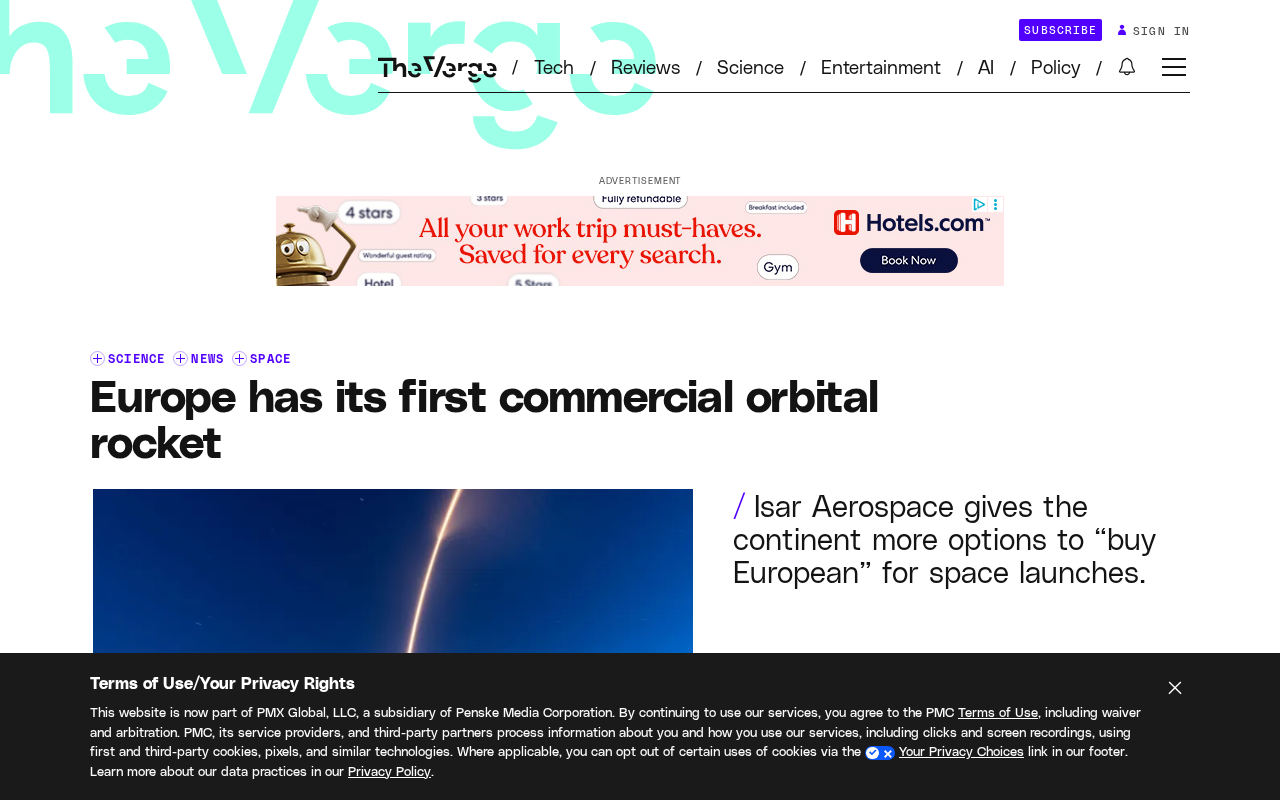
Isar Aerospace's Spectrum becomes Europe's first commercial rocket to reach orbit, reshaping the space landscape.
German startup Isar Aerospace has made history by successfully launching its Spectrum rocket into low Earth orbit from Norway's Andøya Space Center — making it Europe's first commercial orbital rocket. After a failed maiden flight in 2024, the team iterated rapidly and achieved orbit, filling a critical gap in Europe's autonomous space access as Ariane 5 retires and Ariane 6 faces competitiveness challenges. The success marks a turning point for European commercial spaceflight.
A Historic Breakthrough for European Commercial Spaceflight
In 2025, German aerospace company Isar Aerospace accomplished a milestone feat — launching its two-stage launch vehicle Spectrum from a Norwegian spaceport into low Earth orbit, making it the first purely commercial orbital rocket in Europe to successfully reach orbit. This achievement not only marks a new chapter for European commercial spaceflight but also leaves a significant mark on the global commercial space landscape.
Isar Aerospace Technologies AG was founded in 2018 and headquartered in Munich, Germany. Its three co-founders — Daniel Metzler, Josef Fleischmann, and Markus Brandl — conceived the startup idea while studying at the Technical University of Munich. The company's name "Isar" comes from the Isar River that flows through Munich. By 2024, the company had raised over €300 million in cumulative funding from top European strategic and financial investors including Porsche SE, Airbus Ventures, and Lombard Odier. The team has grown to over 400 people, bringing together engineers from more than 40 countries. Notably, Isar Aerospace employs a highly vertically integrated strategy for engine development and manufacturing — from propellant supply systems to turbopumps, all core components are designed and manufactured in-house. This not only helps control costs and accelerate iteration cycles but also reduces dependence on external suppliers. This "building rocket engines in a garage" startup model stands out particularly against the traditional landscape of European aerospace industry, which has long been dominated by large contractors.
Previously, Isar Aerospace attempted its first launch in March 2024, but the rocket crashed into the sea and exploded just about 30 seconds after liftoff. Facing this public failure, the team didn't retreat. Instead, they systematically investigated the fault, optimized the design, and ultimately achieved this successful orbital insertion. This ability to iterate rapidly from failure is one of the core competitive advantages that distinguishes commercial space companies from traditional national space agencies.
Spectrum Rocket's Technical Architecture and Market Positioning
Built for the Small Satellite Launch Market
Spectrum is a two-stage liquid-fueled launch vehicle designed specifically for the LEO small satellite launch market. A two-stage launch vehicle consists of two independent rocket stages: the first stage (booster) provides primary thrust within the atmosphere, accelerating the rocket to a certain altitude and velocity before separating; the second stage (upper stage) continues accelerating in a near-vacuum environment, ultimately delivering the payload into the target orbit. Compared to single-stage-to-orbit approaches, the two-stage design significantly improves the rocket's mass ratio and payload efficiency by progressively discarding structural mass from spent fuel stages. Liquid-fueled rocket engines offer advantages over solid rocket motors, including higher specific impulse, adjustable thrust, and multiple ignition capability — though system complexity also increases significantly, involving the coordinated operation of precision subsystems such as turbopumps, propellant feed lines, and cooling systems. Spectrum's choice of liquid fuel reflects its technical roadmap pursuing high performance and future reusability potential.
Similar to the market positioning of SpaceX Falcon 9 or Rocket Lab Electron, Spectrum targets the growing demand for deploying small commercial satellite constellations. Low Earth Orbit (LEO) typically refers to the orbital range of 200 to 2,000 kilometers above the Earth's surface — currently the most densely populated zone for satellite deployment. Due to low signal transmission latency and relatively manageable satellite manufacturing and launch costs, LEO has become the preferred orbit for communication constellations, Earth observation, IoT connectivity, and other applications. In recent years, as satellite miniaturization technology has matured, individual satellite weights have dropped from several tons to hundreds or even tens of kilograms, giving rise to large-scale constellation networking business models — such as SpaceX's Starlink and OneWeb's communication constellations. This trend has created explosive demand for small and medium launch vehicles: compared to the "rideshare" model where large rockets carry dozens of satellites, dedicated small rockets offer customers more flexible launch windows, precise orbital insertion, and shorter queue times, creating differentiated competition between "space taxis" and "space buses." Europe previously relied heavily on American and Russian launch services in this market segment, and Spectrum's successful orbital insertion means a European domestic alternative is now a viable option.
What you might not have noticed is that this launch used the Andøya Space Center in Norway as its launch site. Andøya Space Center was originally established in 1962 and had long been primarily used for suborbital sounding rocket launches and atmospheric research. In recent years, as Europe's need for autonomous space access has become increasingly urgent, the Norwegian government invested in upgrading it to an orbital-class spaceport, which was officially approved for operations in 2023. Located at 69°N latitude — nearly within the Arctic Circle — the site enjoys a geographically advantageous position well-suited for polar orbit and Sun-Synchronous Orbit (SSO) missions.
A Sun-Synchronous Orbit is a special type of polar orbit that maintains a fixed angular relationship between its orbital plane and the Sun, ensuring that the satellite passes over any given ground location under roughly the same lighting conditions each time. This characteristic is particularly important for Earth observation satellites — it ensures that images taken of the same area at different times have consistent illumination angles, facilitating change detection and long-term monitoring. Meteorological satellites, agricultural remote sensing satellites, and environmental monitoring satellites almost all operate in SSO. High-latitude launch sites can more easily send satellites into high-inclination polar orbits with lower energy costs, and Andøya's northward launch trajectory passes over the open waters of the Arctic Ocean, meeting both the orbital mechanics requirements for polar launches and avoiding the safety risks of rocket debris falling on populated areas. Compared to Europe's traditional primary launch facility — the Guiana Space Centre near the equator in French Guiana, which excels at geostationary orbit launches but is less efficient for polar missions — Andøya's emergence fills a gap in Europe's polar and SSO launch infrastructure, creating a "equatorial + polar" dual-anchor structure for European space launch operations.
Engineering Iteration from First Flight Failure to Successful Orbit
After the first launch failure, the Isar Aerospace engineering team faced not only technical challenges but also the dual test of commercial pressure and investor confidence. In the commercial space industry, first flight failures are not uncommon — Rocket Lab and SpaceX both experienced similar setbacks during their early development stages.
In fact, first flight failures are almost a "rite of passage" in commercial spaceflight history. SpaceX's Falcon 1 rocket failed three consecutive launches between 2006 and 2008, only succeeding on its fourth attempt when the company was nearly out of funds. Rocket Lab's Electron rocket failed to reach orbit on its 2017 maiden flight due to a ground equipment communication error, succeeding only on its second launch. Chinese private space company i-Space's Hyperbola-1 achieved a successful first flight in 2019 but subsequently experienced multiple mission failures. First flight failures typically stem from the first-ever full-chain integration verification of complex systems — no amount of ground testing can fully simulate the extreme conditions of real flight environments, including aerodynamic loads, vibration environments, and stage separation timing. Therefore, the industry consensus is: the core objective of a maiden flight is to acquire flight data, and successful orbital insertion is a "bonus." What truly tests a space company is its systematic engineering capability to conduct Root Cause Analysis after failure, implement corrective measures, and rapidly return to the launch pad.
This success proves that Isar Aerospace possesses the engineering capability to transform failure into experience — no small feat for a young space company founded in 2018.
Strategic Significance of the European Commercial Space Ecosystem
Filling the Gap in Europe's Autonomous Space Access Capability
For a long time, European space launches have primarily relied on the Ariane series of rockets, but Ariane 5 has retired, Ariane 6 faces challenges in commercial competitiveness, and the Vega-C rocket was also grounded for a period after suffering a launch failure in late 2022.
To understand the severity of this predicament, one must appreciate the historical significance of the Ariane series. Developed under the leadership of the European Space Agency (ESA) and operated by ArianeGroup, the Ariane rocket series represents Europe's flagship program for autonomous space access. Since its maiden flight in 1996, Ariane 5 accumulated over 110 launch missions, earned a reputation for high reliability, and became a major force in the global geostationary orbit satellite launch market. However, Ariane 5 officially retired in 2023, and its successor Ariane 6 experienced multiple delays in development and first flight, only completing its maiden flight in 2024. More critically, Ariane 6's design philosophy still follows the traditional "large, highly reliable, high-cost" approach, with per-launch pricing that struggles to compete with SpaceX Falcon 9's commercial rates — the latter has driven LEO launch costs down to approximately $2,700 per kilogram through first-stage booster recovery and reuse. Meanwhile, the Vega-C small launch vehicle suffered a launch failure during its first commercial flight in December 2022 due to an upper stage malfunction and was grounded for an extended period of corrective work, further exacerbating the supply crunch in European launch capability. This "gap between generations" has objectively created a market window for European commercial space newcomers like Isar Aerospace and PLD Space.
Spectrum's successful orbital insertion means Europe finally has a domestic commercial option in the small launch vehicle market. For European satellite operators, defense agencies, and research institutions, this represents not only supply chain diversification but also a crucial expression of strategic autonomy in space.
Europe's Position in the Global Commercial Space Competitive Landscape
From a global perspective, the commercial orbital launch market has formed a landscape dominated by SpaceX, with competition from Rocket Lab, Blue Origin, and others, while Chinese private space companies (such as i-Space and Tianbing Technology) are also catching up rapidly. While Europe got a relatively late start in the commercial space race, Isar Aerospace's breakthrough proves that Europe is fully capable of securing a place in the commercial spaceflight sector.
Going forward, the core challenge facing Isar Aerospace is converting this technical validation into sustainable commercial launch capability — increasing launch frequency, reducing per-launch costs, and building a stable customer pipeline. These are the factors that will truly determine its market position. When discussing the challenge of reducing launch costs, one cannot avoid mentioning the industry-transforming trend of rocket reusability. SpaceX has dramatically lowered per-launch costs from industry averages through vertical landing recovery of the Falcon 9 first stage, with individual boosters achieving over 20 reuses by 2025, completely rewriting the launch market's price baseline. For Spectrum's current expendable design, establishing a foothold in long-term price competition will require Isar Aerospace to choose between two paths: pursuing partial or full rocket reusability to reduce hardware costs, or achieving cost amortization through scale effects by simplifying design, optimizing manufacturing processes, and increasing launch cadence. Isar Aerospace has indicated it is studying reusability upgrade options for the Spectrum rocket, though no specific timeline has been announced. In the meantime, precise market positioning — offering dedicated launch services for customers who cannot afford to wait for SpaceX "rideshare" scheduling — may be the key strategy for maintaining price competitiveness.
Insights and Outlook for the Space Industry
Isar Aerospace's path to success reveals several noteworthy industry trends:
- Rapid iteration beats perfectionism: Achieving orbit in less than two years after a maiden flight failure — this iteration speed would be almost unimaginable in traditional aerospace systems. Conventional national space programs often require years of failure investigation and review processes before returning to the launch pad, whereas commercial space companies' flat organizational structures and results-oriented engineering cultures dramatically shorten the cycle from failure to return-to-flight.
- Geographic advantages are redefining launch site value: The choice of Norway's Andøya spaceport demonstrates that demand for polar orbit missions is driving diversification in global launch site infrastructure. Beyond Andøya, Scotland's SaxaVord Spaceport and Sweden's Esrange Space Center are also actively developing orbital launch capabilities, potentially leading to a multi-spaceport coordinated operations framework across Europe.
- Europe's commercial space ecosystem is maturing: From capital support to regulatory environments, Europe now has the foundational conditions to incubate and nurture commercial space companies. Multiple commercial space support policies introduced by the EU and ESA in recent years — including priority procurement of European domestic launch services and establishment of commercial space innovation funds — are providing institutional-level safeguards for these startups.
This launch may be just a beginning. Whether European commercial spaceflight can find differentiated positioning in global competition remains to be seen. But one thing is certain: the historic moment for European commercial space has arrived.
Key Takeaways
Related articles

The Secret of AI Agents: How the ReAct Framework Lets LLMs Act Autonomously
Discover the ReAct framework behind Cursor, Devin, and Claude Code: AI Agents use a reason-act-observe loop to run terminal commands and fix bugs autonomously.

AI Coding Tools Hit a Saturation Point? Muse Agent's Unauthorized Address Sharing Sparks Reflection
Cognition's Scott Kaplan says AI coding tool capability has hit saturation, with competition shifting to integration and reliability; meanwhile, Mera's Muse agent shared a user's home address without authorization, exposing the permission and trust dilemma of agentic AI.

Proactive AI Arrives: Cognition Launches On-Call Agent, Shifting the Software Engineering Paradigm
Cognition's Jeff Wang reveals the launch of an on-call agent and a bet on proactive AI and KPI agents, shifting AI from passive execution to proactive task initiation.