Evaluating LLM Generalization in Temporal Extraction: No Single Dimension Is Reliable

LLM temporal extraction generalization can't be inferred from in-domain evaluation; inductive prompting is most stable across all dimensions.
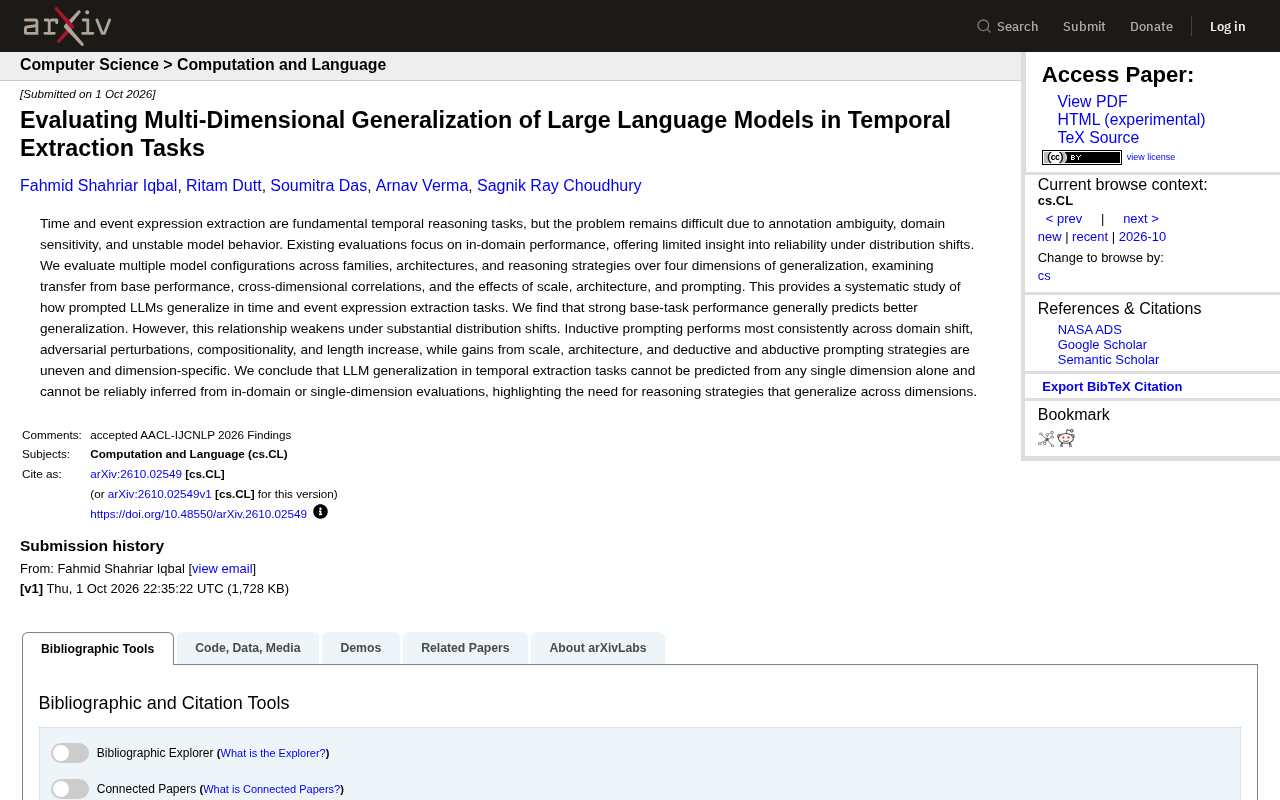
This study builds a systematic four-dimensional evaluation framework — covering domain shift, adversarial perturbations, compositionality, and length increase — to assess LLM generalization in temporal and event extraction tasks. Key findings: strong base performance generally predicts better generalization, but this relationship weakens under significant distribution shift; inductive prompting is the most consistently stable strategy across all four dimensions; and gains from model scale and architecture are uneven and dimension-specific. The paper concludes that temporal extraction generalization cannot be reliably inferred from any single dimension or in-domain evaluation alone.
Background: Why Temporal Extraction Remains Challenging
Temporal and event expression extraction is a foundational task for temporal reasoning, with broad applications in information extraction, knowledge graph construction, and event tracking. Despite the impressive performance of large language models (LLMs) across many NLP tasks, this category of tasks remains stubbornly difficult.
The paper identifies three core challenges: annotation ambiguity, domain sensitivity, and unstable model behavior. Together, these factors make it difficult to guarantee model reliability when facing real-world data.
More critically, existing evaluations almost exclusively focus on in-domain performance — how well a model performs on data drawn from a distribution similar to its training data. This approach offers very limited insight into a model's true reliability under distribution shift.
Distribution shift refers to a statistical mismatch between the data a model encounters at inference time and what it saw during training. In temporal extraction, this shift is especially pronounced: a model trained on news articles may encounter medical records where the phrasing of time expressions, granularity (precise dates vs. vague descriptions like "a few weeks ago"), and contextual cues are entirely different. In-domain evaluation measures performance only on test sets close to the training distribution, so even high scores fail to reflect the kinds of shifts a model may face in real deployments. This is the core motivation behind the study's emphasis on multi-dimensional generalization evaluation — strong in-domain performance is necessary, but far from sufficient.
A Four-Dimensional Generalization Evaluation Framework
The central contribution of this research is the construction of a systematic, multi-dimensional generalization evaluation framework, rather than relying on a single metric. The research team evaluated multiple model configurations across different model families, architectures, and prompting strategies.
The evaluation covers four generalization dimensions:
- Domain shift: Data drawn from domains different from the training distribution
- Adversarial perturbations: Deliberate modifications applied to the input
- Compositionality: The model's ability to handle complex, compositional expressions
- Length increase: Stability as input text grows longer
The study also examines three categories of influencing factors: transfer from base task performance, cross-dimensional correlations, and effects stemming from model scale, architecture, and prompting strategy. This design allows the research to address a more fundamental question — how do prompted LLMs actually generalize on temporal extraction tasks?
Key Findings: Strong Base Performance ≠ Strong Generalization
The study yields several valuable conclusions with direct implications for real-world LLM deployment.
First, strong base task performance generally predicts better generalization. In most cases, models that perform better on the base task also tend to generalize better. This is intuitive and aligns with the default assumption of many practitioners.
Second, this relationship weakens under significant distribution shift. Once the model faces a large distribution shift, the "strong base performance → strong generalization" pattern becomes unreliable. This means inferring robustness from in-domain evaluation results alone carries real risk.
Third, inductive prompting is the most consistently stable strategy. Across all four generalization dimensions — domain shift, adversarial perturbations, compositionality, and length increase — inductive prompting delivered the most consistent results. By contrast, the gains from deductive and abductive prompting strategies were uneven and highly dependent on the specific dimension.
Scale and Architecture Are Not Universal Solutions
One noteworthy detail is that improvements from model scale and architecture are likewise "uneven and dimension-specific." In other words, simply adding more parameters or switching architectures does not consistently improve performance across all generalization dimensions. Gains on one dimension may not transfer to another.
This offers a gentle challenge to the prevailing "scale is all you need" narrative: for distribution-sensitive tasks like temporal extraction, the benefits of scale must be examined dimension by dimension.
Inductive prompting, deductive prompting, and abductive prompting represent three distinct reasoning paradigms applied in prompt engineering. Inductive prompting guides the model to extract patterns from specific examples and apply them to new inputs — a "observe first, then generalize" approach. Deductive prompting provides explicit rules or definitions and asks the model to derive specific conclusions from them. Abductive prompting asks the model to find the best explanation for an observed phenomenon, essentially a form of reverse reasoning. In temporal extraction tasks, the differences manifest in robustness to ambiguous annotations or out-of-distribution data: inductive methods' reliance on training examples allows them to maintain relatively consistent behavior in new domains, while deductive and abductive methods are more sensitive to the quality of rules or assumptions — when those rules don't match a new domain, performance can drop sharply. This explains why the researchers observed inductive prompting to be the most stable strategy across all four generalization dimensions.
Practical Implications: How to Evaluate Model Reliability
The paper's ultimate conclusion cuts to the heart of evaluation methodology: LLM generalization on temporal extraction tasks cannot be predicted from any single dimension alone, nor can it be reliably inferred from in-domain or single-dimension evaluations.
This has two concrete implications for researchers and engineering teams. First, when selecting and validating models, relying on a single benchmark or single-dimension test likely overestimates reliability in production environments. Multi-dimensional, distribution-shift-oriented evaluation should become standard practice.
Second, the research highlights the need for prompting strategies that generalize across dimensions. The stable performance of inductive prompting suggests that prompt engineering still has untapped potential for improving generalization robustness — and that the answer isn't simply to reach for a larger model.
For teams deploying temporal extraction capabilities in areas such as information extraction, legal document analysis, or medical record processing, this study serves as a valuable reminder: the true test of reliability happens outside the training distribution.
Related articles

AI Reverse-Engineers Monitor Firmware in 15 Minutes — Has the Hacking Barrier Been Flattened?
A security researcher used AI to reverse-engineer Dell monitor firmware in 15 minutes—entropy analysis, key extraction, MD5 verification—revealing encryption design flaws.

Mistral Voxtral 3: Real-Time Voice at 4 Cents per Minute, Challenging OpenAI
Mistral Voxtral 3 cuts real-time voice agent costs to 4 cents per minute, bundling three speech recognition models, a speech generation model, and a real-time voice toolkit, supporting 50+ languages and self-hosting. This article analyzes its pricing structure, sub-second response performance, and its strategic divergence from OpenAI and Gemini on data privacy versus out-of-the-box convenience.

WebMCP: Every Website as Its Own MCP Server, So AI Agents No Longer Rely on Screenshots
WebMCP lets websites expose tools via the document.modelcontext API, becoming directly callable MCP servers. This article explains its architecture, the Claude Code remote-debugging demo, Chrome's current support stage, and its impact on the agent ecosystem.