EvoGuard: A New Approach to Mitigating Degradation in Online Skill Evolution

EvoGuard uses a pairwise skill selector for low-latency online skill evolution, effectively mitigating performance degradation.
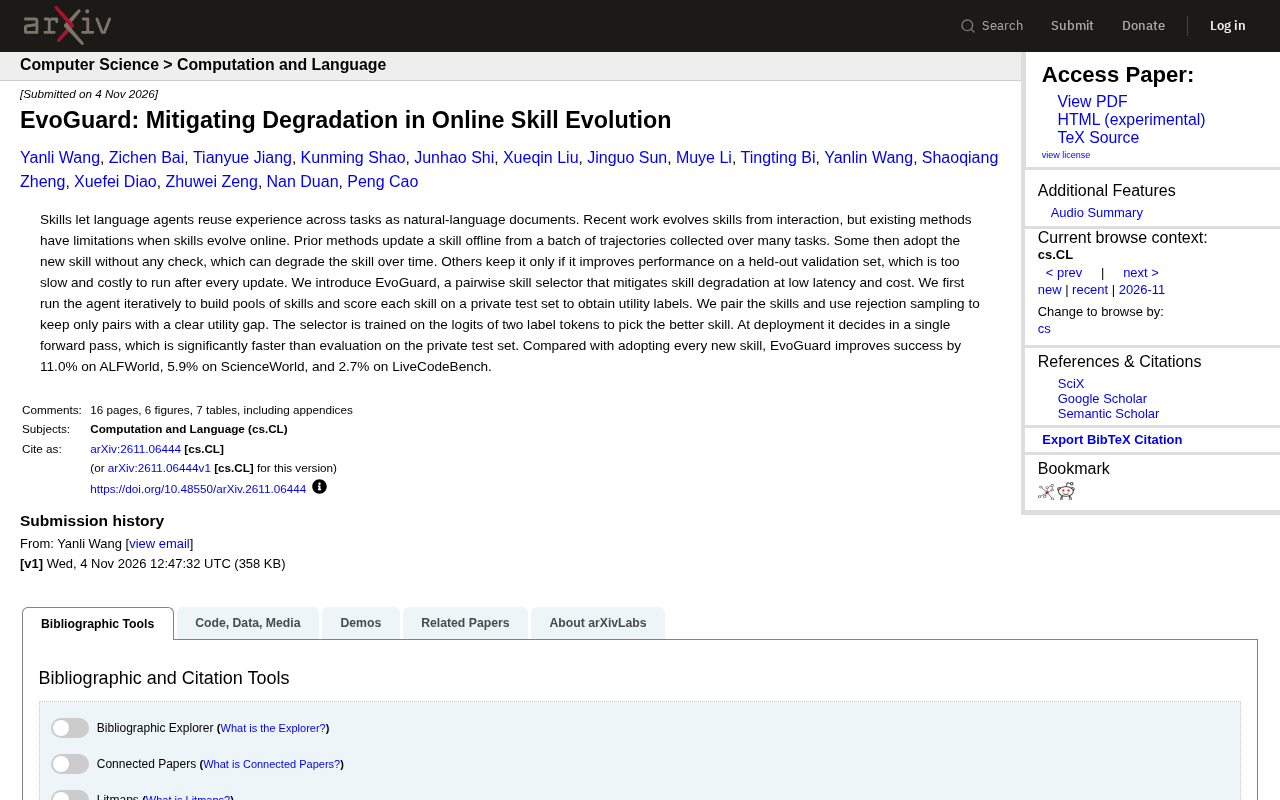
This article introduces EvoGuard, a lightweight quality control method for online skill evolution in language agents. It trains a pairwise skill selector based on the logits of two label tokens and uses rejection sampling to keep only skill pairs with clear utility gaps as training data, requiring just one forward pass at deployment to judge which of the old and new skills is better. It improves over the adopt-all baseline by 11.0%, 5.9%, and 2.7% on ALFWorld, ScienceWorld, and LiveCodeBench, respectively, and can be extended to other online learning scenarios.
Online skill evolution is a key capability for language agents to continuously adapt to their environments, but existing methods either blindly adopt new skills after each update—causing performance degradation—or rely on expensive validation set evaluations that slow down iteration. The recently proposed EvoGuard achieves effective mitigation of skill degradation at low latency and low cost through a pairwise skill selector, offering a new approach to online skill evolution.
The Dilemma of Online Skill Evolution
Language agents achieve cross-task reuse by distilling experience into skills in the form of natural language documents. However, when skills need to evolve online, traditional methods face two extremes: one approach updates skills offline from multi-task trajectories and adopts them directly without any check, causing skill quality to gradually degrade over time; the other relies on a held-out validation set to evaluate new skills and keeps them only if performance improves, but running the validation set after every update is too slow and expensive to support high-frequency online iteration.
This dilemma essentially reflects the dual demand of online learning scenarios for "fast decisions" and "quality assurance." EvoGuard's starting point is precisely to find a low-latency compromise that quickly determines whether a new skill is better than an old one without sacrificing too much accuracy.
EvoGuard's Core Mechanism: Pairwise Selection and Rejection Sampling
EvoGuard's design is divided into two phases: training and deployment. In the training phase, the agent first runs iteratively to build a skill pool, and each skill is scored on a private test set to obtain utility labels. Skills are then paired up, and rejection sampling is used to keep only skill pairs with clear utility gaps—this ensures the quality of the training signal and prevents the model from learning ambiguous preferences.
The selector itself is trained on the logits of two label tokens, with the goal of determining which of a pair of skills is better. This design turns skill comparison into a binary-classification-style preference judgment problem: the model only needs to output the relative probabilities of the two label tokens to make a choice. Training data comes from pairs in the skill pool with clear utility gaps, allowing the selector to focus on distinguishable cases.
Rejection Sampling is a general technique for obtaining high-quality samples from a target distribution. Its basic idea is to first generate candidate samples from an easy-to-sample proposal distribution, then decide whether to keep each sample according to some acceptance criterion, thereby filtering out low-quality or non-conforming samples. In EvoGuard, rejection sampling is used to screen skill pairs: a skill pair is kept as training data only when the utility gap between the two skills exceeds a preset threshold. The benefit is that the selector avoids learning ambiguous or noisy preference signals, thereby improving training efficiency and the accuracy of final decisions. Rejection sampling is widely used in reinforcement learning, preference modeling, and dataset construction, and its core trade-off lies in threshold setting—too high a threshold leads to insufficient samples, while too low a threshold introduces noise.
Logits are the unnormalized score vectors output by the last layer of a neural network (typically a linear layer). For classification tasks, the model outputs a real-valued score for each class, and these scores must pass through a softmax function to be converted into a probability distribution. In EvoGuard, the selector is designed to output the logits of two label tokens, corresponding to the preference scores for "choose skill A" and "choose skill B," respectively. By comparing the magnitudes of these two logits (or computing their softmax probabilities), the model can determine which of a pair of skills is better. This logits-based binary-classification-style preference judgment avoids the overhead of generating full text, enabling a decision to be made in a single forward pass—this is precisely the key technical foundation for EvoGuard's low latency.
Deployment Phase: Fast Decisions in a Single Forward Pass
At deployment time, EvoGuard performs a single forward pass for each pair of old and new skills, directly outputting the choice of the better skill. Compared with running evaluations on a private test set, a single forward pass is significantly faster and much cheaper. This means the agent can obtain a quality judgment immediately after each skill update without waiting for an expensive evaluation process.
This low-latency property makes online skill evolution more practical. The agent can continuously accumulate and filter skills during interaction, preventing degraded skills from entering the skill library while maintaining a fast iteration pace.
Experimental Results: Success Rate Improvements Across Multiple Environments
The paper reports comparison results on three benchmark environments. Compared with the "adopt every new skill" baseline, EvoGuard improves the success rate by 11.0% on ALFWorld, 5.9% on ScienceWorld, and 2.7% on LiveCodeBench. These improvements show that the pairwise selector can effectively filter out skill updates that cause degradation and retain genuinely useful skill evolution.
Interestingly, the variation in improvement across environments reflects differences in how sensitive task characteristics are to skill degradation. ALFWorld, as an embodied interaction environment, has a more direct impact of skill quality on task success; whereas LiveCodeBench, as a code generation benchmark, is relatively mildly affected by skill degradation. This difference also suggests that the selector's conservativeness could be adjusted for different task types in the future.
Implications for Online Skill Evolution
EvoGuard's value lies not only in its specific method but also in the lightweight paradigm for skill quality control that it proposes. Traditionally, skill evolution either fully trusts updates or relies on heavyweight evaluation; EvoGuard demonstrates that by training a lightweight selector, a balance can be struck between the two. This is especially important for agent systems that need to run online for extended periods—the quality of the skill library directly determines the upper limit of the agent's adaptability.
From a broader perspective, the combination of pairwise comparison and rejection sampling can be extended to other online learning scenarios, such as filtering model parameter updates and sample selection in experience replay. EvoGuard provides a reusable technical component for quality assurance in online evolution.
As language agents move from static deployment toward continual learning, lightweight guard mechanisms like EvoGuard will become part of the infrastructure. How to achieve more accurate skill evaluation at lower cost, and how to handle complex dependencies between skills, remain worthwhile directions to explore.
One-line Summary
EvoGuard uses a pairwise skill selector to achieve low-latency online skill evolution and effectively mitigate performance degradation.
Paragraph Summary
This article introduces EvoGuard, a lightweight quality control method for online skill evolution in language agents. To address the dilemma that existing methods either blindly adopt new skills and cause degradation or rely on expensive validation set evaluation that slows iteration, EvoGuard trains a pairwise skill selector based on the logits of two label tokens and uses rejection sampling to keep only skill pairs with clear utility gaps as training data. At deployment, a single forward pass is all that is needed to determine which of the old and new skills is better, significantly faster than private test set evaluation. On the three benchmarks ALFWorld, ScienceWorld, and LiveCodeBench, it improves over the adopt-all baseline by 11.0%, 5.9%, and 2.7%, respectively. The article notes that this paradigm can be extended to online learning scenarios such as filtering model parameter updates and sample selection in experience replay.
Related articles

ChatGPT Plus Subscription Pitfall Guide: Go/Plus/Pro Tier Comparison and Quick Activation
A complete ChatGPT Plus subscription guide based on a Bilibili tutorial: from registering an account, comparing Go/Plus/Pro tiers, to the practical steps for quickly completing your subscription.

GPT-6.2 Sol/Astra Released! A Step-by-Step ChatGPT Plus Subscription Guide and Tier Comparison
GPT-6.2 Sol/Astra is out—here's a ChatGPT Plus subscription guide: register an account, compare Go/Plus/Pro tiers, and subscribe in a minute.

Comparing Three Channels for Subscribing to GPT Plus in China: Is Website Top-Up the Easiest?
How to subscribe to GPT Plus in China? This article compares website top-up, credit card, and mobile top-up channels—process, cost, and risk—with steps and tips to help you choose wisely.