ExplainDB: A Database System Built for Understandability

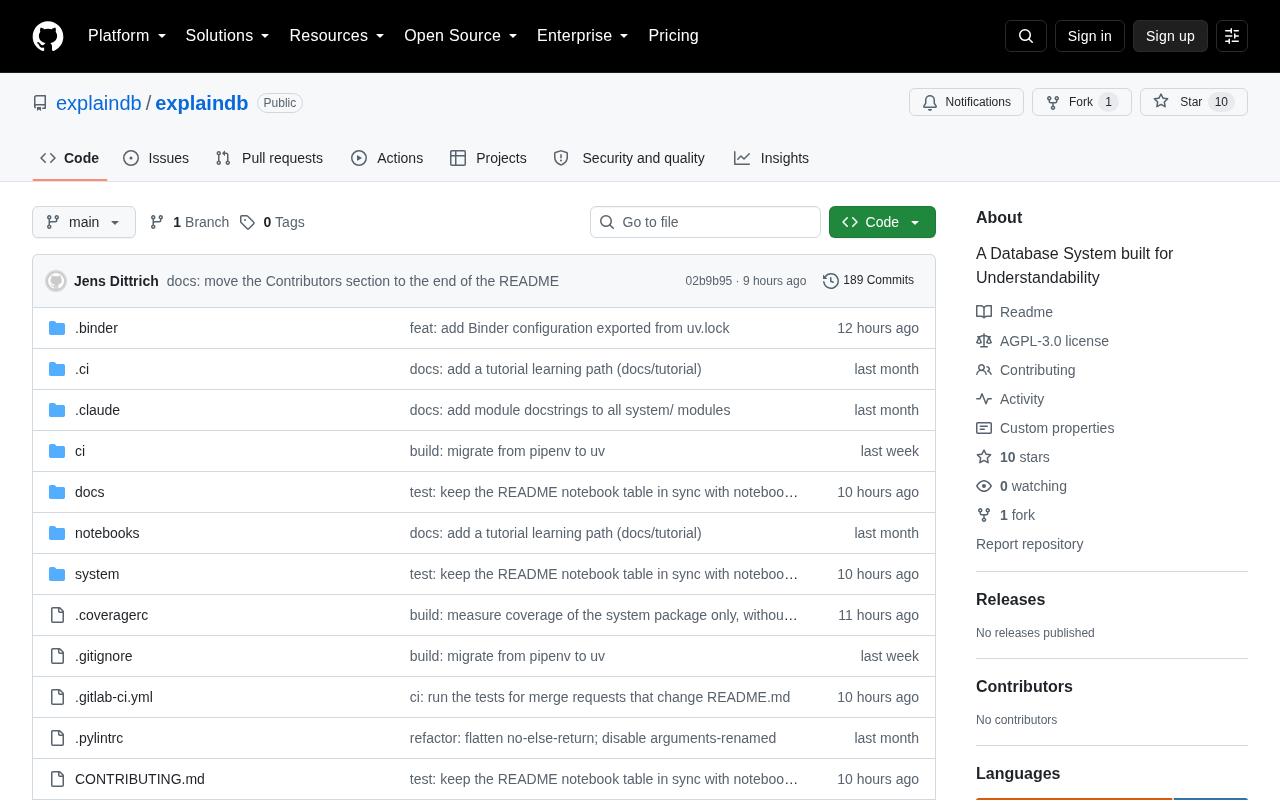
ExplainDB is an open-source database project built to make database internals transparent and understandable.
ExplainDB is an open-source database project that appeared on Hacker News with a core design goal of "understandability" — making system internals more transparent to users and learners rather than optimizing purely for performance or scalability. While mainstream databases like PostgreSQL are powerful, their complexity makes them black boxes for beginners. ExplainDB's philosophy echoes recent discussions around AI explainability, highlighting understandability as a key software quality dimension. The project is currently in early stages with limited public information and low community traction.
A Database Project That Puts "Understandability" First
In the database world, performance, scalability, and consistency tend to dominate developer conversations. ExplainDB takes a refreshingly different angle — understandability. The project surfaced on Hacker News with a clear thesis: database systems should be designed so that users and learners can more easily grasp how they work internally.
For many developers, mainstream databases like PostgreSQL and MySQL are incredibly powerful, yet their internals are dauntingly complex. The query optimizer, storage engine, transaction manager — these components are effectively black boxes for anyone just getting started. ExplainDB appears to be positioned as an answer to exactly that problem: making system behavior more transparent and explainable.
The internal complexity of mainstream database systems is easy to appreciate when you look at raw code size: PostgreSQL's codebase exceeds 1.4 million lines of C, spanning tightly coupled subsystems including a query parser, planner/optimizer, executor, storage manager (with MVCC), and WAL write-ahead logging. The query optimizer alone involves sophisticated algorithms for statistics collection, cost estimation, and join order enumeration. This complexity is precisely what makes "designing for understandability" a meaningful differentiator — common strategies for such projects include narrowing the feature surface, adding inline documentation and visualization hooks, or rewriting core modules in more expressive languages like Rust or Go.
Why Understandability Deserves Attention
The learning curve for database systems has always been steep. To truly understand how a query gets parsed, optimized, and executed, developers typically need to wade through source code or academic papers. A system designed with understandability as a first-class goal could offer real value in several ways:
- Educational value: Helping students and beginners build intuition about database internals — not just learning how to use a database, but understanding what's happening underneath.
- Debuggability: When system behavior is transparent, troubleshooting issues and reasoning about query execution plans becomes far more efficient.
- A reminder of what matters: It signals to the industry that beyond raw performance metrics, maintainability and understandability are equally important dimensions of software quality.
This design philosophy resonates with broader conversations around "explainability" — whether in AI models or infrastructure software, making system behavior more legible to humans is increasingly recognized as a priority worth pursuing.
In software engineering, "understandability" is typically treated as a sub-characteristic of maintainability in the ISO/IEC 25010 software quality model. Unlike performance or reliability, it resists easy quantification — yet it directly determines whether developers can quickly locate problems, safely modify code, or reason about system behavior. In the database domain, this idea manifests in practices like query transparency: PostgreSQL's EXPLAIN ANALYZE command, which exposes every step of a query execution plan along with actual timing, is a classic example of surfacing internal decisions to users. Teaching-oriented database implementations — such as Carnegie Mellon University's BusTub and SQLite's compact codebase — have been widely adopted in university database courses for similar reasons, demonstrating that there is genuine real-world demand for an "understandability-first" design approach.
The Limits of What We Know
It's worth being candid: public information about ExplainDB is quite sparse. The project generated relatively little traction on Hacker News — only a handful of points and no comments at the time of writing — which suggests a few things:
- The project may still be in an early or experimental stage;
- Details about its architecture, implementation language, and feature set are not yet publicly documented;
- Community feedback and real-world usage examples are essentially nonexistent.
For developers who want to dig deeper or try it out, the best approach is to visit the project's source page directly, review the documentation and code, and form your own first-hand impression.
Closing Thoughts: A Design Philosophy Worth Taking Seriously
Whether ExplainDB matures into something widely adopted remains to be seen. But the design philosophy it represents — building for understandability — carries broader lessons for the entire software engineering field. As systems grow ever more complex, finding the right balance between performance and comprehensibility is a question every infrastructure developer should be asking.
If you're curious about database internals, or looking for an implementation suited to teaching and learning, ExplainDB may be an open-source project worth keeping an eye on.
Related articles

RTX 5090 vs M5 Ultra: Which Is Better for Local AI Inference?
A full comparison of RTX 5090 vs Apple M5 Ultra for local AI inference: specs, speed, and power. 32GB VRAM vs 256GB unified memory — which runs LLMs better?

Colossal Launches AI Platform to Accelerate Species De-Extinction
Colossal Biosciences launches an AI platform to accelerate de-extinction research, while Peter Diamandis starts a new fund to invest in related startups.

Flock CEO Denies Terminating Police Contracts as Surveillance Controversy Escalates
Flock CEO Garrett Langley denies proactively terminating any police contracts amid surveillance abuse controversy. Analysis of privacy challenges, industry impact, and future compliance in AI surveillance.