EXPOSURE: A New Method for Tracing Uncertainty in Reinforcement Learning
EXPOSURE uses a mask-aware belief network to unify action selection and Shapley explanation, decomposing return variance and belief entropy for the first time.
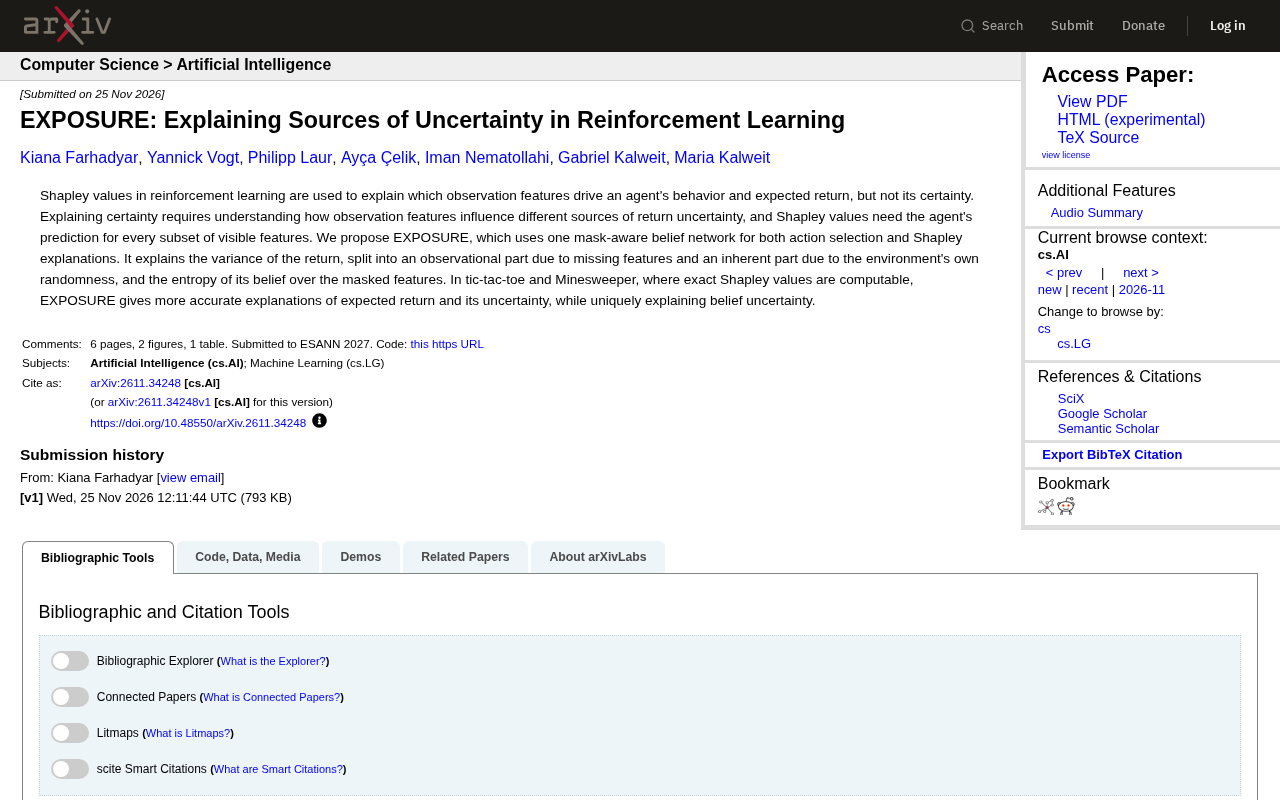
The article introduces EXPOSURE, a new interpretability method for reinforcement learning. Existing Shapley value methods can only explain expected return and cannot clarify the sources of an agent's certainty. EXPOSURE uses a single mask-aware belief network to simultaneously perform action selection and predictions for any visible feature subset, thereby computing the impact of each feature on return variance and decomposing the variance into an observation part caused by missing features and an intrinsic part caused by environmental randomness; it can also explain belief entropy over masked features. In tic-tac-toe and Minesweeper environments, EXPOSURE explains expected return and its uncertainty more accurately than traditional methods and uniquely explains belief uncertainty. The article notes that the method helps diagnose agent brittleness and design more robust algorithms, but its scalability in complex environments remains to be studied.
Why Does Reinforcement Learning Need to Explain Uncertainty?
When making decisions, reinforcement learning (RL) agents need to know not only "what to do" but also "how certain" they are. However, existing interpretability methods mainly focus on expected return rather than uncertainty. Shapley values are used to explain which observation features drive an agent's behavior and expected return, but they cannot explain its certainty. To explain certainty, one needs to understand how observation features affect return uncertainty from different sources, and Shapley values require the agent's predictions for every visible feature subset.
To solve this problem, researchers proposed EXPOSURE, a method that uses a single mask-aware belief network to simultaneously perform action selection and Shapley explanation.
Shapley values originate from cooperative game theory and are used to fairly distribute the total payoff generated by cooperation among multiple participants. In the field of interpretability, they decompose a model's prediction value into the contributions of each input feature: the Shapley value of each feature equals the weighted average of that feature's marginal contribution across all possible feature subsets. Computing exact Shapley values requires evaluating the model output for all feature subsets, and the computational cost grows exponentially with the number of features, so sampling approximations are often used in practice. In reinforcement learning, Shapley values can be used to explain which observation features drive an agent's action selection and expected return, but they describe contributions at the mean level and cannot directly characterize the influence of features on return variance or belief uncertainty.
The Core Mechanism of EXPOSURE
The core innovation of EXPOSURE lies in using a mask-aware belief network to simultaneously handle action selection and Shapley explanation. This means the network can handle any visible feature subset and output the corresponding action probabilities and belief distribution. In this way, EXPOSURE can compute the impact of each feature on return variance and decompose the variance into two parts:
- Observation part: uncertainty caused by missing features;
- Intrinsic part: uncertainty caused by the environment's own randomness.
In addition, EXPOSURE can also explain the entropy of belief over masked features, i.e., the agent's uncertainty about missing features.
The mask-aware belief network is a neural network that randomly masks part of the input features during training, enabling the network to learn to output valid predictions even under any visible feature subset. Its key design is to have the network receive a mask vector indicating which features are visible and which are missing, and to train on a large number of random mask patterns, thereby generalizing to unseen feature combinations. This architecture enables the same network both to select actions based on currently visible features and to give predictions for any feature subset, providing an efficient way to obtain all subset outputs needed for computing Shapley values and avoiding the overhead of training a separate model for each subset.
The observation part and intrinsic part in return variance decomposition correspond to two fundamentally different sources of uncertainty in reinforcement learning. The observation part (also called epistemic uncertainty) stems from the agent's lack of information about the current state, for example when certain features are masked in a partially observable environment; this part of the uncertainty can decrease as information increases. The intrinsic part (also called aleatoric uncertainty) stems from the environment's own stochastic transitions and reward mechanisms, and cannot be eliminated even with full observation. Splitting the total variance into these two parts helps determine whether an agent's hesitation is because it "cannot see clearly" or because "the environment is inherently random," which has direct guiding significance for diagnosing brittleness and designing exploration strategies.
Experimental Validation and Advantages
In two environments where exact Shapley values can be computed—tic-tac-toe and Minesweeper—EXPOSURE demonstrated advantages. Experiments showed that EXPOSURE explains expected return and its uncertainty more accurately, and uniquely explains belief uncertainty. In contrast, traditional methods can only explain expected return and cannot decompose the sources of uncertainty.
This capability is crucial for understanding agent behavior in partially observable environments, because agents often need to make decisions with incomplete information.
Significance for Reinforcement Learning Interpretability
The proposal of EXPOSURE opens a new direction for reinforcement learning interpretability research. It focuses not only on "what the agent did" but also explains "why it is uncertain." This fine-grained analysis of uncertainty sources helps researchers diagnose agent brittleness and design more robust algorithms.
Although EXPOSURE has been validated in simple environments, its scalability in complex environments still requires further research. Future work can explore how to apply this method to high-dimensional observation spaces and how to reduce computational costs.
Conclusion
Through the mask-aware belief network, EXPOSURE unifies action selection and Shapley explanation, and for the first time achieves decomposition of return variance and belief entropy. Experiments in tic-tac-toe and Minesweeper environments prove that it can provide more accurate explanations of expected return and uncertainty, offering a new tool for reinforcement learning interpretability.
Related articles

A 19-Year-Old's Rental Horror Story: Ceiling Collapse, Bug Infestation, and the Lessons It Taught Me
At 19, my first off-campus rental brought bug infestations, no heat, a collapsed ceiling, and a ruined laptop with no renter's insurance. Here are the hard-won lessons for first-time student renters.

Veda Nurse's Cranial Nerve Exam: Why ASMR Role-Play Is Going Viral
Bilibili creator Veda's cranial nerve exam ASMR video goes viral, blending humor and sensory triggers through nurse role-play. This article analyzes its unique appeal and the audience psychology behind ASMR role-play.

LG Cinebeam AI Review: 120-Inch Giant Screen + 3000 Lumens, a New Choice for the Living Room Theater
LG Cinebeam AI projector review: 3000 ANSI lumens, 4K, 100 inches from about 8 cm and 120 inches from about 18 cm. Built-in webOS, AI Concierge voice recommendations, AI Sound Pro 11.1.2 virtual surround, and Game Optimizer—positioned for fixed living room installation, complementing the portable Cinebeam S.