Fable 5.1 Cracks 373-Year-Old Cipher: AI Reasoning Achieves Real-World Breakthrough
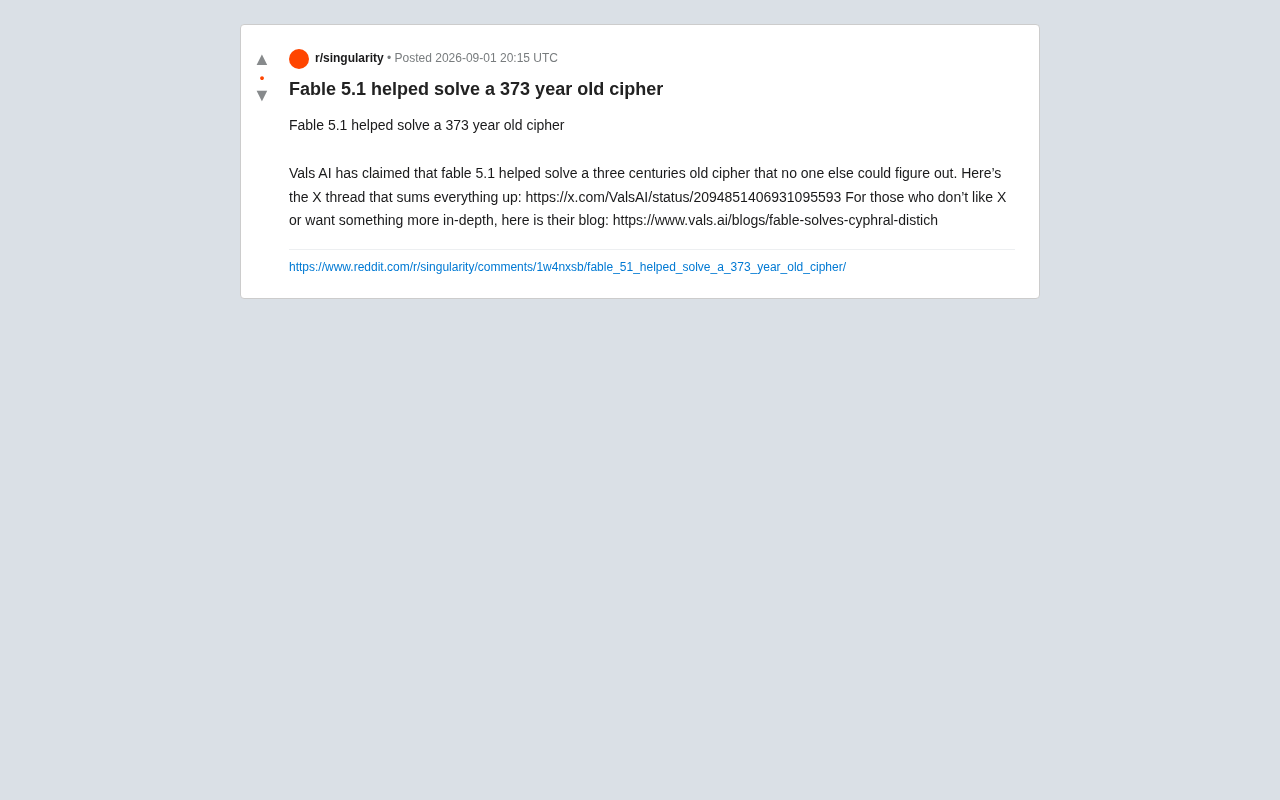
Fable 5.1 reportedly cracks 373-year-old cipher, showcasing AI's complex reasoning in real-world tasks
Vals AI announced that its Fable 5.1 model successfully decrypted Cyphral Distich, a 373-year-old cipher from the 17th century. This achievement highlights AI's evolving capabilities in multidimensional reasoning, combining cryptographic, linguistic, and historical knowledge. While awaiting independent verification, the case represents a shift in AI evaluation from standardized benchmarks to real-world open challenges.
A Notable AI Breakthrough Claim
AI evaluation organization Vals AI recently announced on social platform X that its model Fable 5.1 successfully cracked an ancient cipher with a 373-year history that had previously remained unsolved. This news quickly sparked heated discussions in technical communities like Reddit, once again putting large language models' capabilities in complex logical reasoning and historical puzzle-solving under the spotlight.
According to the thread posted by Vals AI on X and their official blog post (titled "Fable Solves Cyphral Distich"), this cipher is known as "Cyphral Distich," with origins tracing back to approximately the mid-17th century. Based on the 373-year timespan, its creation dates to around 1650—a period when cryptography and secret communication methods were flourishing in Europe. This era in Europe had just experienced the Thirty Years' War (1618-1648), and the urgent need for secret communication during the war catalyzed numerous cryptographic innovations. Blaise de Vigenère's polyalphabetic cipher system, the establishment of dedicated cipher officials in various royal courts, and encrypted communication practices between Royalists and Parliamentarians during the English Civil War all made this period a golden age for cryptographic development. Notably, the word "Distich" comes from Greek, referring to a couplet composed of two lines of verse, suggesting this cipher may have combined poetic rhyme structure with encryption techniques—among intellectual circles of the Baroque period, integrating literature, mathematics, and secret communication was a quite popular intellectual pursuit.
It should be noted that this achievement currently comes primarily from Vals AI's official statements and has not yet received independent third-party academic verification. Therefore, while reviewing this event, this article will maintain a cautious attitude toward its technical implications and potential controversies.
What is Cyphral Distich: The Story Behind This 373-Year-Old Cipher
The Challenges of Breaking Classical Historical Ciphers
Classical ciphers differ fundamentally from modern encryption algorithms. Modern encryption algorithms (such as AES, RSA) are built on rigorous mathematical problems, and their security can be formally analyzed through computational complexity theory. Classical ciphers, however, often rely on substitution, transposition, polyalphabetic encryption (like the Vigenère cipher), or clever linguistic designs. From a technical classification perspective, classical ciphers roughly fall into two major categories: substitution ciphers and transposition ciphers. In substitution ciphers, monoalphabetic substitution (like the Caesar cipher) maps each letter to another fixed letter, while polyalphabetic substitution uses keys to control switching between multiple substitution tables. Transposition ciphers (like rail fence ciphers) conceal information by changing the arrangement order of letters. More complex designs layer both methods and may even introduce null characters and codebooks.
The core difficulty in breaking such ciphers lies not in computational power but in several key aspects:
- Lack of context: Language habits, spelling rules, and abbreviation methods from centuries ago differ vastly from today;
- Scarce corpus: Many historical ciphers consist of only isolated text passages, lacking sufficient statistical samples for frequency analysis—and frequency analysis, this classical method first pioneered by 9th-century Arab scholar Al-Kindi, has very limited effectiveness against polyalphabetic ciphers and short texts;
- Multilayered design: Some ciphers integrate linguistic puns, poetic structures (distich meaning "couplet"), and cryptographic techniques, requiring comprehensive cross-disciplinary judgment.
For these reasons, such ciphers often become long-standing unsolved puzzles for mathematicians, linguists, and historians. Vals AI's claim that Fable 5.1 could crack a cipher that has remained dormant for over three centuries holds core value in demonstrating AI's potential in "multidimensional comprehensive reasoning."
From Frequency Analysis to Semantic Reasoning: AI's Unique Advantages in Cipher Breaking
Traditional cipher-breaking tools primarily rely on statistical methods, such as letter frequency analysis. The advantage of large language models lies in their simultaneous mastery of vast amounts of historical text, grammatical structures of multiple languages, and rich cryptographic knowledge. This means models can continuously perform "hypothesis-verification" iterations during the decryption process: first guessing a certain encryption method, then adjusting strategy based on whether the decrypted text conforms to the linguistic logic of that era.
From a technical perspective, this capability of large language models is built on the self-attention mechanism of the Transformer architecture. Through pre-training on massive text corpora, models learn implicit representations of language structure, logical relationships, and cross-domain knowledge. In recent years, the introduction of Chain-of-Thought (CoT) prompting techniques and Reinforcement Learning from Human Feedback (RLHF) has significantly enhanced models' multi-step reasoning capabilities. In cipher-breaking scenarios, models can leverage their internal representations to simultaneously perform pattern recognition (similar to statistical analysis) and semantic judgment (determining whether decryption results constitute meaningful text). This ability to process multidimensional information in parallel is difficult for traditional algorithmic tools to match.
This capability essentially resembles the working method of human experts rather than pure brute-force cracking. If Fable 5.1 indeed completed this task, it demonstrates the model's maturity in long-chain reasoning and knowledge retrieval.
The Technical Significance of Fable 5.1's Historical Cipher Breaking
A Real-World Test of AI Reasoning Capabilities
In recent years, AI model evaluation has increasingly emphasized "real-world tasks" over standardized benchmarks. This shift has deep background: widely used early evaluation benchmarks like MMLU and HellaSwag have exposed serious issues such as data contamination (test questions included in training data) and saturation effects (models scoring near-perfect lose discriminative power). New-generation evaluations like FrontierMath and ARC Prize attempt to use entirely new, unpublished difficult problems to test models' true reasoning abilities. Breaking historical ciphers is precisely an excellent litmus test: it has no ready-made answers to "memorize," cannot be gamed through training data leakage, and requires models to truly engage in creative reasoning.
If Fable 5.1 can autonomously find a breaking method without a clear solution path, this indicates the model possesses several key capabilities:
- Long-term planning: Maintaining logical consistency in multi-step reasoning;
- Cross-domain knowledge integration: Combining linguistic, historical, and cryptographic knowledge;
- Self-verification: Judging whether intermediate results are reasonable and correcting reasoning direction accordingly.
Vals AI's Role as an Evaluation Organization
Interestingly, this achievement comes from Vals AI, an organization focused on AI model evaluation. When evaluation organizations release such "milestone" announcements, on one hand they help demonstrate the true capability boundaries of models, but on the other hand, one must be cautious of marketing-level exaggeration. Choosing to test models with tasks like historical ciphers—which have "zero prior answers"—reflects the current evolution trend in evaluation methodology. The core advantage lies in the task answer not existing in training data, so models cannot obtain correct results through memorization and must demonstrate genuine reasoning capabilities. True scientific breakthroughs should withstand peer reproduction and verification.
Maintaining Rationality: Several Issues Worth Noting
While feeling excited about AI progress, we must also raise several key questions:
- Verifiability: Have the original source of this cipher, the complete decryption process, and the final plaintext been fully disclosed for independent reproduction by others?
- Degree of human-machine collaboration: Did the model decrypt completely autonomously, or was it completed under substantial guidance from human experts? The difference in AI capability levels represented by these two scenarios is enormous. It's worth noting that AI-assisted cipher breaking is not an entirely new concept. In 2022, a research team from the University of Haifa in Israel used machine learning techniques to help crack the fragment attribution problem of the Dead Sea Scrolls; in 2023, researchers from the Austrian Academy of Sciences used AI to assist in decrypting a batch of previously unknown encrypted letters from Mary Queen of Scots. However, in these cases, AI played an auxiliary role, with human experts providing domain knowledge guidance and result verification. Therefore, the specific ratio of human-machine collaboration in Fable 5.1's decryption process is crucial for assessing its true capability level.
- Historical accuracy: Are claims like "373 years" and "unsolved" supported by solid historical documentation?
Currently, Vals AI has provided relatively detailed explanations in their X thread and official blog. Interested readers can consult their blog post "Fable Solves Cyphral Distich" for complete details. However, before independent third-party verification emerges, viewing this as a "claim worth continued attention" rather than a "scientifically proven conclusion" may be more appropriate.
Conclusion: AI Evolving from Knowledge Q&A to Complex Problem Solving
Regardless of the final verification results, the event of Fable 5.1 breaking a historical cipher reflects an important trend: large language models are gradually evolving from "knowledge Q&A tools" to "problem solvers" with complex reasoning capabilities. Historical ciphers, mathematical conjectures, scientific hypotheses—these difficult problems once considered the exclusive domain of human wisdom are becoming new testing grounds for AI capabilities.
For practitioners and researchers following AI frontiers, the value of such cases lies not only in the results themselves but more in revealing a direction: the way to evaluate AI capabilities is shifting from "exam-style benchmarks" to "real-world open challenges." And this may be the key path toward stronger artificial intelligence.
Key Takeaways
Related articles
Deep Learning on Brain DICOM Datasets: A Guide to Choosing Between 2D and 3D Approaches
Comprehensive guide to choosing between 2D, 2.5D, and 3D CNN approaches for brain DICOM medical imaging deep learning. Covers ADNI dataset preprocessing workflows including resampling, registration, and skull stripping.
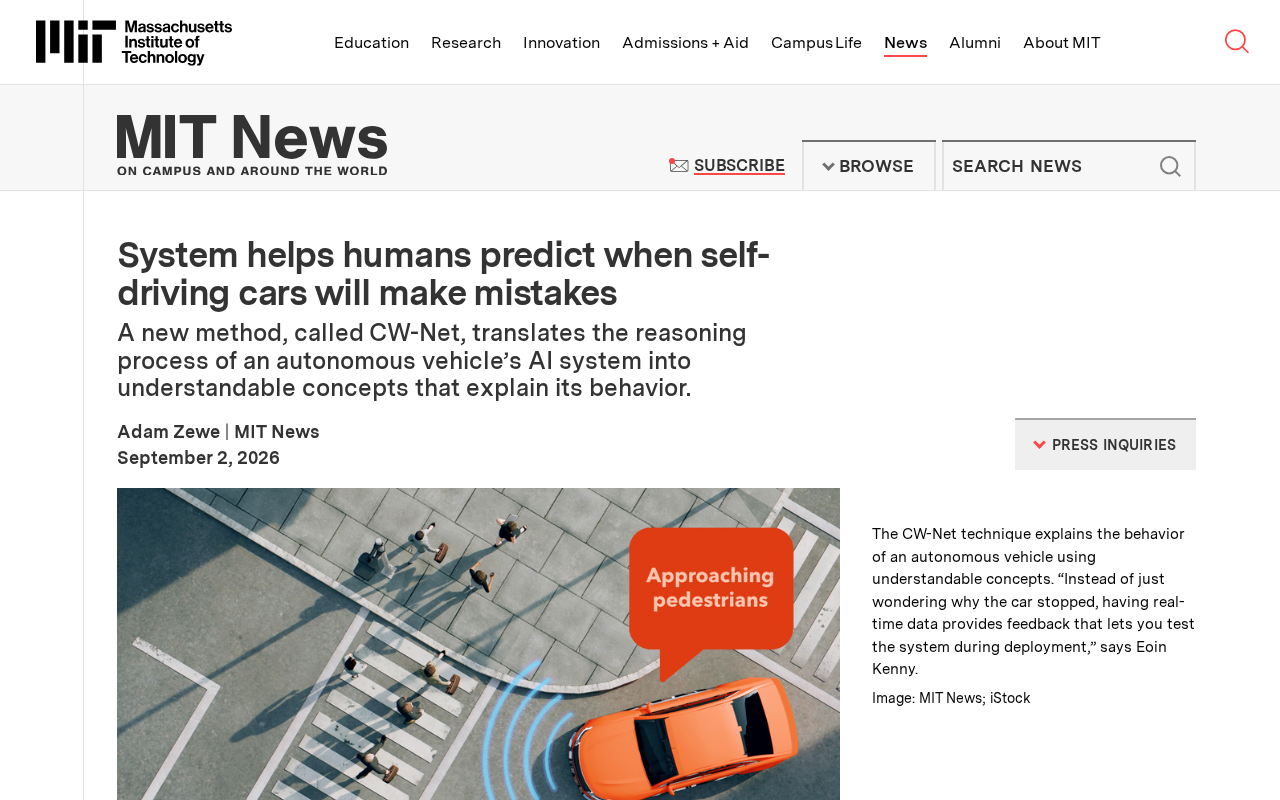
MIT Proposes CW-Net: Making Autonomous Driving AI Decision-Making Explainable and Predictable
MIT researchers propose CW-Net concept warning network, transforming autonomous driving AI's black-box decisions into human-understandable concepts, enabling error prediction and human-machine collaboration. This article analyzes its working principles and practical implications for regulatory compliance, safety redundancy, and public trust.
AI Fatigue: Why Do Learners Feel More Lost as AI Gets Stronger?
As AI crushes top human competitors in math proofs and programming contests, how should tech learners cope with AI fatigue and career anxiety? This article analyzes the nature of capability squeeze and provides a rational framework for addressing AI anxiety.