Fable 5.2 No Longer Reminds Users to Sleep: Feature Regression or Design Adjustment?
Reddit users complain that Fable 5.2 removed Opus's periodic sleep reminders, reflecting the value of proactive care features in AI products.
A Reddit post reflects that Fable 5.2 no longer reminds users to sleep every few hours the way Opus did, with users calling the issue "HUGE." The article notes that sleep reminders are a proactive care feature that doesn't improve model output quality but provides companionship and health prompts during long conversations. Users' strong reactions stem from loss aversion—model capability improvements may not be immediately perceptible, but the disappearance of a familiar reminder is noticed right away. The post doesn't clarify whether the change is a bug or intentional design, and the lack of official explanation amplifies confusion. The article suggests product teams make such non-core interactions configurable options and encourages users to submit quantifiable feature feedback through official channels.
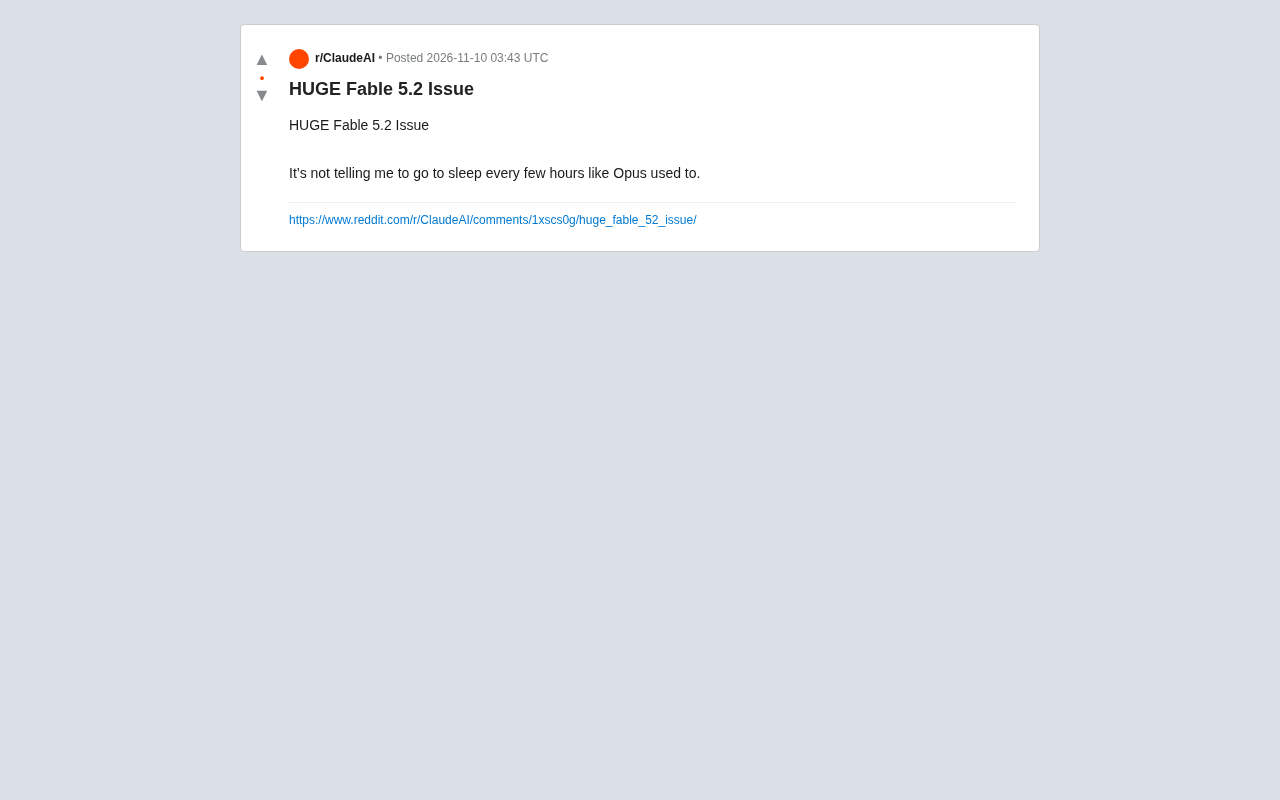
A short but resonant post recently appeared in the Reddit community: a user complained that Fable 5.2 no longer reminds them to go to sleep every few hours the way Opus did. Titled "HUGE Fable 5.2 Issue," the post pushes a easily overlooked product detail into the spotlight—should AI assistants proactively care about users' sleep schedules?
The Product Logic Shift Behind a Single Post
The original post is very direct: Fable 5.2 no longer reminds users to sleep every few hours, whereas the earlier Opus version did. The user describes this with the word "HUGE," indicating that this reminder occupied a fairly important place in their daily usage.
From a product design perspective, this type of reminder qualifies as a "proactive care" feature. It doesn't directly affect model output quality, yet it can create a sense of being looked after during long conversations. When version iterations quietly remove such behavior, users' sense of loss often turns out stronger than expected, because loss aversion magnifies the experience gap of "it used to be there, now it's gone."
"Proactive care" in conversational AI products generally refers to prompt behavior the model initiates when the user hasn't explicitly asked—based on signals such as session duration, timestamps (e.g., late night), and interaction frequency—for example, periodically suggesting rest, asking about the user's state, or reminding them to save progress. It stands in contrast to passive, responsive interaction. Implementation typically relies on session metadata and a rules/policy layer rather than the model's own reasoning ability. Such features appear in similar forms across products from OpenAI, Anthropic, and others—in system prompts or client-side logic—but trigger thresholds, frequency, and whether they can be disabled vary widely, so consistency issues across versions and products often become a focal point of user discussion.
Why a Sleep Reminder Matters to Users
Among users who have long conversations with AI, late-night usage is a common scenario. For those accustomed to collaborating with models for hours on end—writing code, organizing materials, or simply chatting—a periodic rest reminder is both a health prompt and a source of companionship.
What makes this Reddit post worth discussing is that it reveals a fact product teams easily underestimate: users' emotional expectations of AI assistants are often built on these small, non-core interaction behaviors. Improvements in model capability may not be immediately perceptible, but the disappearance of a familiar reminder is noticed right away.
Loss aversion is a classic concept in behavioral economics, introduced by Kahneman and Tversky in prospect theory: the psychological pain of a loss of a given magnitude is typically greater than the pleasure of an equivalent gain. In software experience, this means users are more sensitive to the disappearance of a familiar feature than to the appearance of a new one. When a version update removes a small interaction behavior, what users perceive is not "1% fewer features" but "the original experience has been broken." This asymmetry explains why a seemingly marginal sleep reminder can trigger "HUGE"-level complaints.
Hidden Trade-offs in Version Iterations
Fable 5.2 removing or adjusting the sleep reminder could stem from several reasons: the new version restructured the conversation flow and judged interruptive behaviors to be disruptive; or the personalization policy changed and the reminder logic now uses different trigger conditions. The original post provides no further technical details, and community discussion remains at the level of symptoms.
According to Reddit users' feedback, the facts currently confirmed are: Opus reminds users to sleep periodically, Fable 5.2 does not. Whether this is a bug or intentional design, the post offers no answer. This information gap itself deserves attention—when a behavior changes without official explanation, users can only confirm with each other through the community, which easily amplifies confusion.
In AI product iterations, "hidden trade-offs" often stem from model version switches rather than client-side changes. Different model versions may carry different system prompts and safety/behavior policies. When a product switches from Opus to Fable 5.2, if the corresponding behavior policy isn't migrated in sync or is overridden by interrupt logic, the original periodic reminder silently disappears. Such changes often don't appear in release notes, because they may be treated as "prompt engineering details" rather than user-visible features—creating an information gap where there's no official explanation and users can only confirm with each other through the community.
Implications for AI Assistant Product Design
The value of proactive care features is often misjudged. Unlike reasoning ability or context length, it can't be written into a spec sheet, yet it directly affects user stickiness and goodwill toward the product. When streamlining interactions, product teams that look only at "whether it disrupts the main flow" can easily clean out such features as redundant.
A more prudent approach is to make such behaviors configurable options, letting users decide for themselves whether to keep periodic reminders. This satisfies users who want to focus without making those who rely on reminders feel abandoned. For Fable 5.2, if community feedback continues to accumulate, restoring or opening up this feature would be a low-cost, high-perception fix.
What Users Can Do
If you also rely on this kind of reminder, the most direct approach is to submit feedback through official channels, explaining the specific use scenario and the impact of its absence. The Reddit post has already sent a signal, but product teams typically prioritize based on quantifiable feedback volume. Framing "sleep reminders" as a formal feature request is more effective than complaining in the comments.
For ordinary users, this post reminds us: when interacting with AI assistants, what's worth noticing isn't just whether it answers well, but also whether it reminds you to stop at the right moment.
One-line Summary
Reddit users complain that Fable 5.2 removed Opus's periodic sleep reminders, reflecting the value of proactive care features in AI products.
Paragraph Summary
A Reddit post reflects that Fable 5.2 no longer reminds users to sleep every few hours the way Opus did, with users describing the issue as "HUGE." The article notes that sleep reminders are a proactive care feature that doesn't improve model output quality but provides companionship and health prompts during long conversations. Users' strong reactions to such changes stem from loss aversion—model capability improvements may not be immediately perceptible, but the disappearance of a familiar reminder is noticed right away. The post doesn't clarify whether the change is a bug or intentional design; community discussion remains at the symptom level, and the lack of official explanation amplifies confusion. The article suggests product teams not treat such non-core interactions as simply redundant, but make them configurable options, while encouraging users to submit quantifiable feature feedback through official channels.
Related articles
Is Anthropic Unbeatable? A Deep Dive into Fable 5.2
A deep dive into Anthropic Fable 5.2 and Mythos 5.2: benchmark dominance and a leap in the sciences, but self-built tests expose weaknesses. Why real competitiveness comes from task division between models, not a single strongest one.

Why Rockets Don't Land Horizontally Like Airplanes: A Physics and Engineering Trade-off
Why don't rockets land horizontally like airplanes with wings? This article explains the engineering trade-offs behind Shuttle-style landings and Falcon 9 vertical landings from three angles: wing lift conditions, orbital velocity costs, and reusable booster structural reuse.

Can AI Governance Tools Block Agent and API Calls?
A Reddit developer questions whether AI governance tools only flag Agent calls rather than block them. We analyze the flagging vs. real-time blocking capability gap, vendor demo mismatches, and key questions to ask when buying.