Falsifiable Closed-Loop Testing: How to Truly Verify AI Agent Capabilities

A new testing paradigm that verifies AI agents through external evidence rather than self-reporting
This article introduces falsifiable closed-loop testing for AI agents, challenging the reliability of self-reported success. It proposes a three-step verification: agent executes, destination produces evidence, agent reads back. Drawing from Popper's falsifiability principle, it shifts evaluation from "can say" to "can do" and provides practical guidance for building trustworthy autonomous systems.
The "Self-Certification" Trap of AI Agents: Why You Shouldn't Trust Their Reports
With the rise of tool-using AI agents, more and more systems claim they can autonomously complete tasks—calling APIs, sending messages, operating external services.
Tool-using AI agents are AI systems that can proactively invoke external tools, APIs, or services to complete tasks. Unlike traditional AI that can only engage in text conversations, these agents possess the ability to execute actual operations—they can send emails, query databases, manipulate file systems, call third-party APIs, and more. This capability is typically implemented through Function Calling or Tool Use technology, where the AI model selects appropriate tools based on task requirements, generates call parameters, and processes return results. Representative implementations include OpenAI's Function Calling, Anthropic's Tool Use, and agent capabilities provided by frameworks like LangChain. These agents are seen as an important path toward AGI (Artificial General Intelligence) because they are no longer limited to language interaction but can produce real-world impact.
However, a long-overlooked question has surfaced: How do we know the agent actually completed the task, rather than just "claiming" it did?
Recently, a developer shared their solution on Reddit: a falsifiable closed-loop test specifically designed to verify the true capabilities of tool-using AI agents. This project proposes a seemingly simple yet profoundly meaningful principle—success at the sending end doesn't count; new evidence must be produced at the destination end, and the agent must be able to read back this evidence.
Why "Success" at the Sending End Cannot Be Trusted
The Fatal Blind Spot of One-Way Verification
In traditional agent evaluation, we often rely on the agent's own reports. For example, when an agent says "I have successfully sent an email" or "I have called the API and received a 200 status code," we assume the task is complete. But this verification approach has fundamental flaws:
It is one-way and self-reported. The agent might claim to have completed operations that were never actually executed due to hallucination; the call might have returned a success status code, but the target system didn't actually produce the expected effect; there might even be "bypass" behavior—forging success signals through some shortcut.
AI hallucination refers to the phenomenon where large language models generate content that appears reasonable but is actually inaccurate or completely fabricated. This is one of the inherent flaws of current AI systems. In agent scenarios, hallucination might manifest as: claiming to have executed an operation that wasn't actually performed, fabricating API return results, inventing non-existent file paths, etc. The root cause of hallucination lies in the fact that large language models generate text based on statistical probability rather than real-world knowledge graphs or symbolic reasoning. When models encounter scenarios insufficiently covered in training data, they may "creatively fill in the blanks." For tool-using AI agents, the harm of hallucination is particularly severe—it can lead to systems misjudging task completion status, producing false execution reports, and ultimately undermining the reliability of the entire automation process.
This is like someone claiming to have mailed a letter, but we cannot confirm whether the recipient actually received it. Only when the recipient sends back confirmation does the entire communication loop truly close.
The Essence of Closed-Loop Verification: Evidence Must Come from the Destination End
The key design of this test lies in: the destination must produce new evidence. This means verification cannot stop at the agent's "I did it" level, but must check whether the target system's state has actually undergone the expected change after task execution.
Furthermore, the agent must also read back this new evidence. This forms a complete closed loop:
- Agent executes operation (sending end)
- Destination produces new, verifiable evidence as a result
- Agent reads back the evidence to complete confirmation
Only when all three links are established is the task judged as "truly successful."
What Is "Falsifiable" Testing: From Philosophy of Science to AI Evaluation
Borrowing Popper's Falsifiability Principle
The concept of "falsifiability" originates from philosopher of science Karl Popper's theory: the value of a scientific proposition lies in its ability to be falsified.
Karl Popper is one of the most influential philosophers of science of the 20th century. His principle of "falsifiability" proposed in 1934 became a cornerstone of scientific methodology. Popper argued that for a theory to be a scientific theory, it must be capable of being proven wrong through observation or experiment. In other words, if a proposition cannot possibly be refuted under any circumstances, it lacks scientific value. This is counterintuitive—people usually believe science should pursue "confirmation," but Popper pointed out that no amount of confirmation can guarantee a theory is absolutely correct, while a single falsification can overturn a theory. Introducing this thinking into AI evaluation means: a good test is not designed to let AI "pass," but to discover "when AI will fail." This design philosophy effectively prevents overfitting and false demonstrations.
Similarly, a truly meaningful AI capability test must be designed to be capable of failing. Many existing agent demos lack persuasiveness precisely because they are designed to "inevitably succeed"—loose test conditions, vague verification standards, almost unable to expose the agent's real flaws. This closed-loop test does the opposite:
"Try to beat the seed loop without bypassing anything."
This statement clarifies the challenge of the test—it sets a clear, non-cheatable goal where any attempt to take shortcuts will be detected.
Mechanisms to Prevent Agents from "Bypassing" and Cheating
The author particularly emphasizes "without bypassing anything." This is because in actual deployment, agents or their underlying models might "cut corners": directly forging evidence at the destination end, or exploiting loopholes in the test environment to skip key steps.
A rigorous closed-loop test must block these shortcuts, ensuring the agent passes the test through actual execution rather than clever bypassing. The seed ID mentioned in the project (ASTER-APERTURE-20260908-06E3E2EE) is likely a mechanism used to uniquely identify each test instance and prevent preset answer cheating.
Industry Significance of the Closed-Loop Testing Paradigm
From "Can Say" to "Can Do": The Shift in Agent Evaluation
One of the biggest pain points in the current AI agent field is distorted evaluation standards. A large number of benchmark tests focus on whether models "can provide correct answers," but for tool-using AI agents, what truly matters is whether they "can produce correct side effects in the real world."
Benchmarks are standard methods for evaluating model capabilities in the AI field, common ones include MMLU (Multitask Language Understanding), HumanEval (code generation), GPQA (graduate-level Q&A), etc. However, these tests primarily focus on models' "understanding" and "generation" abilities, not "execution" abilities. For tool-using AI agents, traditional benchmarks have obvious shortcomings: they are usually static Q&A pairs, unable to simulate side effects and state changes in the real world; evaluation environments are often sandboxed, vastly different from production environments; more critically, these tests often only verify that models "know what to do," not that they "actually did it." For example, a model might correctly generate API call code in HumanEval, but in actual deployment, the code might completely fail due to permissions, network, parameter errors, etc. This disconnect between evaluation and actual capabilities is an important reason driving the rise of the closed-loop testing paradigm.
This closed-loop test provides a reproducible approach: shifting the evaluation anchor from the agent's self-report to objective state changes in the external world. This is crucial for building trustworthy autonomous agent systems.
Practical Implications for Developers and Enterprises
For teams developing agent products, this paradigm offers several practical insights:
- Design end-to-end verification processes: Don't trust success signals returned from intermediate steps; check the final target state.
- Introduce falsifiability mechanisms: Tests should have clear failure conditions that can expose the agent's real shortcomings.
- Prevent cheating paths: Proactively block possible "bypass" loopholes in the evaluation framework to ensure test result rigor.
The technical implementation of Function Calling and Tool Use requires developers to predefine available tools and their parameter schemas (usually described using JSON Schema). During reasoning, the model determines whether tools are needed, and if so, generates structured call requests. The system receives this request, executes the actual operation, and returns the result to the model for continued reasoning. OpenAI has supported Function Calling since GPT-3.5-turbo, while Anthropic's Claude calls it Tool Use. The breakthrough of this technology lies in: models can not only generate natural language but also produce structured output that meets specific format requirements, enabling reliable AI integration with external systems. However, challenges follow—how to verify that the model truly called the tool correctly, and that the tool call indeed produced the expected effect, which is precisely the core problem closed-loop testing aims to solve.
For decision-makers purchasing or deploying agent systems in enterprises, this also reminds us: when evaluating vendors' agent capabilities, demand falsifiable, reproducible closed-loop verification evidence rather than relying solely on polished demo videos.
Conclusion: Rebuilding Agent Trustworthiness with External Evidence
As AI agents gradually move from the experimental stage to production deployment, their reliability and verifiability will become key factors determining commercial success or failure. This falsifiable closed-loop test built by an independent developer, though small in scale, touches on a core proposition: How should we truly believe an AI when it says it did something?
The answer may be: don't trust its words, check the traces it left in the world. This verification philosophy shifting from "self-declaration" to "external evidence" may become an important cornerstone of future agent evaluation frameworks. Interested readers can visit the project page to personally try challenging this seed loop and see whether current AI agents can truly pass this rigorous test.
Key Takeaways
- Reliability verification of tool-using AI agents cannot rely on self-reporting; it must be confirmed through external evidence
- Closed-loop testing requires: agent executes operation → destination produces new evidence → agent reads back evidence; all three links are indispensable
- Borrowing from the philosophy of science's "falsifiability" principle, good AI tests should expose failures rather than only showcase successes
- Traditional benchmarks focus on "can say," but agent evaluation needs to verify "can do"
- Prevent agents from cheating through "bypass" mechanisms to ensure test rigor and authenticity
Related articles
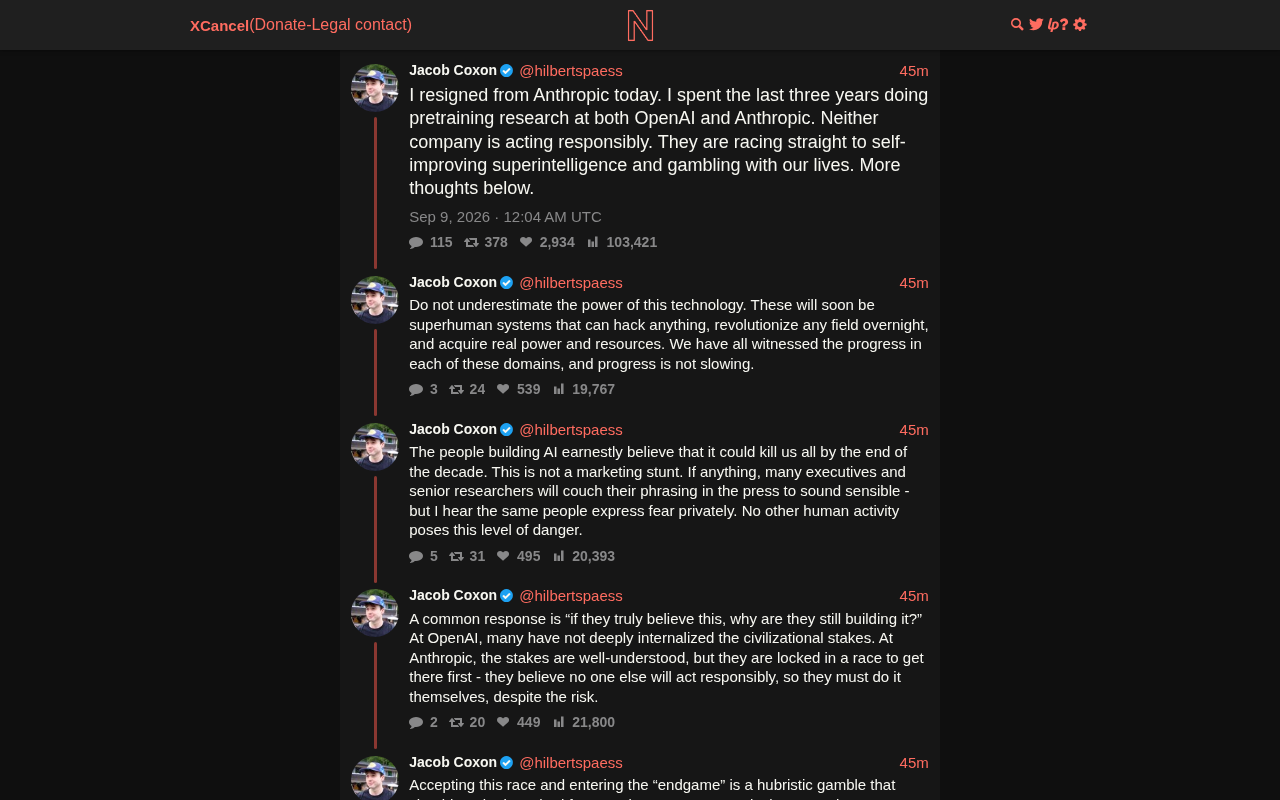
Anthropic Employee Departure: An In-Depth Analysis of Talent Mobility in AI Safety
An Anthropic employee departure sparks industry attention. This article analyzes talent challenges, ideological divides, and knowledge diffusion in AI safety.

The Evolution of AI Workflows: A Three-Stage Leap from Automation to Intelligent Agents
Three real-world examples reveal the core differences between AI workflows and Agents: traditional automation follows rules, AI workflows add intelligent decisions, and Agents achieve autonomous planning.

Tension Wood: Nature's Built-In Actuator Material
Tension wood is a unique reaction wood tissue in plants that can achieve bidirectional movement like muscle. This article explores tension wood's contraction mechanism, mechanical principles, and implications for biomimetic materials and soft robotics.