The Evolution of AI Workflows: A Three-Stage Leap from Automation to Intelligent Agents
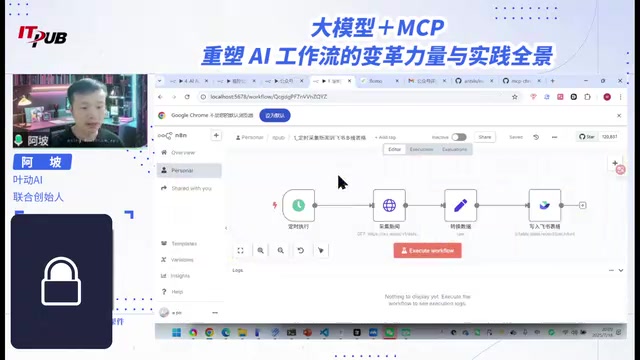
Exploring the three-stage evolution of automation: from rule-based workflows to AI workflows to autonomous AI Agents.
This article uses three practical examples to illustrate the evolution from traditional rule-based automation to AI-empowered workflows and finally to autonomous AI Agents. It explains how large language models shift from being execution nodes to decision-making brains, how MCP protocol enables Agents to call external tools autonomously, and how to choose the right automation approach for different tasks.
Understanding Real AI Workflows Through Practical Examples
When first venturing into the automation space, many people get confused by terms like "workflow," "AI workflow," and "AI Agent." Rather than throwing out abstract definitions, let's start with two contrasting real-world scenarios.
Scenario 1: Scheduled Data Collection Workflow Every morning at a fixed time, the system automatically visits news websites, scrapes content from designated columns, converts the format, and saves it to an Excel spreadsheet. The entire process is simple and straightforward — it repeats daily with highly predictable results.
Scenario 2: Sentiment Monitoring Workflow Imagine one of your articles suddenly goes viral, and comments flood in. You want to quickly understand the real reader feedback — which comments are positive endorsements, which are negative criticisms, and which contain constructive suggestions. You could build a workflow like this: batch-scrape comments based on the article link, call an AI model to analyze the sentiment and content value of each comment, automatically categorize and compile statistics, then generate a visual report and send it to your inbox.
Both cases are workflows, but the fundamental difference is immediately apparent: the first relies entirely on preset rules, while the second introduces multiple AI nodes to understand, evaluate, and summarize unstructured information.
The Technical Origins of Workflows
Workflows originated in the office automation field in the 1970s, referring to the process of linking tasks in a business process according to specific rules and procedures to achieve automated task flow. Traditional workflow engines like Apache Airflow and n8n are essentially task scheduling systems based on Directed Acyclic Graphs (DAGs), where each node performs a predefined operation and nodes are connected through deterministic logical relationships. This model is widely used in data ETL (Extract-Transform-Load), batch processing, and similar scenarios. However, when dealing with unstructured data that requires semantic understanding, traditional workflows can only rely on extensive if-else rules with hard-coded logic — resulting in high maintenance costs and poor flexibility.
The Essence of AI Workflows: Introducing Intelligent Decision Nodes
The dividing line between traditional workflows and AI workflows is actually quite clear — whether AI capabilities are introduced for intelligent decision-making. The former is rule-based traditional automation, while the latter gains semantic understanding and dynamic judgment capabilities by embedding AI reasoning nodes. Although the two concepts are often used interchangeably in everyday conversation, clarifying their boundaries is a necessary foundation for understanding AI Agents.
An AI workflow can be defined as follows: It is an AI-driven end-to-end automated process that chains together task execution, logical judgment, and decision nodes through AI technology, achieving a complete closed loop from input to output. Unlike single-point AI applications, it covers the entire pipeline of "data input → intelligent analysis → dynamic decision-making → result output." Its core value lies in understanding and processing unstructured information.
Technical Breakthroughs in Unstructured Data Processing
Unstructured data refers to information without a predefined data model or organizational method, primarily including text, images, audio, and video — accounting for over 80% of global data volume. Traditional automation systems can only handle structured data (such as database tables) and are completely helpless when facing questions like 'Is this comment expressing dissatisfaction or making a joke?' — questions that require understanding context, sentiment, and metaphor. The breakthrough of large language models lies in their pre-training on massive text corpora, through which they learn the statistical patterns of language and world knowledge, enabling them to perform complex cognitive tasks such as semantic understanding, sentiment analysis, and intent recognition. However, it's worth noting that AI's 'understanding' of unstructured data is still probabilistic pattern matching rather than true semantic comprehension — which is why AI workflow outputs need well-designed confidence thresholds and human review mechanisms. Currently, both academia and industry are exploring multimodal large models (such as GPT-4V and Gemini) to unify processing of multiple unstructured data types including text, images, and audio.
Taking sentiment monitoring as an example, the AI node reads each comment text and, based on the prompt, determines whether the comment is a friendly question, an aggressive remark, or valuable constructive feedback. This ability to perform semantic understanding and sentiment analysis on natural language is precisely what sets AI workflows apart from traditional automation.
The Critical Role of Prompt Engineering
Prompts are the core interface for human interaction with large language models, essentially representing a natural language programming paradigm. An effective prompt typically contains three elements: task description (telling the model what to do), contextual information (providing necessary background knowledge), and output format constraints (standardizing the structure of returned results). In AI workflows, the quality of prompt design directly determines the execution effectiveness of AI nodes. For example, in a sentiment analysis task, 'Determine whether this comment is positive or negative' is a basic prompt, while 'As a social media analysis expert, please evaluate the following comment across three dimensions — user intent, sentiment orientation, and constructiveness — and return scores in JSON format' is an engineered prompt. The latter significantly improves output stability and usability. Prompt engineering has developed mature techniques such as Chain-of-Thought and Few-shot Learning.
Breaking Down the Three Core Elements of AI Workflows
Analyzing a complete AI workflow, we can extract three indispensable components:
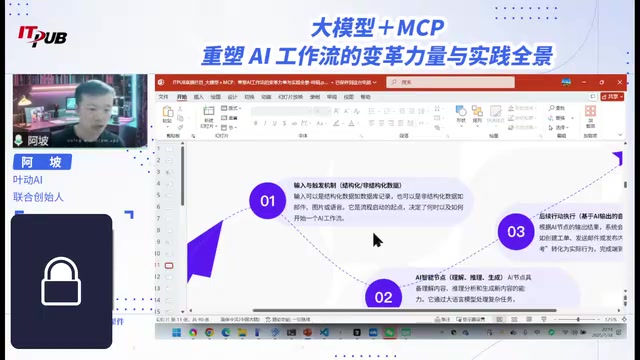
1. Trigger Mechanism: How the Process Starts
This determines the startup conditions for "when the workflow begins execution." The sentiment monitoring example uses a scheduled trigger mechanism, automatically monitoring changes in a specified article's comment section at a fixed time each day. Triggers can also be event-driven (e.g., executing immediately when a new comment is received) or manually activated.
2. Core Processing Logic: Where Intelligent Decisions Happen
This is the most value-dense part of the entire workflow. Multiple AI nodes collaborate here: text extraction, semantic understanding, sentiment analysis, content classification, and summary generation. The complexity and intelligence of business logic are concentrated at this layer.
3. Downstream Execution: How Decisions Are Carried Out
After AI analysis is complete, concrete actions must follow to close the loop — delivering the generated report to designated recipients via email, messaging, or API. Since final business decisions often still require human involvement, AI provides structured decision-support materials, and downstream execution ensures results are effectively delivered.
The Third Example: When Automation Evolves into an Autonomous Agent
The third example goes beyond the scope of a "workflow" — it's a true AI Agent.
Here's the task description: "In two days, I'm taking the high-speed train from Luoyang to Beijing to meet a friend. After arriving in Beijing, I want to find a hotel near Gaobeidian and check in. The next afternoon at 3 PM, we'll meet at Maan Coffee's Tuanjiehu location. Please help me find suitable train schedules, recommend cost-effective hotels, plan the subway route from the hotel to the café, and compile a complete itinerary report saved to my Flomo notes."
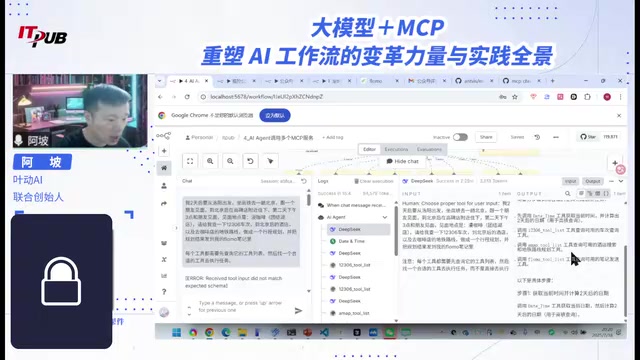
The key difference is: I didn't predefine any execution nodes or process sequence. I only described the goal and the available tool set in natural language. The Agent autonomously completed all the planning — task decomposition, tool selection, and execution sequencing.
The Agent's ReAct Working Mechanism
Modern AI Agents are typically designed following the ReAct (Reasoning + Acting) framework: the model first performs reasoning to generate an action plan, then executes specific operations (Acting), observes the execution results, and decides the next action — forming a 'Think-Act-Observe' loop. In technical implementation, this loop manifests through the large model's multi-turn conversation capability: the first turn's output might be 'I need to check today's date first,' and after the system executes this and returns '2025-01-15' to the model, the second turn continues planning with 'Since today is the 15th, two days from now is the 17th, so I need to check high-speed trains from Luoyang to Beijing on the 17th.' This mechanism gives Agents the ability to dynamically adjust strategies. However, it also introduces new challenges: overly long reasoning chains can lead to error accumulation (similar to human cognitive drift), so engineering practice typically includes safeguards like maximum loop counts and human confirmation at critical checkpoints. Current mainstream Agent frameworks such as LangChain, AutoGPT, and BabyAGI are all built upon extensions of this core paradigm.
From the execution logs, we can see the Agent first calls the DeepSeek large model to create an overall plan for the requirements and autonomously determines the execution order: first confirm the current date and time, then call 12306's MCP interface to query train schedules, next call the Amap (Gaode Maps) API to plan subway routes and search for nearby hotels, and finally call Flomo's write interface to generate notes. It first 'explores' what tools each MCP service provides, then calls them one by one according to its self-designed execution plan, ultimately generating a structured itinerary report and returning a link to access the notes.
MCP: The Tool-Calling Standard for Agents
Model Context Protocol (MCP) is an open standard released by Anthropic in November 2024, designed to address the standardization of integrating large models with external tools and data sources. Before MCP, every AI application needed to write specialized adapter code for different APIs, causing severe duplication of effort. MCP defines a unified server-client communication specification: the server (MCP Server) encapsulates various tools (such as database queries, API calls, file operations) into standardized 'resources' and 'tools,' while the client (typically an AI Agent) discovers and invokes these capabilities through the JSON-RPC protocol. This design allows large models to use tools much like humans do — first 'learning' about a tool's capabilities, then selecting the appropriate tool based on task requirements. As of early 2025, over 50 official and community MCP servers cover common scenarios including file systems, databases, cloud services, and third-party APIs.
Throughout the entire process — what to do first, what to do second, how to adjust when problems arise — everything is decided autonomously by the Agent. This is the fundamental divide between Agents and workflows: In workflows, orchestration authority lies with humans; in Agents, orchestration authority lies with the Agent itself.
Three-Stage Evolution: The Leap in Automation Capabilities
The three examples neatly form the complete evolutionary chain of automation technology:
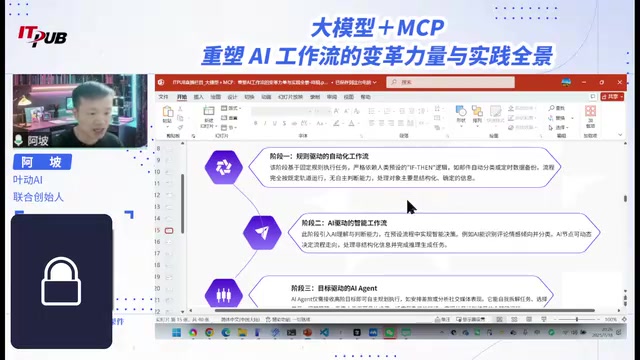
Stage 1: Rule-Driven Traditional Automation
Using scheduled news collection as an example, this strictly relies on human-preset if-then logic rules, executing mechanically along a fixed track with no autonomous judgment capability. It processes structured, deterministic information. No matter how many times it runs, the execution path and results are completely identical.
Stage 2: AI-Empowered Intelligent Workflows
Using sentiment monitoring as an example, because AI reasoning capabilities are embedded, the workflow gains semantic understanding and intelligent judgment abilities. It can make dynamic decisions within a preset process framework: identifying comment sentiment, dynamically routing based on content value, processing unstructured text, and completing logical reasoning. However, the overall process design and orchestration authority remain in human hands.
Stage 3: Goal-Driven AI Agents
Using itinerary planning as an example, humans only need to provide the final goal and available tool set. The Agent independently handles task decomposition, tool selection, execution sequencing, and exception handling — no manual intervention needed for specific execution steps — achieving a fully autonomous closed loop from goal to result. It's important to note that the Agent's execution path has a degree of uncertainty — influenced by the randomness inherent in large models, the specific steps may vary slightly between runs, but the overall logical framework typically remains stable and controllable.
Understanding AI's Uncertainty
Deterministic systems produce outputs entirely determined by inputs and rules — identical inputs always produce identical outputs, which is the cornerstone of traditional software engineering. But large models introduce probabilistic mechanisms: the same prompt may produce slightly different outputs across different runs. This stems from the Temperature Sampling parameter in the generation process — higher temperatures increase randomness, while a temperature of 0 approaches determinism but may sacrifice creativity. This uncertainty is an advantage in some scenarios (e.g., content creation requires diversity) but can pose risks in critical business processes. Engineering countermeasures include: lowering temperature parameters for greater stability, using structured output constraints (such as JSON Schema validation), setting up multi-sample voting mechanisms for critical decision points, and introducing rule engines for boundary checking on AI outputs. It's worth mentioning that even with Agent 'uncertainty,' the overall planning logic typically remains stable — much like how humans, when solving problems, may adjust specific steps based on circumstances while maintaining a consistent high-level strategy.
The Shifting Role of Large Models: From Executor to Decision-Making Brain
Once you understand the three-stage evolution, you can deeply appreciate the fundamentally different roles that large models play at each stage. Comparing AI workflows with AI Agents:
| Comparison Dimension | AI Workflow | AI Agent |
|---|---|---|
| LLM Role | Execution node | Decision-making core |
| Process Control | Human-led | Agent-led |
| Task Source | Passively receives instructions | Proactively plans and decomposes |
| Execution Determinism | Highly deterministic | Reasonable variability |
In AI workflows, the large model only performs reasoning and judgment tasks at designated nodes and does not participate in process design decisions. In Agent architectures, however, the large model plays the role of the "brain" — first creating an execution plan for itself, then dispatching tools according to that plan to complete tasks. This working pattern closely resembles the human approach of "plan first, execute second."
The value of MCP (Model Context Protocol) is demonstrated precisely here: it provides large models with the standardized ability to call external tools, enabling Agents to seamlessly connect with services like 12306, Amap, Flomo, and others. This is the critical infrastructure that makes autonomous planning capabilities practically viable.
Final Thoughts
From rule-based traditional automation, to AI-empowered intelligent workflows, to goal-driven autonomous Agents — the essence of this evolutionary path is the gradual transfer of decision-making authority from humans to AI. Understanding this underlying logic not only helps us clarify conceptual boundaries but, more importantly, enables us to make accurate judgments in real-world application design: whether a specific task is better suited for precise control through fixed processes, or should be handed over to an Agent for autonomous planning. Choosing the right tool often means an order-of-magnitude difference in efficiency.
Related articles

Tension Wood: Nature's Built-In Actuator Material
Tension wood is a unique reaction wood tissue in plants that can achieve bidirectional movement like muscle. This article explores tension wood's contraction mechanism, mechanical principles, and implications for biomimetic materials and soft robotics.

AlphaGenome Atlas Explained: How DeepMind Uses AI to Decode 3 Billion Base Pairs
Deep dive into DeepMind's AlphaGenome Atlas platform: how AVI scores assess 9 billion genetic variants and how this petabyte-scale genomic resource accelerates precision medicine research.

Gemini Agent Mode in Action: Let AI Efficiently Handle API Data Layer Code
An Android developer shares a real-world case of using Gemini Agent Mode to automatically write Retrofit data sources from API docs, covering prompt strategies, architectural constraints, and task slicing methodologies for efficient data layer development.