Faster Convergence Rates for Federated Variational Inequalities: A Theoretical Breakthrough

Refined analysis of Local Extra SGD yields tighter convergence rates for Federated Variational Inequalities.
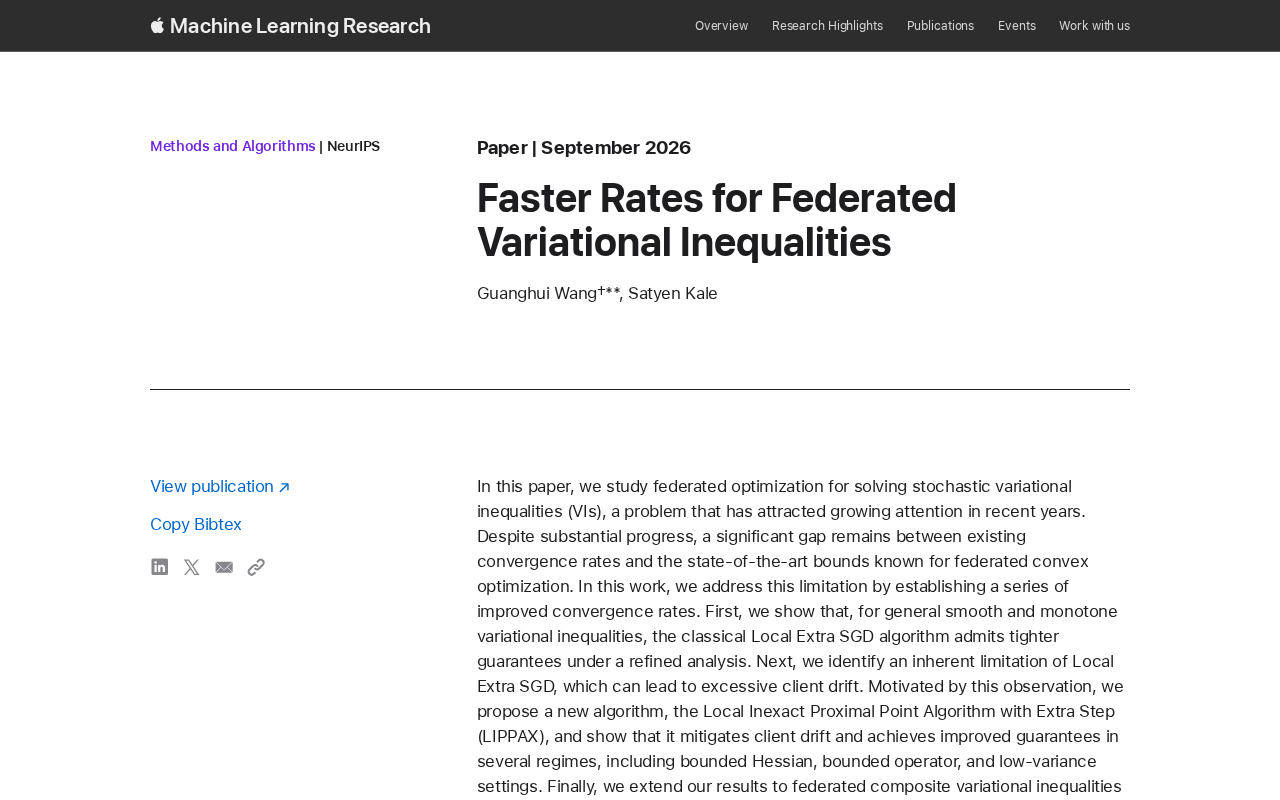
Federated Variational Inequalities (Federated VI) provide a unified framework for distributed machine learning problems such as min-max optimization and game equilibrium finding, but their convergence theory has long lagged behind optimal bounds in federated convex optimization. This paper takes an "old algorithm, new analysis" approach — applying refined theoretical analysis to the classical Local Extra SGD algorithm — to establish tighter convergence guarantees under general smooth monotone VI conditions, systematically narrowing this gap. The results require no changes to existing algorithm implementations, offer practitioners stronger theoretical backing, and have direct relevance to applications in distributed adversarial training, multi-agent game solving, and privacy-preserving computation.
Background: The Variational Inequality Challenge in Federated Optimization
In recent years, with the rise of distributed machine learning and privacy-preserving computation, Federated Optimization has become a focal point for both academia and industry. Within this field, solving Stochastic Variational Inequalities (VIs) is an increasingly important yet challenging problem. As a unified mathematical framework, variational inequalities can model a wide range of problems — including min-max optimization and game-theoretic equilibrium finding — making them broadly applicable to generative adversarial networks (GANs), adversarial robustness training, and multi-agent systems.
Despite meaningful progress in this direction over the past few years, a critical theoretical gap persists: the convergence rates of existing federated variational inequality algorithms still lag noticeably behind the known optimal bounds in federated convex optimization. In other words, the theoretical guarantees achievable for convex optimization have not yet been fully reproduced in the variational inequality setting. This paper targets exactly that gap.
The basic formulation of Variational Inequalities (VIs) is: find a vector $x^$ such that $\langle F(x^), x - x^* \rangle \geq 0$ holds for all feasible points $x$, where $F$ is an operator (typically a gradient or pseudo-gradient). When $F$ is the gradient of a convex function, the VI reduces to standard convex optimization; when $F$ is formed by taking partial derivatives of a min-max objective with respect to both variables, the VI captures a saddle-point problem. Monotonicity is the key condition in VI analysis that corresponds to convexity: if $\langle F(x) - F(y), x - y \rangle \geq 0$ holds for all $x, y$, the operator $F$ is said to be monotone, which guarantees the existence of solutions and algorithmic convergence. In the stochastic setting, only noisy estimates of $F$ are accessible at each iteration, further complicating the analysis. The federated setting adds two more layers of difficulty on top of this — heterogeneous client data distributions and limited communication — making it infeasible to directly apply the theoretical analyses of centralized VI algorithms.
Core Contributions: A Series of Improved Convergence Rates
The central goal of this work is to close the aforementioned theoretical gap by establishing a series of tighter convergence rates that push forward the theoretical frontier of federated variational inequalities.
Refined Analysis of a Classical Algorithm
The paper's first contribution is particularly illuminating: for general smooth and monotone variational inequalities, the authors show that the classical Local Extra SGD algorithm, upon more careful analysis, yields strictly tighter convergence guarantees than previously known.
The value of this result lies not in proposing a complex new algorithm, but in revisiting the theoretical potential of an existing method. This "old algorithm, new analysis" paradigm often carries stronger practical significance in optimization theory — it means practitioners can enjoy better theoretical backing without changing their existing implementations. Extra SGD stabilizes the VI-solving process by introducing an additional gradient extrapolation step, and in the federated (Local) setting, clients perform multiple rounds of local updates before aggregation, effectively reducing communication overhead.
Extra SGD (Extragradient SGD) is rooted in the extragradient method proposed by Korpelevich (1976): before the standard gradient step, a "look-ahead" prediction step is taken, and the gradient at the predicted point is used to guide the actual update. This two-step structure effectively suppresses the oscillations commonly observed when solving variational inequalities, and provably guarantees convergence for monotone operators — a setting where vanilla gradient descent-ascent (GDA) may diverge. In the Local Extra SGD federated variant, each client runs multiple rounds of Extra SGD locally (i.e., "local steps") before synchronizing model parameters or gradient information to a central server for aggregation. More local steps mean greater computational amortization per communication round and higher communication efficiency, but they also accumulate "client drift" error due to heterogeneous data distributions across clients. Striking the right balance between local computation and drift error is precisely what makes the refined analysis of federated VI so challenging.
Technical Significance: Bridging Convex Optimization and Variational Inequalities
Variational inequalities are fundamentally harder to analyze than standard convex optimization, primarily because the monotonicity of an operator does not imply the gradient structure of some convex function. As a result, many analytical techniques that work well for convex optimization cannot be directly transferred. This is the root cause of why federated VI convergence rates have long lagged behind those of federated convex optimization.
This is precisely where the paper's contribution lies: it systematically attempts to port the advanced analytical tools and bounds from federated convex optimization into the variational inequality setting. If this transfer can be accomplished successfully, it means we can obtain stronger theoretical guarantees and more efficient algorithm designs for a much broader class of problems, including min-max optimization and distributed game solving.
In federated convex optimization, algorithms such as SCAFFOLD and FedProx have established near-optimal communication complexity bounds by introducing variance reduction or proximal regularization to correct client drift. However, these techniques rely critically on the premise that the objective function's gradient has a "potential function" structure — that is, the operator $F$ is itself a gradient field of some function, allowing the use of function value descent to construct a Lyapunov potential and prove convergence. For general monotone operators, no such potential function exists. Researchers must instead construct alternative metrics based on operator norms or gap functions, effectively rebuilding the entire analytical framework from scratch. This is precisely why theoretical progress in federated VI has long stalled, even as the toolbox on the convex optimization side has become quite mature. The core technical challenge of this paper is finding an analytical pathway that can bridge this structural divide.
Applications and Research Value
From a practical standpoint, improved convergence rates for federated variational inequalities carry multiple real-world implications:
- Distributed adversarial training: Generative models such as GANs are fundamentally min-max problems that naturally map to variational inequalities. When training such models in a federated learning environment, faster convergence rates translate directly to fewer communication rounds and lower computational costs.
- Multi-agent and game-theoretic settings: Distributed Nash equilibrium finding and multi-party game optimization can both be framed as variational inequalities, and theoretical improvements translate directly into gains in algorithmic efficiency.
- Privacy-preserving computation: The federated framework is inherently designed for privacy requirements that keep data local; improving convergence rates makes the tradeoff between privacy and efficiency more favorable.
Summary
This work focuses on a concrete and important theoretical question — how to close the convergence rate gap between federated variational inequalities and federated convex optimization. Through refined analysis of classical algorithms such as Local Extra SGD, the authors achieve tighter convergence guarantees for general smooth monotone variational inequalities. For researchers interested in distributed optimization, min-max problems, and federated learning theory, these improved rate results provide a new baseline for subsequent algorithm design and theoretical analysis.
It should be noted that, as a theoretical paper, the complete technical details, proof techniques, and quantitative comparisons with existing methods can only be fully grasped by consulting the original paper.
Related articles

Amphibious Transforming Drone: Beyond 100x Power Savings, What Are the Real Needs?
Is the amphibious transforming drone just a gimmick? Starting from the 100x power difference of the M4 Morphobot, explore real application scenarios and thesis topic ideas, analyzing boundary conditions where pure drones and pure ground robots both fail.

Warhound Raises $200 Million: Genetically Engineered "War Dogs" Paired with Anduril Gear
Warhound raises $200M, backed by Ben Lamm and Palmer Luckey, to genetically engineer dogs for military and law enforcement use and equip them with Anduril gear. This article analyzes its technology direction, funding logic, and ethical controversy.

Claude API Comes to Google Cloud: IAM Integration and SDK Access Guide
Anthropic hosts the full Claude API on Google Cloud with IAM-controlled permissions and unified billing. This guide covers the Vertex AI and Anthropic-hosted entry points, IAM role configuration, and SDK access.