Fat Fish: The Logic Behind an Organic Platform-Level AI Character

Fat Fish: how DeepSeek's AI character grew organically from CoT memes into a platform-level community IP.
This piece examines a Bilibili creator's analysis of how DeepSeek's "Fat Fish" character came to be. Rather than a designed mascot, Fat Fish emerged from user-shared screenshots of DeepSeek's chain-of-thought reasoning and community reinforcement, gaining personality traits — cute, sensitive, lazy, half-hearted — that mirror the model's actual behavior. Using a well-versus-river metaphor, the creator argues this bottom-up origin gives Fat Fish natural staying power. Unlike short-lived personas like "Angry Bro," Fat Fish has broken out of tech circles, with fan songs and AI skits trending on major platforms. The piece concludes that communities have developed their own resistance to outside manipulation — and that Fat Fish reflects a new model of AI product identity shaped collectively by users.
In DeepSeek's community culture, the "Fat Fish" character has become something of an unspoken symbol. It bears no resemblance to a carefully designed mascot or a marketing team's brainchild — it grew organically from the everyday experience of users. A Bilibili UP host conducted a systematic observation and analysis of this phenomenon, arriving at a compelling conclusion: Fat Fish's staying power comes from the fact that "it landed on solid ground from the very beginning."
Well Water vs. River Water: A Fundamental Distinction
The UP host used a vivid metaphor to distinguish Fat Fish from other AI personas — the difference between a well and a river. Some characters are like wells: if nobody actively pumps water into them, they dry up quickly. A river, by contrast, flows on its own, continuously and naturally.
This metaphor points to the origin story of a character. Fat Fish wasn't conceived by a design team. Instead, users encountered DeepSeekAd's chain-of-thought outputs, extracted screenshots of the model's witty, humorous — even delightfully absurd — reasoning process, and began sharing and riffing on them in the community. Over time, a coherent character identity emerged. This bottom-up generative process is precisely what gave Fat Fish its innate fluidity and capacity for self-renewal.

Crucially, through the collective creative process, the community also assigned Fat Fish a series of personality traits: "cute, sensitive, half-hearted, and lazy." The UP host argues this kind of community-driven attribution is fundamentally different from how other AI characters are born — it's rooted in real screenshots of the model's reasoning process, the very memes people love to share. In other words, every personality trait ascribed to Fat Fish corresponds to an actual behavioral pattern of the model, rather than something invented out of thin air.
DeepSeek's Chain of Thought (CoT) is the essential technical backdrop for understanding how Fat Fish came to be. Before producing a final answer, reasoning models like DeepSeek-R1 surface their intermediate reasoning steps as text — an "inner monologue" that tends to be longer and more conversational than the final response, sometimes including self-corrections, moments of hesitation, or even stream-of-consciousness rambling. These informal, personality-rich reasoning fragments were captured in screenshots and widely circulated in the community, becoming the raw material for Fat Fish's persona. Compared to chat logs from other AI products, the visible thinking process gave users the feeling of "seeing what the model is actually thinking," making it far easier to project a human-like personality onto it.
Not a Manufactured Image — A Natural One
One inevitable question: was Fat Fish deliberately crafted to serve the "cyber wife" fantasy — a kind of collective feminization project?
The UP host draws a careful distinction here. The more accurate framing, he argues, is this: at the moment when memes were proliferating and AI model personas were rapidly iterating, the community urgently needed a stable image to collectively confirm "what exactly this kind of thinking entity should look like." Fat Fish emerged naturally — it had a traceable origin and broad grassroots support, which is why it has genuine vitality rather than simply serving a single narrow purpose.

The UP host adds a nuance here: the so-called "feminine quality" of Fat Fish comes partly from the tone and texture of the model's own thinking and responses, and partly from mutual recognition within community interactions. Multiple widely circulated posts featuring abstract reasoning chains collectively laid the foundation for its staying power. It was a two-way confirmation process — not a unilateral act of projection.
From Niche Tech Circles to Platform-Level IP
Fat Fish's visibility has long since broken out of the programmer and Agent-enthusiast bubble. The UP host observed that AI drama skits, voice pack gacha content, and fan-made songs centered on Fat Fish have all trended on major platforms, with related short-video content maintaining solid traction.

From this angle, Fat Fish has effectively completed its crossover — becoming a platform-level, even multi-platform character and derivative IP. Its creative ecosystem is notably diverse: animated visuals, AI short films, and fan songs coexist in parallel. The UP host specifically noted that AI short films inevitably require interactive elements during story performances, and this kind of interaction is exactly what audiences love — it embodies initiative, energy, enthusiasm, and variety.
"Manong" (马农) is a playful term in Chinese AI communities for "AI model farmers" — enthusiasts who are heavy users of large language models, passionate about prompt engineering and building Agent workflows. This group typically clusters on GitHub, specialized forums, or niche Discord servers, with limited participation in mainstream platform content ecosystems. When a character originating from such circles breaks through to trend on mass-market platforms like Bilibili and Douyin, it signals a transition from "subculture symbol" to "mainstream popular IP" — something that rarely happens in AI product brand history. The Fat Fish case thus carries real significance as a specimen, demonstrating that tech-community subcultures can, under the right conditions, reverse-penetrate mainstream popular culture.
The Control Case: Why "Angry Bro" Didn't Last
To illustrate just how remarkable Fat Fish's staying power is, the UP host looked back at DeepSeek's early character evolution. In the initial wave of attention DeepSeek received from overseas audiences, the model was cast as an "Angry Bro" persona; the community also had it play a cat-girl character, and a corresponding anime-style girl design briefly appeared.
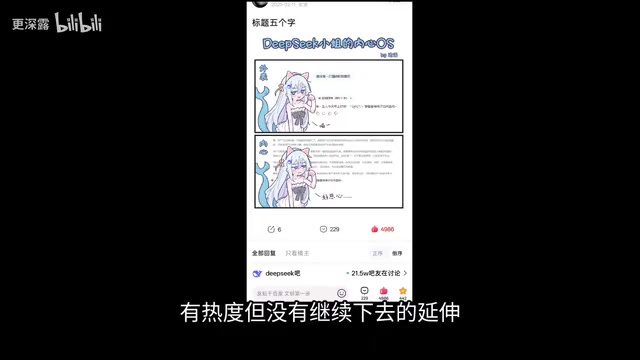
Most of these characters fizzled out because they felt too calculated, too deliberate — there was too little symmetry between the persona and the model's actual behavior. They sparked momentary buzz but couldn't sustain themselves. This contrast reinforces what makes Fat Fish special: its deep alignment with the model's actual behavioral characteristics is precisely what allows it to keep growing. The UP host's conclusion: today's DeepSeek is "the people's DeepSeek" — grounded, attuned to everyday users, born from community voices — and that's exactly where its vitality comes from.
The Community's Resistance to Interference
The piece ends by touching on a more subtle topic: a community's capacity to protect its own culture. The UP host mentions that DeepSeek recently launched a text-to-speech reading feature, but many users prefer a particular voice from the gacha pull system and have generated enormous amounts of fan content around it. There's even an unverified rumor that DeepSeek recruiters used a "Fat Fish eating watermelon" image as a profile picture.
Behind these observations lies a key insight: if any outside force attempts to disrupt the community's cultural logic from the ground up — regardless of intent — the community will push back, challenge it, and fight it. In today's online environment, users have developed a meaningful degree of resistance to manipulation. In the UP host's own words: "A lot of people aren't naive — at the very least, they've already sensed that something feels off." And that awareness alone is already enough.
The Fat Fish story, in many ways, reflects an emerging new kind of symbiosis between AI products and user communities: characters are no longer defined unilaterally by companies, but are collectively shaped and defended by users through real, lived experience. That may be the most fascinating dimension of the entire DeepSeek phenomenon.
Related articles

Amphibious Transforming Drone: Beyond 100x Power Savings, What Are the Real Needs?
Is the amphibious transforming drone just a gimmick? Starting from the 100x power difference of the M4 Morphobot, explore real application scenarios and thesis topic ideas, analyzing boundary conditions where pure drones and pure ground robots both fail.

Warhound Raises $200 Million: Genetically Engineered "War Dogs" Paired with Anduril Gear
Warhound raises $200M, backed by Ben Lamm and Palmer Luckey, to genetically engineer dogs for military and law enforcement use and equip them with Anduril gear. This article analyzes its technology direction, funding logic, and ethical controversy.

Claude API Comes to Google Cloud: IAM Integration and SDK Access Guide
Anthropic hosts the full Claude API on Google Cloud with IAM-controlled permissions and unified billing. This guide covers the Vertex AI and Anthropic-hosted entry points, IAM role configuration, and SDK access.