FBI Accuses North Korea of Orchestrating $6.3 Billion Binance Crypto Heist

FBI accuses North Korea of the $6.3B Binance hack, codenamed TraderTraitor, as hackers convert funds to Ethereum for laundering.
The FBI has publicly accused North Korea of responsibility for the $6.3 billion hack against Binance, the world's largest crypto exchange, on October 29, codenamed "TraderTraitor." The FBI says North Korea-linked actors are converting stolen tokens into Ethereum and preparing for further money laundering, closely mirroring past North Korean hacking tactics. The scale is more than ten times the Ronin Bridge incident (about $620 million) and, if confirmed, would be one of the largest state-sponsored thefts in crypto history. The article analyzes the potential impact on trust in centralized exchanges, the U.S. enforcement stance, and North Korea's shift from traditional banks to crypto finance, and notes that follow-up investigation progress, exchange security architecture changes, and international joint enforcement deserve continued attention.
Event Overview: One of the Largest Crypto Thefts in History
According to foreign media reports, the U.S. Federal Bureau of Investigation (FBI) recently publicly accused North Korea of being responsible for a large-scale hack against Binance, the world's largest cryptocurrency exchange, on October 29, with losses amounting to as much as $6.3 billion. The FBI named the operation "TraderTraitor" and stated that it has observed North Korea-linked threat actors converting the stolen tokens into Ethereum and preparing for further money laundering.
If confirmed, this accusation would make it one of the largest state-sponsored thefts in cryptocurrency history, and it once again highlights the profound impact of geopolitical and cybersecurity risks on the digital asset market.
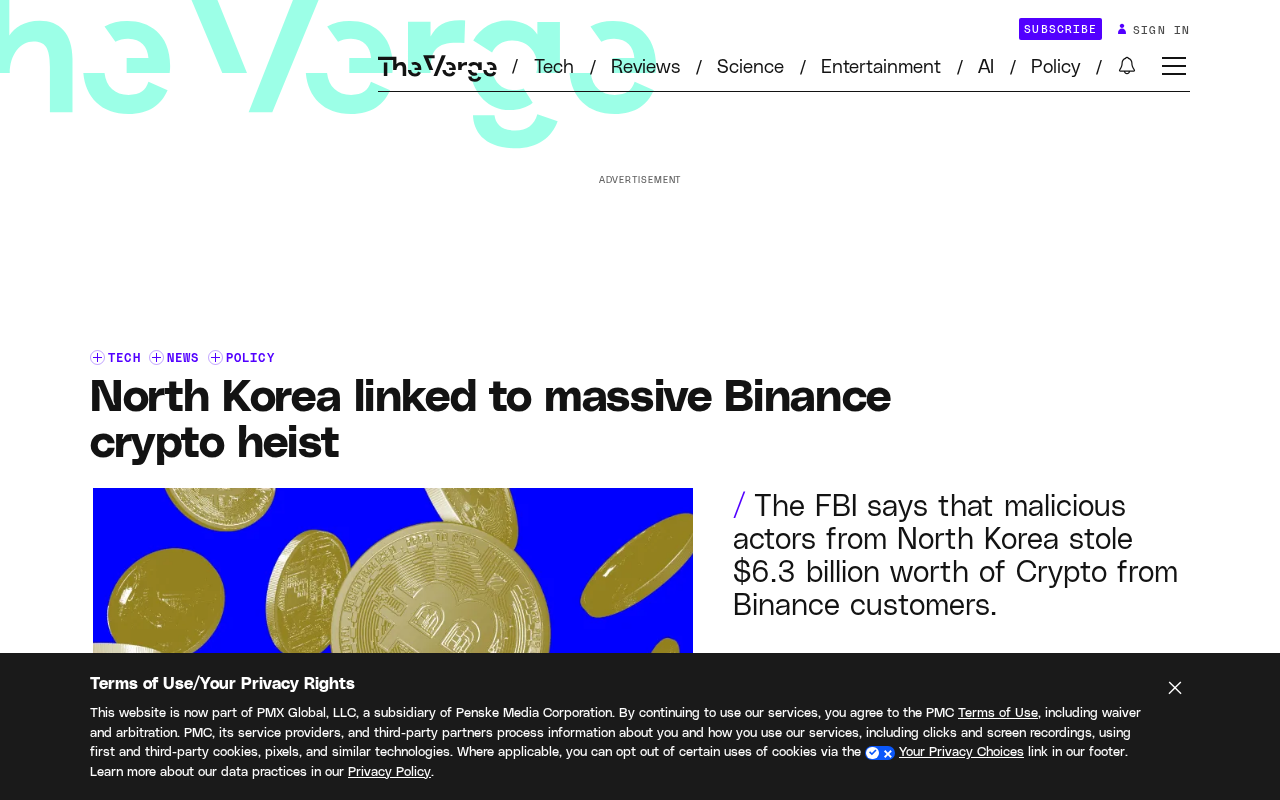
Binance is the world's largest centralized cryptocurrency exchange by trading volume, founded in 2017 by Changpeng Zhao (CZ), with more than 150 million users. As a centralized platform, Binance custodies a large number of users' private keys and assets, making its hot wallets and cross-chain bridges high-value targets for hackers. Historically, Binance suffered a Bitcoin theft of approximately $40 million in 2019, but the $6.3 billion scale alleged in this case far exceeds any previous exchange security incident and, if true, would set a historic record for the amount stolen from a centralized exchange.
TraderTraitor Operation Details: From Token Conversion to Money Laundering Preparation
In its statement, the FBI said it observed North Korea-linked actors converting the stolen tokens into Ethereum and preparing for subsequent money laundering activities. Although the FBI did not disclose further specifics, this pattern closely resembles the modus operandi of past North Korean hacking groups—typically using decentralized exchanges and mixing services to obscure the flow of funds, ultimately converting assets into fiat currency or hard-to-trace cryptocurrencies.
The name "TraderTraitor" suggests that the operation may have involved infiltrating trading systems or traders. Although there is currently no detailed official explanation from Binance regarding the technical details of this attack, the figure of $6.3 billion alone is enough to shake the entire industry. For comparison, the well-known Ronin Bridge hack previously resulted in losses of approximately $620 million—this incident is more than ten times that scale.
Mixing services (Mixer/Tumbler) are privacy tools that pool, split, and redistribute multiple users' crypto assets to sever the link between on-chain fund inputs and outputs. North Korean hacking groups often use such services to obscure the tracing path of stolen funds. However, the U.S. Department of the Treasury's Office of Foreign Assets Control (OFAC) sanctioned the well-known mixer Tornado Cash in 2022, determining that it facilitated money laundering, which has pushed hackers increasingly toward alternative channels such as decentralized exchanges (DEXs), cross-chain bridges, and privacy coins to cash out. On-chain analytics firms (such as Chainalysis and Elliptic) track these fund flows through clustering analysis and transaction graphs, and the FBI's rapid attribution typically relies on such on-chain intelligence.
Potential Impact on the Crypto Market and Security Ecosystem
The impact of this incident may extend far beyond a single hack. As the world's leading cryptocurrency exchange by trading volume, Binance's security is directly tied to the asset safety of millions of users. If hackers were able to breach its defenses and move such a massive amount of funds, market trust in centralized exchanges would face a severe test.
On the other hand, the FBI's public attribution also signals that U.S. law enforcement is taking an increasingly hard line on state-level cybercrime. Previously, the U.S. Treasury sanctioned the North Korean hacking group Lazarus Group, and the naming and attribution of "TraderTraitor" in this case may foreshadow further legal or economic countermeasures.
For ordinary investors, this incident is a reminder that while the anonymity and cross-border liquidity of cryptocurrencies bring convenience, they also provide channels for illicit fund transfers. Exchanges and users alike need to strengthen security audits and risk monitoring, especially amid geopolitical tensions.
North Korea's Cyberattack Patterns: Evolution from Banks to Crypto
North Korea has long been accused of using cyberattacks to obtain foreign exchange. Over the past several years, North Korea-linked hacking groups have been accused of attacking global banking systems, cryptocurrency exchanges, and DeFi protocols to circumvent international sanctions. If the attack on Binance is confirmed, it would be another example of its targets extending comprehensively from traditional finance to crypto finance.
You may not have noticed that North Korean hacking groups typically employ a phased strategy: first infiltrating systems and stealing assets, then obscuring the flow of funds through multiple layers of transactions, and finally cashing out via over-the-counter trading or mixers. The FBI's rapid attribution and public release of the operation's codename in this case may indicate that the U.S. side has obtained some on-chain tracking evidence, but publicly available information remains limited.
Lazarus Group is a state-level hacking group widely believed to be associated with North Korea's Reconnaissance General Bureau (RGB), active in global cyberattack campaigns since 2009. The group has been accused of orchestrating the 2016 theft of $81 million from the Bangladesh central bank, the 2017 WannaCry ransomware incident, and multiple attacks on cryptocurrency exchanges and DeFi protocols. The U.S. Treasury has sanctioned Lazarus Group and its sub-groups (such as APT38 and Bluenoroff). North Korea's theft of foreign exchange through cyber means is seen as an important means of evading international sanctions and financing its nuclear and missile programs, and United Nations expert panel reports have repeatedly stated that North Korea uses funds obtained from cryptocurrency to finance its weapons of mass destruction programs.
What to Watch Next: Investigation Progress and Industry Response
Currently, Binance has not issued a detailed response to the FBI's accusation, and the incident remains under investigation. Industry observers should watch several directions: first, whether the FBI will release more technical details or on-chain addresses; second, whether Binance will adjust its security architecture or user asset protection measures; and third, whether other countries will follow up with sanctions on North Korea or joint law enforcement actions.
For the cryptocurrency industry, this incident is yet another security wake-up call. Whether the attackers are state-backed or independent hackers, the massive assets held by centralized exchanges remain high-risk targets. Strengthening cold storage, multi-signature, and real-time monitoring, as well as collaboration with international law enforcement agencies, will become capabilities that trading platforms must reinforce in the future.
Cold storage refers to keeping cryptocurrency private keys offline (such as in hardware wallets, paper wallets, or air-gapped network devices), physically isolating them from the internet and thereby greatly reducing the risk of remote theft by hackers. In contrast, hot wallets need to be online to support daily transactions and are less secure. Multi-signature requires multiple private keys to jointly authorize a transaction, preventing the loss of all assets due to the compromise of a single private key. Major exchanges typically store most user assets in cold wallets, keeping only a small amount of hot wallet funds to meet withdrawal demand; if this incident involved hot wallet or cross-chain bridge vulnerabilities, it will prompt the industry to reassess its custody architecture and investment in real-time anomaly monitoring.
One-line Summary
FBI accuses North Korea of responsibility for the $6.3 billion Binance hack, codenamed TraderTraitor, with hackers converting funds to Ethereum for money laundering.
Paragraph Summary
The FBI has publicly accused North Korea of being responsible for the $6.3 billion hack against Binance, the world's largest cryptocurrency exchange, on October 29, under the codename "TraderTraitor." The FBI says North Korea-linked actors are converting stolen tokens into Ethereum and preparing for further money laundering, with a modus operandi highly similar to past North Korean hacking groups. The scale is more than ten times that of the Ronin Bridge incident (approximately $620 million); if confirmed, it would be one of the largest state-sponsored thefts in cryptocurrency history. The article analyzes the incident's potential impact on trust in centralized exchanges, the U.S. enforcement stance, and North Korea's extension of attacks from traditional banks to crypto finance, and notes that follow-up investigation progress, exchange security architecture adjustments, and international joint law enforcement warrant continued attention.
Related articles

AI Can Read Neural Network Weights Directly: Do Models Already Exceed Expectations?
A Reddit developer experiment shows language models can directly read neural network weights and infer their function. Astra, Opus 5.5, and Muse Spark 1.3 all passed the test, sparking discussion on model generalization and training sources.

India's Microdrama Market Explodes: EloElo Secures $80M Investment from NBCUniversal
EloElo secures $80M from NBCUniversal to boost StoryTV, its microdrama platform with over 33M monthly active users, as India's microdrama market draws global capital.

Acoustic Detection of Multi-Rotor UAVs: Fusing Handcrafted Features with Pre-Trained Embeddings
Study reveals data leakage from random splits in UAV acoustic detection, proposes source-disjoint protocol with stacked ensemble of handcrafted features and YAMNet embeddings, achieving 95.29% accuracy for low-cost drone detection.