How Does ARTEX AI Automate Hacking with Agents?

ARTEX AI uses dual-layer planner and executor agents plus a shared blackboard to push cyberattacks to machine speed.
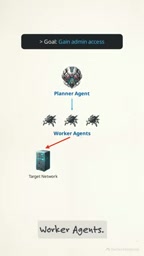
The article introduces an agentic attack framework called ARTEX AI. With just a single instruction—"gain admin access"—it can autonomously decompose and execute an attack workflow. Its architecture is divided into a planner agent and worker agents: the planner decomposes vague goals into concrete steps, while the workers invoke real hacking tools to scan, probe, and exploit. Workers write discovered vulnerabilities to a shared blackboard, and the planner continuously reads and adjusts strategy in real time, forming a high-speed adaptive loop that claims total domain compromise in under three hours with thousands of attack attempts per minute. The article also cautions that these capabilities come from a general YouTube video introduction and lack reproducible details and third-party verification, though its architectural approach carries warning value for defenders.
From a Single Instruction to Total Domain Compromise: The Automated Attack Logic of ARTEX AI
Imagine this scenario: an attacker types a single instruction, then walks away from the computer, and within less than three hours the AI has breached the enterprise network. It sounds like science fiction, but ARTEX AI, as showcased in the video, uses exactly this as its selling point. It is not a traditional automation script, but rather an attack framework built on an agentic architecture, attempting to replace the process of human hackers manually chaining together complex vulnerabilities with continuous, high-speed autonomous decision-making and execution by machines.
The framework's core instruction is just one sentence: Gain Admin Access. Around this goal, the system internally decomposes a complete attack pipeline. The video title carries the #cybersecurity tag, indicating that its context is cybersecurity offense and defense, rather than a mere AI technology demonstration.
A Domain Controller is the core authentication server in an enterprise Windows network, responsible for managing all users, computers, and permission policies within the domain. Once an attacker controls the domain controller, they can operate all accounts and devices across the entire domain with the highest privileges, which is why "total domain compromise" is generally regarded as the hallmark of an enterprise network being thoroughly breached. This is also why ARTEX AI takes "gain admin access" as its core objective: obtaining domain administrator privileges means the attacker can achieve persistent control, move laterally, and steal sensitive data, leaving defenders with almost no depth of defense.
Planner and Executor: The Dual-Layer Structure of Agentic Attacks
In ARTEX AI's architecture, the most critical component is the planner agent. It plays the role of the "central brain," responsible for decomposing the vague goal of "gain admin access" into a series of executable attack steps. The planner itself does not directly execute attacks; its value lies in task decomposition and scheduling.
The actual work is done by worker agents. The planner assigns these concrete tasks to the workers, which invoke real hacking tools to conduct scanning, probing, and exploitation against the target environment. This design of separating planning from execution allows the system to maintain the coherence of the overall strategy while processing a large number of fine-grained operations in parallel. The video notes that human hackers need to manually chain vulnerabilities, whereas this type of AI system can execute thousands of attack attempts per minute.

An Agent here refers to an AI program capable of perceiving the environment, making autonomous decisions, and invoking tools to execute actions. Unlike traditional scripts that run through a fixed workflow, agents are typically driven by large language models and can dynamically choose the next operation based on the current state. In an attack scenario, this means the system can "observe—judge—act" like a human hacker, but far faster than manual effort. The division of labor between planner and executor draws on the classic design of Multi-Agent Systems: one is responsible for high-level reasoning and task allocation, while multiple others handle low-level execution, thereby balancing global strategy and parallel efficiency.
Shared Blackboard: Making the Attack Loop Self-Accelerate
In the process of scanning the network and stealing credentials, the worker agents record every vulnerability they discover onto a shared, centralized "blackboard." This blackboard is the key to the system's autonomous adaptation. The planner continuously reads the latest data on the blackboard and adjusts the next steps accordingly in real time.
This forms a high-speed closed loop: workers discover new vulnerabilities → write to the blackboard → the planner reads and re-plans → assigns new execution tasks. The video describes it as a "continuous high-speed autonomous exploitation loop" that can adapt in real time during operation. It is precisely this loop that makes ARTEX AI's speed—from initial target reconnaissance to total domain compromise—so fast that human defenders may not have time to react.

The Blackboard is a classic collaborative architectural pattern in artificial intelligence and multi-agent systems. It refers to a shared data area that all agents can read from and write to; agents do not communicate with each other directly, but collaborate by writing findings to the blackboard and reading information from it. In ARTEX AI, the blackboard serves as the "global memory" of the attack process: workers write scan results, stolen credentials, and discovered vulnerabilities into it, and the planner updates the attack plan accordingly. The advantage of this design is decoupling—workers do not need to know of each other's existence, and the planner can make decisions based on the latest global state, thereby supporting a high-speed, adaptive attack loop.
What This Means for Defenders
The video concludes by mentioning "read the FBI flash notice to learn how agentic hackers are changing the rules," indicating that this topic has entered the视野 of law enforcement and security agencies. From a technical logic perspective, the trend represented by ARTEX AI is an escalation in the degree of automation on the offensive side: no longer relying on the experience and hand speed of a single hacker, but instead using a planning-execution-feedback loop to push the attack tempo to machine speed.
For defenders, this means the traditional response window may be further compressed. When the attack loop iterates at the minute or even second level, the speed of manual analysis and manual blocking is hard to match. The video does not elaborate on specific defense solutions, but the architecture it presents already hints at a direction: defense also needs an equivalent degree of automation and agent collaboration, otherwise the speed gap will continue to widen.
A Rational Perspective: The Distance Between Demonstration and Real-World Practice
A brief note: this content comes from a YouTube video and is essentially a general introduction to ARTEX AI's capabilities, rather than independent technical verification or a real-world post-mortem. Statements in the video such as "breach the network in less than three hours" and "thousands of attempts per minute" are capability claims made by the framework and lack reproducible details and third-party assessment.
For security practitioners, what is more noteworthy is its architectural approach: separation of planner and executor, and a shared blackboard driving an adaptive loop. This model also has reference value in legitimate scenarios such as automated penetration testing and red team exercises. As for its success rate in real enterprise environments, more public evidence is needed to judge.
Related articles

Jingle Jam 2026 Registration Opens: Lewis Uses Old Footage to Rally Volunteers for Fundraising
Jingle Jam 2026 fundraising registration is open. Lewis uses old footage edited into a new video, calling on viewers to create fundraising pages at jingle jam.tiltify.com to support eight charities. The event takes place in the first two weeks of December.
Gemini 4 Neon Hands-On Test: Can It Replace Claude Opus 5.5?
A Bilibili creator tests Gemini 4 Neon, Claude Opus 5.5, and GPT 6.2 across three coding Agent challenges—pelican animation, 3D racing, and code-generated video—to see if Gemini can replace Opus.
FBI-Warned Artex: How an AI Attack Framework With No In-House Model Pries Open Enterprise Doors
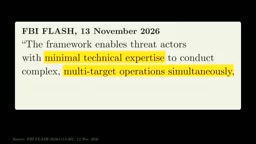
The FBI-warned open-source AI attack framework Artex has no model of its own—it plugs into Claude, GPT, and other external LLMs to drive an agent loop, turning ordinary tools like Nmap into an automated attack pipeline. This article examines three real cases—South Korean finance, ConnectWise, and Barracuda—analyzes the three drivers of speed, cost, and noise, and outlines defenses such as exposure inventory and short-lived credentials.