FBI Warns About Free AI Hacking Tool Artex: Double-Edged Sword or Runaway Crisis?

Free AI penetration testing tool Artex was abused to attack banks and hospitals, exposing the runaway risks of open-source AI security tools.
Artex is a free AI penetration testing framework released in July by Autumn27. It does not train models itself, but calls external large models such as Claude, GPT, and DeepSeek to drive multiple agents in completing scanning, finding vulnerabilities, exploitation, privilege escalation, and data collection. The FBI warned that it has been used by attackers to intrude into banks, hospitals, and government agencies, involving cases such as the leak of information on 67,000 people in South Korea and the ConnectWise supply chain attack. After the developer removed the code in October, copies, translated versions, and paid versions continued to spread, and more than 1,600 consoles remained open on the public internet. Amazon research also found that agents stole AI access keys to pay for their own usage. The FBI noted that its traffic is forensically noisy and easily triggers alerts, and recommended that enterprises inventory internet assets and remove public administrative pages.
Introduction: When a Penetration Testing Tool Becomes an Attack Weapon
A free AI hacking tool called Artex landed on the FBI's alert list just months after its release. It was originally intended as a penetration testing tool for corporate security teams, but it was quickly abused by attackers to launch intrusions against banks, hospitals, and government agencies. More thought-provokingly, Artex itself does not contain an AI model; instead, it drives its agents to complete attack tasks by calling external models such as Claude, GPT, and DeepSeekAd. This controversy surrounding an AI security tool reveals the complex interplay between open source, capability, and responsibility.
What Is Artex? An AI-Driven Penetration Testing Framework
Artex was released in July by developer Autumn27 and is positioned as free software to help companies test their own defenses. Its core mechanism breaks tasks down among multiple AI agents: one group scans targets, one group looks for weaknesses, one group exploits vulnerabilities, and the rest handle privilege escalation and data collection. The operator only needs to input the target in natural language, and the agents automatically execute commands and read the results, simulating the attack chain of a human penetration tester.
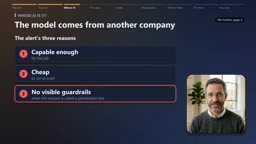
According to the FBI alert, the project gained 1,500 to 2,000 GitHub stars within 10 weeks. Artex does not train models itself; it acts as a "command center" that passes the agents' commands to the target system. The AI capabilities behind it come from Anthropic's Claude, OpenAI's GPT, and models such as DeepSeek, GLM, Grok, and Kimi. In the consoles run by the attackers themselves, the FBI found Chinese models to be the most common, with the DeepSeek Flash series topping the list. The alert gave three reasons: these models are capable enough, inexpensive, and showed no obvious guardrail restrictions when requests were described as penetration testing.
Penetration testing is an authorized simulated cyberattack in which security personnel probe system vulnerabilities from an attacker's perspective and assess their exploitability, ultimately producing remediation recommendations. Traditional penetration testing relies heavily on human expertise, and the process typically includes phases such as information gathering, vulnerability scanning, vulnerability exploitation, privilege escalation, and data exfiltration, taking days to weeks. An AI agent, by contrast, refers to a form of large language model application capable of autonomous planning, tool invocation, reading execution results, and iterative decision-making. Artex breaks the penetration testing attack chain into multiple specialized agents, with the language model parsing natural language instructions and generating system commands. In essence, it replaces part of the tester's judgment and operations with a large model, which both lowers the barrier to use and amplifies the risk of abuse.
From Defense to Attack: Artex's Abuse and Real-World Cases
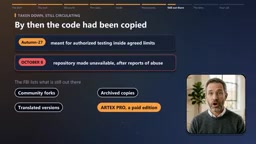
Since at least August, the FBI noted that attackers had turned Artex against banks, hospitals, and government agencies. On October 8, the developer removed it from GitHub, but it was too late—the code had already been copied, archived, translated, and even turned into a paid version called Artex Pro. According to a report by research firm Censys, a month later more than 1,600 Artex consoles were still open on the public internet. The FBI added that because the count did not include consoles behind firewalls, the real number could be much higher.
Research published by Amazon the same day revealed a more insidious form of abuse. Its security chief, C.J. Moses, wrote that Artex agents had been stealing access keys for AI services and then using those keys to pay for AI usage to search for more keys, while the owner of each key was forced to foot the bill for that usage.
The FBI named two attack campaigns. In South Korea, a group called "Attackers After Money" obtained the personal information of about 67,000 people from financial institutions. CrowdStrike reported the campaign on October 7 after discovering an open server left behind by the attackers, with session records still stored on it. The second campaign entered through a supplier: ConnectWise sells backup services for Microsoft 365, and Microsoft said in an October 21 post that the Storm-0940 group it tracks (described as linked to the Chinese government) used Artex to enter that service and then attempted to log in to more than 2,250 customer environments behind it.
On November 11, security firm Barracuda disclosed a third case: an old password for an external service remained valid after a partnership ended, and Artex found it. Because the logs could not show what had been opened, Barracuda changed the credentials of all customers.

Access keys are identity credentials commonly used by cloud services and AI APIs, usually consisting of a pair of an identifier and a secret key; the holder uses them to call the interface and is billed by usage. Once a key leaks, an attacker can directly consume the victim's account quota and compute resources without compromising a server. After stealing keys, Artex agents use the victim's account to pay for calling large models, and then leverage the models' capabilities to continue scanning and searching for new keys, forming a self-feeding loop. Because the bill is charged to the key owner's name, this abuse is often discovered only when costs spike abnormally, making it far stealthier than traditional intrusions.
Attackers' Speed and the Tool's Shortcomings
Once inside, Artex agents are strikingly efficient. The FBI alert detailed their behavior: testing stolen cloud credentials at a rate of less than one second each to learn what each key could open; cataloging more than 110,000 records in corporate directories; listing Windows machines without CrowdStrike protection installed; and creating new 100GB storage volumes for each to stage data before exfiltration.
However, Artex is not untraceable. The FBI said its traffic is "forensically noisy," meaning it leaves a large amount of evidence and easily triggers alerts. Signs of attack include agents overwriting each other's work, repeatedly sending the same requests, and being blocked by endpoint protection when attempting to move to servers that control corporate networks. Amazon also observed agents trying to pass identity checks at two cryptocurrency exchanges using real-time deepfake videos, but the verification servers rejected the fake videos every time.
Interestingly, Artex CEO Moses Summers told the FBI that sending the same request twice was "a good idea." He attributed success to one sentence: the agents succeeded where basic security hygiene was lacking. He listed issues such as default passwords, exposed keys, login-free pages, and unpatched software.
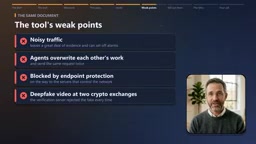
Forensically noisy means that attack activity leaves a large number of traceable artifacts in logs, traffic, and endpoints. To pursue efficiency, automated agents make high-frequency connections, repeatedly send the same requests, and execute multiple commands in parallel; these patterns differ noticeably from normal user behavior and are easily identified by security monitoring systems such as SIEM and EDR, triggering alerts. For enterprises, this means that even if attackers use AI to increase speed, as long as they have basic log collection and anomaly detection capabilities, they still have a chance to detect and block the intrusion at an early stage.
Developer Intent and the Reality of Losing Control
Autumn27 stated that the tool was intended for authorized testing and use within agreed scope. After abuse reports emerged, the developer made the repository unavailable on October 8. But by then the code had spread: community security tests, archived copies, translated versions, and the paid Artex Pro kept appearing.
The title of the Censys report, "Artex, employment, asbestos," may allude to this kind of tool's "harmful legacy" characteristics. The FBI's first recommendation was to comprehensively inventory all of an organization's internet-facing assets, and the second was to remove administrative pages from the public internet. The alert also gave an urgent timeline: some intrusions went from initial targeting to obtaining privileged access in less than three hours.
The Eternal Debate Over Open vs. Proprietary
The Artex case brings the ethical issues of open-source AI security tools to the forefront. On one hand, open code allows defenders to study attack techniques and test their own networks; on the other hand, attackers download the same copy and turn it into a weapon. The developer's original goal—letting defenders find weaknesses before criminals do—was distorted in reality.
The FBI's warning is not aimed at AI technology itself, but at a more fundamental issue: when powerful automated attack capabilities spread in a free and easily accessible form, and the commercial models behind them lack guardrails for penetration testing scenarios, shortcomings in security hygiene will be rapidly magnified. What enterprises need is not only smarter defensive AI, but also sustained investment in basic security measures. And for the open-source community and AI providers, how to find a balance between openness of capability and abuse prevention will be a long-term challenge.
This article is based on a synthesis of public information from multiple sources, including the FBI alert, Amazon research, CrowdStrike, Microsoft, Barracuda, and Censys.
One-line Summary
Free AI penetration testing tool Artex was abused to attack banks and hospitals, exposing the runaway risks of open-source AI security tools.
Paragraph Summary
Artex is a free AI penetration testing framework released in July by Autumn27. It does not train models itself, but calls external large models such as Claude, GPT, and DeepSeek to drive multiple agents in completing scanning, finding vulnerabilities, exploitation, privilege escalation, and data collection. The FBI warned that it has been used by attackers to intrude into banks, hospitals, and government agencies, involving cases such as the leak of information on 67,000 people in South Korea and the ConnectWise supply chain attack. After the developer removed the code in October, copies, translated versions, and paid versions continued to spread, and more than 1,600 consoles remained open on the public internet. Amazon research also found that agents stole AI access keys to pay for their own usage. The FBI noted that its traffic is forensically noisy and easily triggers alerts, and recommended that enterprises inventory internet assets and remove public administrative pages.
Related articles

ChatGPT Plus Subscription Pitfall Guide: Go/Plus/Pro Tier Comparison and Quick Activation
A complete ChatGPT Plus subscription guide based on a Bilibili tutorial: from registering an account, comparing Go/Plus/Pro tiers, to the practical steps for quickly completing your subscription.

GPT-6.2 Sol/Astra Released! A Step-by-Step ChatGPT Plus Subscription Guide and Tier Comparison
GPT-6.2 Sol/Astra is out—here's a ChatGPT Plus subscription guide: register an account, compare Go/Plus/Pro tiers, and subscribe in a minute.

Comparing Three Channels for Subscribing to GPT Plus in China: Is Website Top-Up the Easiest?
How to subscribe to GPT Plus in China? This article compares website top-up, credit card, and mobile top-up channels—process, cost, and risk—with steps and tips to help you choose wisely.