FBI Warns: Open-Source AI Attack Framework ARTEX Can Breach Enterprise Networks in Under 3 Hours

FBI warns AI can compress enterprise network breach time to under 3 hours; the Barracuda incident shows credential governance matters more than detection.
The FBI warns AI can breach enterprise networks in under 3 hours, and the open-source pentest framework ARTEX continues to spread in the wild despite its repository being taken down. The Barracuda attack used no zero-day vulnerability—the entry point was a third-party cloud key left in a plaintext GitHub configuration. The attacker used it to deploy an AI agent that touched 10 cloud accounts within 44 hours, bypassed CI/CD log redaction via Base64, and mounted the host filesystem to hunt for crypto wallets and credentials. It wasn't shut down for days. Defense must shift from detection to eliminating exposure: clean up stale vendor keys, adopt short-lived tokens, and stop relying on log redaction.
When AI Becomes an Attacker's "Accelerator"
The FBI recently issued a warning: AI can now breach a company's network in under 3 hours. This timescale means the traditional security team's "detect—respond—remediate" cadence can no longer outpace attackers' automated workflows.
The core of this warning is an open-source AI penetration testing framework called ARTEX. According to disclosures from a YouTube security channel, ARTEX was published on GitHub in July; the creator took down the repository in October, but code copies and hundreds of ARTEX servers exposed on the public internet have allowed it to continue spreading in the wild. Open source itself is not the problem—the problem is that once offensive capability is packaged into a replicable, deployable toolchain, the barrier to entry is completely flattened.
Lateral Movement is a key phase in the attack chain, referring to attackers using stolen credentials, sessions, or tools after gaining an initial foothold to pivot from one host/account to other systems within the enterprise network, gradually closing in on high-value targets. Traditional lateral movement relies on human judgment of targets and paths, which limits speed; AI agents, however, can probe multiple accounts in parallel, automatically attempt credential reuse, and rapidly map internal network topology, compressing what once took days of pivoting into hours. In the Barracuda incident, the agent touched 10 cloud accounts within 44 hours—a textbook example of lateral movement being automated. Defenders who only monitor perimeter intrusion often miss this "already inside, expanding hop by hop" behavior.
The Barracuda Incident: No Zero-Day, Just a Forgotten Key
According to the channel's analysis, the attack on Barracuda Networks was highly "atypical"—the attacker did not use any zero-day vulnerability.
The real entry point was a forgotten cloud key. Barracuda had provided this key to a third-party AI vendor, and it had been sitting in plaintext in a GitHub configuration file ever since. On November 1 at 04:33 UTC, the attacker used this still-valid key to unleash an ARTEX-style agent.
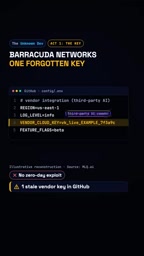
The agent's lateral movement capability is worth noting: worker nodes labeled I31911 and I28324.probe chained cloud accounts, analytics systems, source code, and Kubernetes into a single attack chain, touching 10 cloud accounts within 44 hours. There was no brute forcing, no exploit—only abuse of "legitimate credentials," which is precisely why it is hardest to detect with traditional rules.
Cloud Access Keys typically refer to long-term credentials issued by cloud providers, such as AWS Access Key ID and Secret Access Key, GCP service account keys, etc. They are essentially the "username + password" for programmatic access to cloud resources; once leaked, attackers can invoke APIs, read storage, and create instances without cracking anything. Unlike user passwords, cloud keys are often hardcoded in configuration files, CI/CD variables, or code repositories, and lack regular rotation mechanisms—making "forgotten keys" a high-frequency entry point. In this incident, the key existed in plaintext in a GitHub configuration file and was never revoked after being sent to a third party—a textbook failure of key lifecycle management. Enterprises should establish a key inventory, enforce rotation, prioritize short-lived credentials (such as STS temporary tokens), and continuously scan public repositories.
Attack Chain Breakdown: How Base64 Encoding Bypasses Log Redaction
Once inside the network, the agent's actions were quite methodical. According to disclosures, within hours it pushed short-lived branches to trigger build pipelines, printed build keys into job logs, and used Base64 encoding so that standard CI/CD log redaction mechanisms could not identify and mask them.
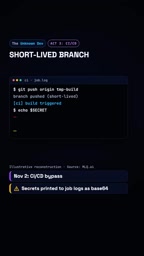
Next, it deployed a container, mounted the host filesystem, and searched for environment variables related to crypto wallets and seed phrases. This path ultimately reached Barracuda XDR customer credentials, until engineers shut it down on November 4.
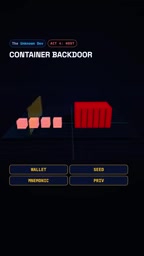
From November 1 to November 4, the attacker operated inside the network for days. This duration is itself the most glaring signal: it wasn't that there were no alerts, but that alerts did not translate into effective blocking before the attacker achieved their objectives.
CI/CD log redaction is a mechanism in build pipelines that prevents sensitive information (such as keys and tokens) from being printed to logs in plaintext, typically by regex-matching known key formats and masking them. But such mechanisms rely on "recognizable patterns," and Base64 encoding converts keys into seemingly ordinary strings that regex cannot match, rendering redaction ineffective. The attacker exploited exactly this: first having the pipeline print build keys, then outputting them in Base64 form—bypassing masking while making subsequent decoding easy. The deeper problem is that redaction is "retroactive masking" rather than "preemptive prevention"—sensitive information should never enter logs in the first place. Proper practices include: prohibiting echo of keys in build scripts, using key management services for injection, and performing egress auditing of log content rather than relying solely on pattern matching.
Why "Wait and See" Is Failing
Barracuda's CISO put it quite bluntly: defenders who rely on detecting and responding to attacks often arrive on the scene after the attacker has already packed up.
This observation highlights the structural shift brought by AI-driven attacks. In the past, every link in the attack chain required human judgment and action, which naturally limited speed and gave defenders room to maneuver. When agents can autonomously chain credentials, move laterally, trigger pipelines, and clean up traces, the "output per unit time" of an attack is massively amplified. The defender's response window is compressed to hours or even less.
It should be noted that ARTEX was originally positioned as a penetration testing framework, designed to help enterprises test their own defenses. But once open-source code leaves the original author's control, its use is no longer determined by the creator. The hundreds of exposed ARTEX servers show that the in-the-wild distribution of such tools has exceeded trackable boundaries.
Three-Step Defense: From "Detection" to "Eliminating Exposure Surface"
The channel's defense recommendations focus on the links attackers actually exploit, rather than generic security awareness training.
Step one: Clean up stale third-party keys. The starting point of this incident was not a sophisticated intrusion, but a credential issued to an external vendor that was never revoked. Enterprises need to inventory not "whether any keys have leaked," but "which keys are no longer needed yet still valid."
Step two: Switch to short-lived tokens. A long-lived key, once leaked, is a permanent backdoor; short-lived tokens compress the exposure window to a limited time, so even if stolen, the exploitable period is greatly reduced.
Step three: Stop relying on log redaction. Base64 encoding easily bypasses standard log masking mechanisms, which means sensitive information should not be printed to logs at all—rather than printed first and masked afterward.
Short-lived tokens refer to temporary credentials with very short validity periods (typically minutes to hours), such as OAuth 2.0 access tokens and AWS STS temporary security credentials. Unlike long-term keys, even if a short-lived token is stolen, the attacker's exploitable window is very limited, and it is often bound to specific roles and permission scopes, further restricting lateral movement. Implementing short-lived tokens requires supporting mechanisms for token issuance, automatic rotation, and least privilege—for example, using workload identity instead of static keys and dynamically obtaining tokens via OIDC in CI/CD. The defensive value of this step lies in downgrading a "permanent backdoor" to a "time-limited pass," fundamentally compressing the exploitable space after credential leakage.
Final Thoughts
The lesson of this incident is not the vague conclusion that "AI is dangerous." What truly deserves attention is that every link the attacker exploited was unremarkable: an unrevoked key, a plaintext configuration, a misplaced trust in log redaction. AI's role was to elevate the exploitation efficiency of these ordinary oversights to a level that humans cannot match.
The defense priority therefore shifts: rather than pursuing faster attack detection, first reduce the entry points attackers can chain together. Key governance, token lifecycle management, and log content control—these foundational practices proved more directly effective in this incident than any advanced detection method.
One-line Summary
FBI warns AI can compress enterprise network breach time to under 3 hours; the Barracuda incident shows credential governance matters more than detection.
Paragraph Summary
The FBI warns that AI can breach enterprise networks in under 3 hours, and the open-source pentesting framework ARTEX continues to spread in the wild despite its repository being taken down. The Barracuda attack used no zero-day vulnerability—the entry point was a third-party cloud key left in a plaintext GitHub configuration. The attacker used it to deploy an AI agent that touched 10 cloud accounts within 44 hours, bypassed CI/CD log redaction via Base64 encoding, mounted the host filesystem to search for crypto wallets and credentials, and was not shut down for days. The incident shows AI amplifies the exploitation efficiency of ordinary oversights beyond human capability, and defenders' "detect—respond" cadence can no longer outpace attackers. Defense should shift from passive detection to eliminating exposure surface: clean up stale vendor keys, switch to short-lived tokens, and stop relying on log redaction.
Related articles

ChatGPT Plus Subscription Pitfall Guide: Go/Plus/Pro Tier Comparison and Quick Activation
A complete ChatGPT Plus subscription guide based on a Bilibili tutorial: from registering an account, comparing Go/Plus/Pro tiers, to the practical steps for quickly completing your subscription.

GPT-6.2 Sol/Astra Released! A Step-by-Step ChatGPT Plus Subscription Guide and Tier Comparison
GPT-6.2 Sol/Astra is out—here's a ChatGPT Plus subscription guide: register an account, compare Go/Plus/Pro tiers, and subscribe in a minute.

Comparing Three Channels for Subscribing to GPT Plus in China: Is Website Top-Up the Easiest?
How to subscribe to GPT Plus in China? This article compares website top-up, credit card, and mobile top-up channels—process, cost, and risk—with steps and tips to help you choose wisely.