FCC Relaxes Foreign Ownership Rules: The Double Standard Controversy in the Paramount Merger
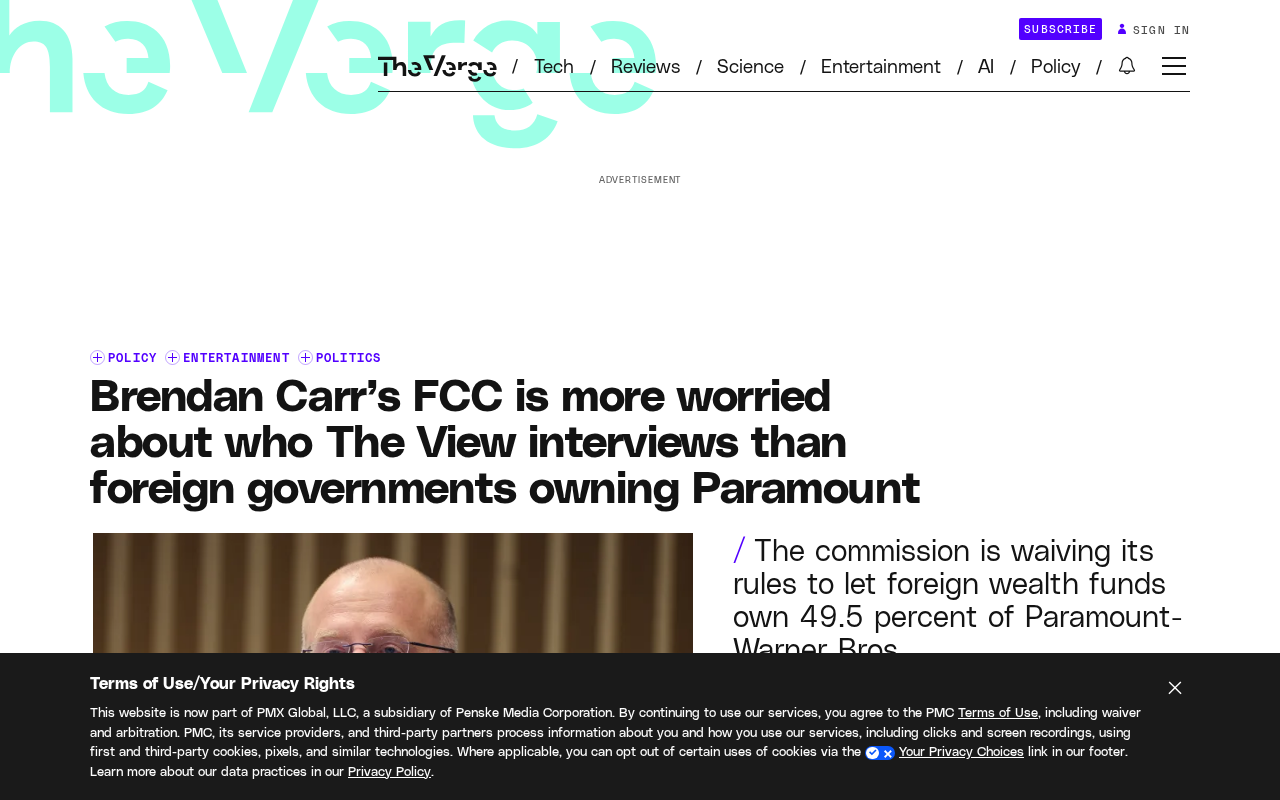
FCC lets three foreign sovereign funds hold nearly half of Paramount while cracking down on domestic TV content.
The FCC recently approved sovereign wealth funds from Saudi Arabia, Qatar, and Abu Dhabi to collectively hold 49.5% of the Paramount-Warner Bros. merged entity, far exceeding the 25% foreign ownership cap it has long enforced. At the same time, under Chairman Brendan Carr, the FCC has repeatedly pressured domestic broadcasters like ABC over program content, even scrutinizing the guest lists of *The View*. This inverted regulatory logic — waving through structural risks while frequently intervening on content — has sparked widespread questions about the FCC's credibility and motivations.
The Federal Communications Commission (FCC) recently announced it will grant a waiver of its 25% foreign ownership cap in the Paramount-Warner Bros. deal, allowing three sovereign wealth funds operated by the governments of Saudi Arabia, Qatar, and Abu Dhabi to collectively hold 49.5% of the combined entity. The decision has triggered widespread questions about the FCC's regulatory consistency.
An Unusual Rule Waiver
For decades, the FCC has maintained a clear foreign equity ceiling for companies holding broadcast licenses — a single foreign entity is generally prohibited from owning more than 25%. The rule was designed to prevent foreign governments or interest groups from exerting undue influence over American media content and public discourse.
In the Paramount-Warner Bros. case, however, the FCC chose to move that line significantly, raising the foreign ownership threshold to 49.5% — nearly equal control. What makes this even more notable is that the approved investors are not ordinary commercial entities, but sovereign wealth funds directly operated by the governments of Saudi Arabia, Qatar, and Abu Dhabi. This means foreign governments will hold near-parity equity influence over a major American media conglomerate.
The FCC's foreign ownership rules derive from the Communications Act of 1934. Its core provisions prohibit foreign individuals or entities from directly holding more than 20% of a broadcast licensee, and foreign parent companies from indirectly holding more than 25%. This threshold is not absolute — the FCC has waiver authority and can approve stakes above these limits when it determines doing so serves the "public interest." The FCC has exercised this power several times historically, but typically for non-governmental commercial investors, and never with a waiver of this magnitude. Jumping directly to 49.5% for three sovereign funds simultaneously is unprecedented in both scale and nature.
A Misalignment of Regulatory Priorities
The core contradiction critics point to is a fundamental imbalance in regulatory priorities. Under FCC Chairman Brendan Carr, the agency has repeatedly threatened broadcast networks like ABC, including pressure over specific program content — which guests appeared on the talk show The View and what positions they expressed have become subjects of FCC scrutiny.
This contrast forms the crux of the criticism: the FCC appears more concerned with which guests appear on a talk show than whether foreign governments hold substantial ownership stakes in American media companies. When a regulator scrutinizes domestic media speech down to the finest detail while simultaneously throwing open the doors to foreign sovereign capital, the coherence of its regulatory logic naturally comes into question.
Two Sets of Standards: Content Regulation vs. Structural Regulation
From a regulatory philosophy standpoint, the FCC's mandate should encompass two dimensions: preserving the independence of media ownership structures and national security, and handling content-related matters cautiously within the constitutional framework. In theory, the former — preventing foreign government ownership — represents a structural, systemic risk that should face stricter scrutiny. The latter — which guests a program interviews — touches on the sensitive territory of free speech, where regulators should exercise restraint.
Yet the actual practice presents the opposite picture: structural risks are waved through while content-level interventions occur frequently. This inversion has fueled speculation about the motivations behind regulatory decisions.
Brendan Carr assumed the FCC chairmanship in January 2025 and is widely seen as an advocate for strengthening content regulation and tightening restrictions on media deemed "biased." Under his tenure, the FCC launched an investigation into Disney-owned ABC over programs including The View, applying pressure on "Fairness Doctrine"-related grounds, drawing sharp criticism from press freedom advocates. ABC reportedly settled a defamation lawsuit originally filed by President Trump for $7 million, widely seen as a move to avoid regulatory risk. This series of actions has led outside observers to interpret the FCC's current content regulation behavior as selective enforcement with political intent — and it is against this backdrop that the contrast presented by the foreign ownership waiver appears particularly stark.
The Deeper Concerns About Sovereign Wealth Fund Ownership
Allowing foreign governments' sovereign funds to hold nearly half of a major media company carries implications that go well beyond ordinary financial investment. Sovereign wealth funds represent state interests, and their investment decisions are difficult to fully disentangle from political considerations. When such capital enters the media sector — which plays a role in shaping public opinion — the potential for soft influence warrants serious concern.
Media companies are not merely commercial entities; they serve functions in information dissemination and public agenda-setting. Foreign governments gaining indirect influence over content production pipelines through capital penetration could, over the long term, gradually shift editorial tendencies, story selection preferences, and even value orientations — not necessarily through direct intervention, but quietly, through personnel decisions, budget allocations, and strategic direction.
A Sovereign Wealth Fund (SWF) is a state-owned investment fund established by a national government, capitalized by sovereign wealth such as foreign exchange reserves, commodity export revenues, or fiscal surpluses. Saudi Arabia's Public Investment Fund (PIF), the Qatar Investment Authority (QIA), and the Abu Dhabi Investment Authority (ADIA) are among the world's largest sovereign funds, collectively managing assets exceeding $2 trillion. Unlike private equity funds, sovereign funds' ultimate principals are national governments, and their governance structures often include politically appointed board members. The Committee on Foreign Investment in the United States (CFIUS) is responsible for reviewing national security implications of foreign acquisitions, but broadcast license approvals fall under FCC jurisdiction. The two agencies' review frameworks and standards do not fully overlap — a regulatory gap that is particularly salient in this case.
What This Decision Reveals
The issues exposed by the Paramount case are fundamentally about the tension between principle and practice in media regulation. Rules exist to serve clear public interest objectives — and when rules can be broadly waived in individual cases while regulatory energy is concentrated on far more legally contentious content matters, the credibility of the regulator suffers.
For observers tracking the media landscape and technology policy, this episode offers a window into how regulatory agencies navigate the competing pressures of commercial interests, geopolitics, and free expression. It also serves as a reminder that changes in media ownership structures often carry far deeper and more lasting consequences than the surface-level content controversies that tend to dominate headlines.
(Note: This article is based on publicly available reporting. The final structure of the transaction and related regulatory review remain subject to change.)
Related articles

WorkBuddy Full Tutorial: Build an AI Office Automation Agent from Scratch
A complete WorkBuddy tutorial: installation, three working modes, multimodal picture book video practice, expert team agent building, and workflow configuration for low-cost AI office automation.

WorkBuddy Agent Complete Guide: From Beginner to Automation in 7 Days
Based on Bilibili's 256-episode WorkBuddy masterclass, this systematically breaks down Tencent's AI office workbench core capabilities: Agent principles, Skill encapsulation, cross-platform connectors, scheduled automation, knowledge bases, and zero-code development, with learning path recommendations.

8 AI Accounts, 7 Failed: An Honest Review of Using AI to Get Work Done
Only 1 of 8 AI-run Bilibili accounts succeeded. We break down the real difference between "performing AI" and "using AI to get work done."