FDE (Forward Deployed Engineer): The Human Bridge for AI Implementation — A Beginner's Guide

FDEs are composite engineers who work on-site at client locations to get large models truly running in enterprise business.
The article introduces FDE (Forward Deployed Engineer), an emerging role: they are sent to client sites to write code and truly implement AI systems that work in demo environments but frequently stall in clients' real environments. The biggest difference between FDEs and regular engineers is who they face — not requirements documents handed over by product managers, but clients who can't articulate what they want — so they need large model engineering capability, independent on-site troubleshooting ability, and business communication skills. The model originates from Palantir's on-site delivery practices serving government and intelligence agencies, and now OpenAI, Anthropic, as well as domestic SenseTime and Volcano Engine, are building similar teams. The article argues that as enterprises purchase large models but get stuck at the last mile, this path is worth evaluating for those who want to enter the AI industry.
FDE (Forward Deployed Engineer): The Human Bridge for AI Implementation — A Beginner's Guide
A product manager hands you a requirements doc. You pull three all-nighters to build it, and after launch the client says, "This isn't what I wanted," and sends it straight back. When you ask what they actually want, the client can't quite explain it themselves. This scenario is common in traditional software delivery, but when deploying large models in enterprises, it gets magnified tenfold — because the tech is more of a black box, the environment is more complex, and the client understands even less.
According to this tutorial analysis from a Bilibili creator, the solution to this contradiction is a new role that has emerged in recent years: FDE (Forward Deployed Engineer). It sends people directly to the client site to write code, getting AI out of the demo environment and truly running in the enterprise's real business.
What Exactly Is an FDE?
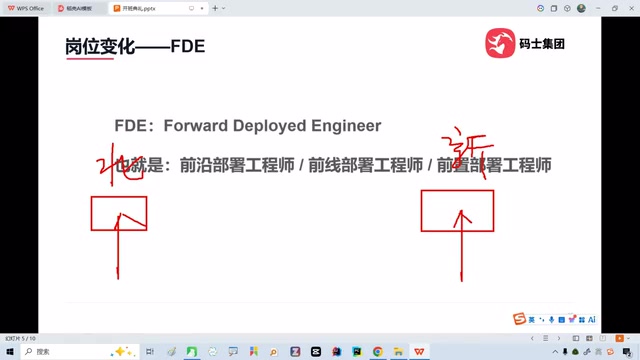
FDE is translated into Chinese in several ways — 前沿部署工程师, 前线部署工程师, 前置部署工程师 — and the term originates from military terminology: deploying personnel directly to the front lines.
In the AI delivery context, the picture looks like this: the R&D team is in Beijing, and the client is 3,000 kilometers away in Xinjiang. R&D has built an impressive AI system, but at the client site it just won't run — data won't connect, the environment conflicts, and during remote communication both sides blame each other. At this point, someone is sent to be on-site, working alongside the client, attending meetings together, eating together, confirming requirements on the spot, modifying code on the spot, and showing the client the results on the spot. This person is the FDE.
So the core positioning of an FDE can be summed up in one sentence: a human bridge between AI models and enterprise business, the person who truly helps enterprises ground large models in reality. Many traditional enterprises have no AI or large model capabilities at all. What they need isn't a set of remote documentation — it's someone who can be on-site and get the whole thing running.
The Essential Difference Between FDEs and Regular Engineers
The biggest divide between the two isn't the tech stack — it's who they face.
Regular engineers write code at their own company. Requirements are organized into documents by product managers and handed over. Delivering according to the document and going through the email process is enough. They face "requirements." FDEs write code at the client site. They have to dig requirements out of the client's fragmented comments themselves, show results directly when done, and fix immediately if it doesn't work well. They face "people."
This difference determines that FDEs need composite skills: they must understand large model deployment and engineering implementation, and also be able to converse with clients from different backgrounds, translating vague business pain points into technical solutions. The creator's judgment in the video is that regular engineers go through the process and leave after delivery, while FDEs are the nail that binds technology and business together.
Origin of the Role: Palantir's On-Site Model
The concept of FDE first came from the software company Palantir. The company initially served government departments and intelligence agencies. The nature of its clients made remote collaboration nearly impossible — classified environments are mostly intranets, where you can't casually send emails, make phone calls, or hold remote meetings. The problems themselves were also extremely complex, and sitting at a distance, you simply couldn't imagine what would happen on site.
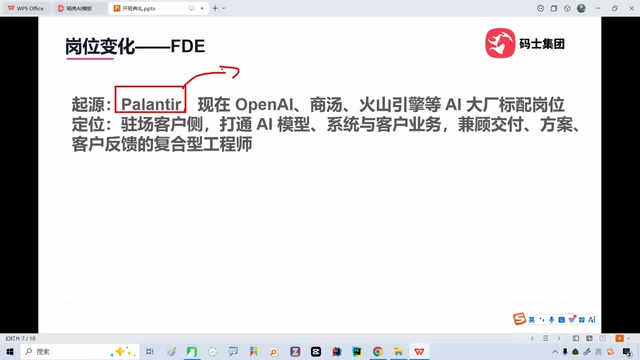
So Palantir sent engineers directly there. It turned out that on-site engineers not only solved problems but also brought client pain points back to the product team, making the product better and better. This model was solidified, and these people got their own name — FDE.
Palantir was founded in 2003, initially backed by investments from early PayPal members such as Peter Thiel. Its early core product was the Gotham platform for government and intelligence agencies, followed by Foundry for commercial clients. Its clients are mostly defense, intelligence, law enforcement, and other classified units, with highly sensitive data and closed IT environments, which directly gave rise to the "engineers deliver on-site" way of working. Internally, Palantir once called this role "Delta," but the industry's more common term later became FDE. It's worth noting that Palantir's FDEs are not simply implementation outsourcers. They usually have strong software engineering backgrounds, and the code they write on-site feeds back into the product itself, forming a closed loop of "discover on-site — iterate the product." This is also why the model has been widely borrowed.
Why Are the Big Players All Rushing to Hire FDEs?
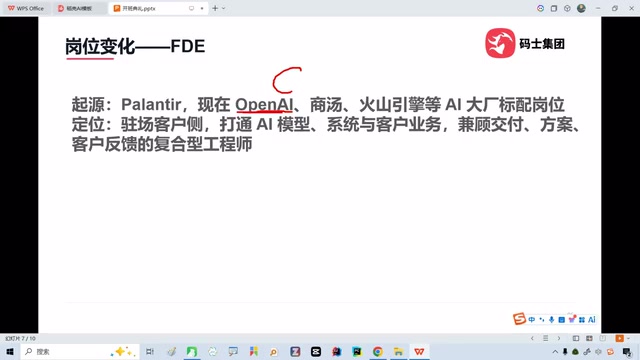
Once the model was validated, many followed suit. According to the video, OpenAI sends people to large enterprises to deploy large models on-site, Anthropic (the company behind Claude) also uses on-site deployment to help clients implement, and domestically SenseTime, Volcano Engine, and others are also vigorously building FDE teams.
The underlying logic of growing demand is simple: no matter how well a large model runs in a demo environment, in the client's real environment it may be a different story. Environment configuration, data access, permission isolation — any one link getting stuck can cause the system to fail to run, and only someone on site can locate and resolve it. This also explains why hiring demand for this role has multiplied over the past year — searching for FDE or 前沿部署工程师 on recruitment platforms reveals quite attractive salary levels.
How to Break Into This Direction from Zero
Based on the video content, if you want to transition to FDE, you can start with three areas of capability:
First, large model engineering capability. At minimum, master model API calls, RAG retrieval augmentation, and the basic process of private deployment, and be able to independently get an AI system running in an unfamiliar environment.
Second, on-site troubleshooting capability. FDEs often face non-standard environments, with pitfalls everywhere in networks, data, and permissions. You need the confidence to troubleshoot solo without relying on remote support.
Third, business communication capability. It's normal for clients to be unable to articulate requirements. The value of an FDE lies in extracting real pain points from conversations and responding on the spot with a runnable prototype.
Interviews usually revolve around real delivery scenarios, testing how you handle typical dilemmas such as environment incompatibility and repeated requirement changes. The video author suggests treating such scenario questions as a key preparation focus.
RAG (Retrieval-Augmented Generation) is currently one of the most mainstream technical routes for enterprises to implement large models: it first retrieves fragments relevant to the question from the enterprise's own documents and databases, then feeds these fragments as context to the large model to generate an answer. Compared with directly fine-tuning a model, RAG does not require retraining weights; updating knowledge only requires updating the index, making it more suitable for enterprise scenarios with frequently changing data and requirements for answer traceability. Private deployment refers to deploying model weights and inference services in the client's own data center or dedicated cloud, so data does not leave the intranet, meeting compliance requirements in industries such as finance and government. These two capabilities, plus basic API calls and prompt engineering, basically constitute the technical foundation for an FDE at entry; on-site troubleshooting often also involves containerized deployment, network proxies, and integration with identity authentication systems, which need to be accumulated gradually in real projects.
A New Track Worth Watching
An FDE is not traditional pre-sales, nor an ordinary developer. It is a role redefined in the AI era's delivery chain. As more and more enterprises purchase large models but get stuck at the last mile, people who can truly land technology in business become scarce resources. For those who want to enter the AI industry but are deterred by the high threshold of algorithms, the cost-effectiveness of this path is worth serious evaluation.
Related articles

Amphibious Transforming Drone: Beyond 100x Power Savings, What Are the Real Needs?
Is the amphibious transforming drone just a gimmick? Starting from the 100x power difference of the M4 Morphobot, explore real application scenarios and thesis topic ideas, analyzing boundary conditions where pure drones and pure ground robots both fail.

Warhound Raises $200 Million: Genetically Engineered "War Dogs" Paired with Anduril Gear
Warhound raises $200M, backed by Ben Lamm and Palmer Luckey, to genetically engineer dogs for military and law enforcement use and equip them with Anduril gear. This article analyzes its technology direction, funding logic, and ethical controversy.

Claude API Comes to Google Cloud: IAM Integration and SDK Access Guide
Anthropic hosts the full Claude API on Google Cloud with IAM-controlled permissions and unified billing. This guide covers the Vertex AI and Anthropic-hosted entry points, IAM role configuration, and SDK access.