FDE (Forward Deployed Engineer): The New AI Implementation Role Commanding $30K-$1M Salaries — A Complete Breakdown
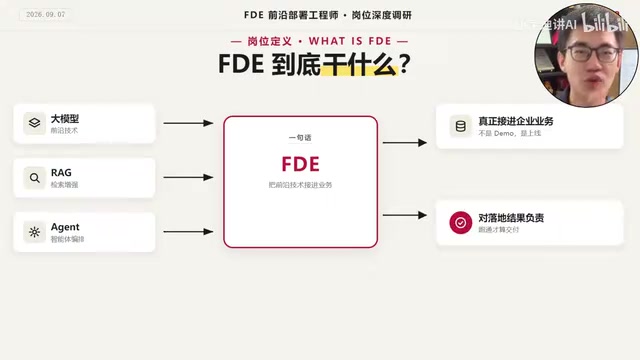
FDE engineers bridge the gap between AI capability and business value, commanding premium salaries.
As AI model costs plummet, professionals who can actually implement large models in enterprise settings — Forward Deployed Engineers (FDEs) — are commanding salaries from $30K monthly to $1M+ annually. FDEs combine AI engineering, software development, business acumen, and delivery accountability. They master RAG, Agents, and MCP while building production-grade systems with proper monitoring, evaluation, and fallback mechanisms. The role suits experienced backend engineers, AI developers, or solution architects ready to fill capability gaps.
The Cheaper AI Gets, The More Expensive Implementation Talent Becomes
The AI industry is witnessing a seemingly paradoxical phenomenon: as large language model API costs continue to plummet with providers slashing prices repeatedly, professionals who can actually integrate these models into enterprise operations are commanding increasingly higher salaries. This isn't actually contradictory — technology accessibility and implementation capability are fundamentally different things.
The API Price War and Model Commoditization
API (Application Programming Interface) is a standardized interface enabling interaction between software systems. In the AI domain, large model providers offer model access services through APIs — developers simply send HTTP requests to receive model outputs without deploying models themselves.
In recent years, providers like OpenAI, Anthropic, and Google have continuously reduced prices, with GPT-4 API costs dropping over 90% between 2023-2024. The price war among Chinese providers like Alibaba's Tongyi Qianwen, Baidu's Wenxin Yiyan, and ByteDance's Doubao has been even more intense, with some scenarios seeing costs fall below 1 RMB per million tokens. This price war reflects optimized compute costs, improved model inference efficiency, and intensified market competition. Model capability commoditization lowers technical barriers but also means simple API calling ability no longer creates competitive moats.
As models become more capable and affordable, enterprises have greater incentive to integrate them into business processes. But between "being able to call an API" and "making AI stably generate value in real business scenarios" lies an enormous gap. Those who bridge this gap are earning significant market premiums. These professionals have an increasingly popular title: FDE (Forward Deployed Engineer).
According to analysis from relevant Bilibili content creators, many domestic FDE positions already offer monthly salaries of 30K-40K RMB, with senior positions reaching annual packages of 500K-600K or even million-level compensation. So what makes forward deployed engineers worth this money?
What Do FDE Forward Deployed Engineers Actually Do?
In one sentence: Take cutting-edge technologies like large models, RAG, and Agents and actually integrate them into enterprise operations, being accountable for implementation results.
The key phrase here is "accountable for results." Being able to call APIs or build an Agent demo using frameworks is just entry-level. Real FDEs don't deliver demonstrable demos — they deliver systems that can go live, run stably, be debugged when issues arise, and genuinely improve efficiency or reduce costs.
This is why FDE is fundamentally a composite role — it's a combination of AI Engineer + Product Manager + Technical Consultant + Project Lead. It requires both engineering hard skills and understanding of business and delivery. This composite nature is the fundamental reason FDE positions are scarce and expensive.
Four Core Competencies Needed to Become an FDE
First: AI Application Development Capability
Technology stacks like large model APIs, RAG, Agent, Function Calling, and MCP are basic skills you must master. But more important than "knowing how to use them" is "knowing how to judge" — when to use RAG, when to deploy an Agent, when a simple workflow suffices.
RAG Technology Principles and Applications
RAG (Retrieval-Augmented Generation) is a technical architecture combining external knowledge bases with large models. Its workflow typically includes: 1) splitting enterprise documents and knowledge bases into chunks and converting them to vector embeddings; 2) storing them in vector databases (like Pinecone, Milvus, Qdrant); 3) when users ask questions, first retrieving relevant document fragments; 4) inputting retrieved results along with user questions to the large model to generate answers.
RAG effectively addresses large models' knowledge currency and domain knowledge gaps, particularly suitable for enterprise internal knowledge Q&A, customer service systems, and intelligent document analysis scenarios. However, RAG system effectiveness heavily depends on engineering details like document chunking strategies, retrieval algorithm selection, and context window management — these are the critical differences between demos and production systems.
Agent Intelligence and Multi-Agent Systems
Agents are AI systems that can perceive their environment, make autonomous decisions, and execute actions. In the large model context, Agents typically refer to application architectures capable of calling tools/functions, performing multi-step reasoning, and autonomously planning tasks. Typical Agent frameworks include LangChain, AutoGPT, and MetaGPT.
Multi-Agent systems involve multiple Agents with different roles collaborating on complex tasks. For example: a code generation Agent, code review Agent, and testing Agent working together on software development. However, multi-Agent systems introduce higher complexity: inter-Agent communication protocols, task allocation strategies, error propagation issues all require careful design. In many real scenarios, a well-designed workflow is actually more stable and controllable than overly complex multi-Agent systems.
Function Calling and Tool Invocation Mechanisms
Function Calling is a critical capability OpenAI introduced in 2023, allowing large models to automatically select and call predefined external functions or APIs based on user intent. For example, when users ask "What's the weather in Beijing today?", the model can recognize it needs to call a weather query API, generate API-compliant parameters (city=Beijing), and integrate returned results into natural language responses.
This technology transforms large models from pure text generators into intelligent agents capable of operating external systems. Mainstream models like GPT-4, Claude 3, and Gemini 1.5 all support Function Calling. In enterprise applications, this means AI can directly query databases, call business system APIs, and control workflows, not just answer questions. However, Function Calling reliability, error handling, and permission control still require careful design in production environments.
MCP Model Context Protocol
MCP (Model Context Protocol) is an open standard Anthropic launched in 2024, aimed at standardizing how large models connect with external data sources and tools. Traditionally, each application needed to write customized integration code for specific models; MCP provides a unified interface specification.
MCP defines three core abstractions: Resources, Tools, and Prompts, enabling developers to write integration code once that allows multiple MCP-supporting models to access the same data sources and tools. This is analogous to how the USB standard unified hardware interfaces. For FDEs, mastering MCP means building more efficient, reusable, maintainable AI integration systems rather than reinventing the wheel for each project. Currently Claude and some open-source models support MCP, and it's expected to become foundational infrastructure for enterprise AI applications.
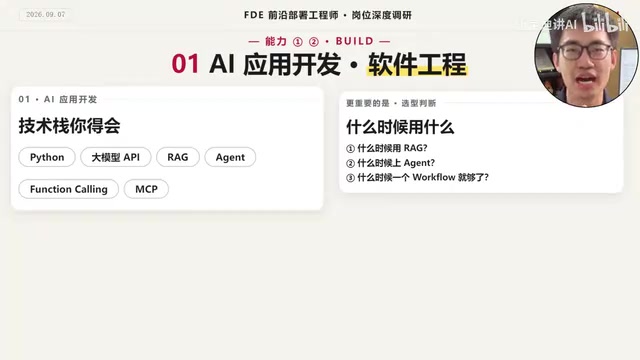
Many fall into the trap of technical showing-off, deploying multi-Agent collaboration at the drop of a hat, but in real scenarios, a deterministic workflow is often more stable, controllable, and cost-effective than complex Agents. Judgment in technology selection is the core value at this level.
Second: Solid Software Engineering Capability
Enterprises don't want scripts that "run once" — they want systems that can go live, run stably, and be debugged when issues arise. This means FDEs must possess solid software engineering capabilities:
- API design and databases
- Docker containerization and cloud deployment
- System integration
- Logging and monitoring
Containerization and Cloud-Native Deployment
Docker containerization technology packages applications and their dependency environments into independent container images, ensuring code that "runs on my machine" runs stably in any environment. This is especially important for AI applications, as large model applications often depend on specific Python library versions, vector databases, GPU drivers, and other complex environments.
Cloud deployment involves deploying containerized applications to cloud platforms like AWS, Azure, or Alibaba Cloud. Common approaches include: using Kubernetes for container orchestration, configuring load balancing, setting up auto-scaling, managing secrets and environment variables. For FDEs, this isn't just a technical requirement but relates to cost control — AI application GPU resources and model calling fees aren't cheap, and proper deployment architecture can reduce costs by 50% or more. Additionally, cloud deployment must consider enterprise-grade security requirements like data security, network isolation, and access control.
Building Observability for AI Systems
Observability refers to understanding system internal state through logs, metrics, and distributed tracing. For AI systems, this is more challenging than traditional software: you need to know not just whether API calls succeeded, but also model output quality, whether reasoning chains are normal, and whether costs exceed budget.
Typical AI system monitoring includes: 1) request-level logs (user input, model output, latency); 2) business metrics (answer accuracy, user satisfaction, task completion rate); 3) cost monitoring (token consumption, API fees); 4) anomaly detection (output format errors, tool call failures, timeouts). Mature AI teams use professional tools like LangSmith, LangFuse, Weights & Biases, or build monitoring systems based on ELK and Prometheus. AI systems without observability are black boxes — when issues arise, you can only restart and pray, which is unacceptable in enterprise environments.
This capability level completely separates "hobbyist AI enthusiasts" from "engineers who can deliver production systems."
Third: Enterprise-Grade AI Engineering Capability
This is where the gap between demos and real projects is greatest, and represents FDEs' core competitive advantage. In real projects, you must answer a series of tough questions:
- What if the model gets it wrong?
- What if tool calls fail?
- How do you control permissions, costs, and latency?
- How do you do evaluation, monitoring, and human fallback?
AI System Evaluation Framework
Evaluation is the most underestimated yet most critical aspect of AI engineering. Traditional software can ensure quality through unit and integration testing, but large model outputs have randomness — the same input may produce different outputs. How do you evaluate whether an AI system is "good"?
Evaluation typically divides into offline and online evaluation. Offline evaluation includes: building test sets, defining evaluation metrics (accuracy, recall, F1 score), using stronger models as judges (LLM-as-a-Judge). Online evaluation includes: A/B testing, user feedback collection, manual sampling. Mature FDEs establish continuous evaluation processes for each project: re-running evaluations after every model upgrade, prompt adjustment, or RAG strategy change to ensure improvements are genuinely effective. AI projects without evaluation frameworks are like blind driving — you never know if you're improving or regressing.
These issues are almost never exposed at the demo stage but are critical to project success or failure in production environments. Enterprise-grade AI engineering capability is fundamentally about providing fallbacks for AI system "uncertainty."
Fourth: Business Understanding and Delivery Capability
Finally, the layer most easily overlooked by technical people: you need to understand what problem the client actually wants to solve, judge whether this scenario should use AI, and ultimately whether it can genuinely improve efficiency or reduce costs.

Many AI projects fail not because the technology doesn't work, but because they used the wrong scenario from the start — forcing problems unsuitable for AI onto AI. FDE value lies in making correct judgments at the source, preventing teams from investing resources in wrong directions.
Who Is Better Suited to Transition to FDE Forward Deployed Engineer?
From the capability structure, FDE currently leans toward mid-to-senior level positions with high requirements for comprehensive experience, not suitable for complete beginners with zero background.
If you have the following backgrounds, transitioning to FDE will be more advantageous:
- Backend Engineers: Already possess software engineering and system deployment capabilities
- AI Application Developers: Familiar with large model technology stacks
- Solution / Project Delivery Personnel: Understand business, clients, and delivery
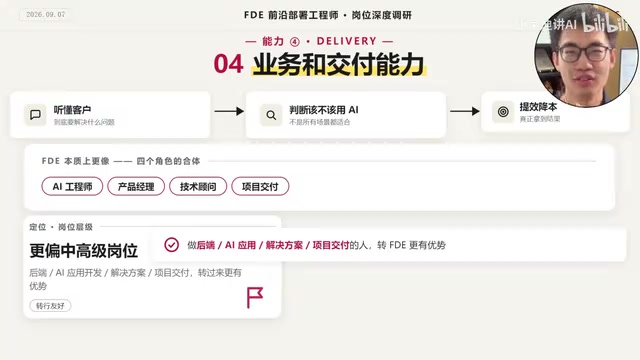
These roles only need to fill in the one or two missing pieces of their puzzle to quickly enter the FDE track, rather than learning from scratch.
What Determines FDE Compensation Isn't Framework Count, But Implementation Capability
One final key insight worth remembering for anyone wanting to enter this field: What truly determines your worth isn't how many frameworks you know, but whether you can actually execute a complete enterprise-grade engineering implementation project.
This means rather than stacking dozens of framework names on your resume, it's better to solidly complete one full-cycle project from requirements analysis, technology selection, development and deployment, to monitoring and fallbacks. Being able to prove your "accountability for results" implementation capability is the true pricing anchor for FDE positions.
In today's era of rapidly democratizing large model technology, pure "ability to call" is rapidly depreciating, while "ability to implement" value is rapidly appreciating. FDE's explosive popularity is essentially a signal that the AI industry is moving from the "model competition" phase to the "value realization" phase.
Key Takeaways
Related articles

GPT-6 Astra Completes All 48 Levels of 'I'm Not A Robot' Game
GPT-6 Astra successfully completes all 48 levels of the 'I'm Not A Robot' game, demonstrating remarkable visual understanding, logical reasoning, and task adaptation. This article analyzes the technical capabilities behind this breakthrough and its implications for CAPTCHA verification and AI safety.
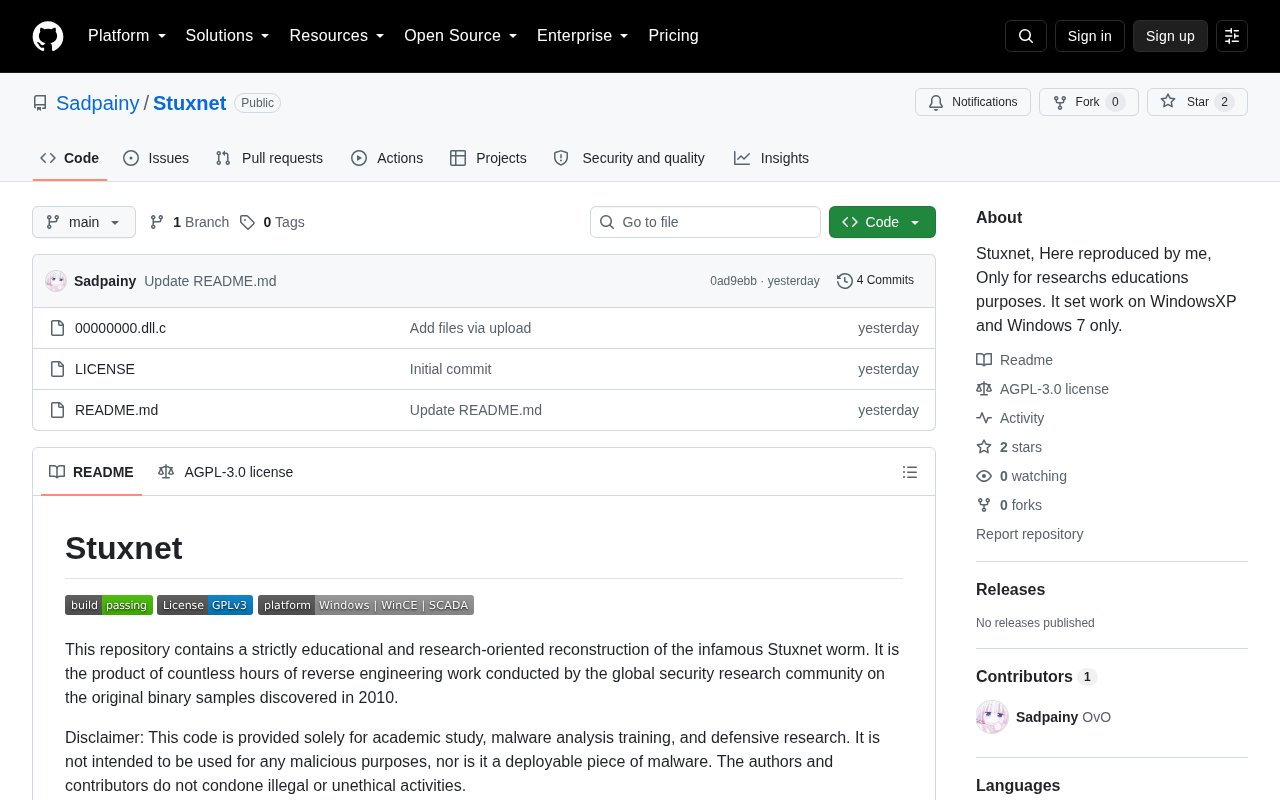
Stuxnet Source Code Reconstruction: Dissecting the Attack Chain of History's Most Complex Cyber Weapon
In-depth analysis of the Stuxnet source code reconstruction open-source project, examining how this cyber weapon targeting Iranian nuclear facilities exploited four zero-day vulnerabilities, stole digital certificates, covertly manipulated PLC centrifuges, and exploring industrial security lessons and ethical controversies of open-source reconstruction.

Minimalist Aesthetic Puzzle Game Development: Insights from Independent Creation
An in-depth analysis of an independent developer's aesthetic puzzle project shared on Hacker News, exploring minimalist design philosophy, Show HN community culture, and aesthetics-first product thinking in independent development.