FDE Forward Deployment Engineer: A New Species in the AI Era and Practical Implementation Analysis

FDE is a new on-site role for AI enterprise deployment that bridges products and needs with reusable productization and end-to-end capabilities.
FDE (Forward Deployment Engineer) first emerged from Palantir's practice of serving government clients. The core is to station engineers on site with a reusable productized foundation to solve customers' personalized needs. In the era of large AI models, changes in the input-output ratio have made this model popular again: on-site deployment and tuning can directly produce verifiable results, so enterprises are willing to pay for deep services. FDE also has product manager responsibilities and needs to understand business end-to-end and translate it into AI solutions. Technically, it is recommended to start with AI Agent development or private deployment and gradually go deeper into fine-tuning, distillation, and pretraining, with increasing difficulty. The biggest pitfall in enterprise deployment is that the value of fine-tuning is difficult to verify, which is essentially a business return problem, not a purely technical one.
FDE Forward Deployment Engineer: A New Species in the AI Era and Practical Implementation Analysis
When large AI models are deployed in enterprises, there is always a gap between the technical team and customer needs. FDE (Forward Deployment Engineer) is the role born to fill this gap. Based on the sharing by Bilibili creator Teacher Li Jin, this article systematically reviews the origins, core capabilities, and practical implementation key points of FDE.
What Exactly Is FDE? Starting from Palantir
FDE stands for Forward Deployment Engineer. This position was first created at Palantir—a company that does intelligence analysis for the CIA. When serving government clients, Palantir found that standardized products were often designed by programmers making guesses in the office, and customer needs were severely distorted after being relayed through multiple layers. So they changed their approach: instead of making a universal product, they built a deeply customizable platform and sent their best engineers directly to client sites.
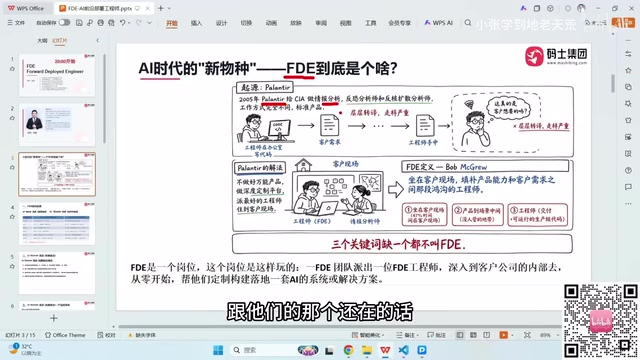
This is the core definition of FDE: an engineer who sits at the customer site and bridges the gap between the product and customer needs. From a programmer's perspective, this seems like doing projects, but the key word is "product"—if what is built at each customer site cannot be reused, then it is just traditional outsourcing, not FDE. A true FDE team enters with a proven AI transformation solution, quickly implementing it by connecting parameters and adjusting environment variables.
Palantir's background is worth expanding on. This company was founded in 2003, initially invested in by Peter Thiel and others, and its core products include Gotham for government intelligence agencies and Foundry for commercial customers. Its most famous approach is "Ontology-driven"—not simply visualizing data, but first building for the customer an "ontology" that describes their business entities, relationships, and actions, and then letting analysts reason and make decisions on top of this semantic layer. FDEs are the executors of this model: they are stationed at customer sites for long periods, understanding business semantics while translating general platform capabilities into specific analysis workflows. This model allowed Palantir to form a hybrid delivery format of "platform + people" early on, and also explains why its engineers are often required to have extremely strong business understanding, rather than merely coding ability.
Why Did FDE Only Become Popular in the AI Era?
This model was not absent in the traditional outsourcing era, but why is it only now being taken seriously? The cost structure has changed. Previously, sending a core engineer with an annual salary of 800,000 yuan to be stationed at a customer site meant the company had to bear a comprehensive cost of over one million, while customer needs might not converge quickly. Many companies could not make this math work. The emergence of large AI models changed the input-output ratio—when model capabilities are strong enough that on-site deployment and tuning can directly produce verifiable business results, enterprises are willing to pay for this kind of deep service.
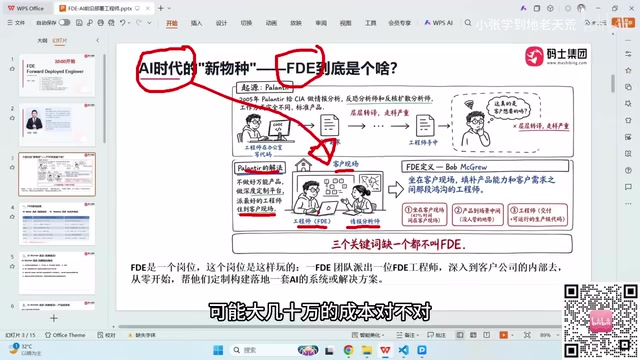
FDE essentially also assumes the responsibilities of a product manager. At the customer site, FDEs need to communicate directly with customers to understand requirements and business scenarios, then translate them into deployable AI solutions. This end-to-end capability requirement is exactly what distinguishes FDE from ordinary algorithm engineers or backend developers.
What Technologies Do You Need to Master to Take the FDE Path?
If you want to take the FDE path today, both depth and breadth in the tech stack are indispensable. Teacher Li Jin gives a clear learning path: start with AI Agent development or private model deployment, then gradually go deeper into fine-tuning, Zhenliu (model compression techniques such as distillation/quantization), and pretraining. In terms of difficulty, fine-tuning < Zhenliu < pretraining, which is also why progressive learning is recommended.
In many business scenarios, during project acceptance, the agent level can reach 90 points, but the acceptance standard requires 95 points—the missing 5 points must be made up through fine-tuning. FDEs will inevitably need to master fine-tuning later on, because relying only on Agent-level development easily hits a bottleneck in results. At the same time, enterprise-level deployment should recommend models of at least 8B or above; models below 8B are already of little significance at the current stage. The cost of localized deployment depends on model scale and business scenario. Hardware procurement for industries such as finance and healthcare may reach the 2 million yuan level, while traditional companies may only be willing to spend 20,000 yuan—this determines the pricing logic and customer selection of FDE services.

The "Zhenliu" mentioned in the text is an industry colloquial umbrella term for model compression-related technologies, mainly covering distillation and quantization, as well as pruning, low-rank decomposition, and other methods. Distillation refers to using the output of a large model (teacher model) to guide the training of a small model (student model), allowing the latter to approach the former's performance with a smaller size; quantization reduces model weights from FP16/FP32 to precisions such as INT8 and INT4 to reduce memory usage and inference latency. These technologies are regarded as important FDE skills because enterprise private deployment is often constrained by local compute and cost, and running a full-powered large model directly is unrealistic. Only by mastering distillation and quantization can model performance and response speed be tuned to a deliverable level on limited hardware, which is also the engineering step that must be added after "fine-tuning."
Unavoidable Pitfalls in Enterprise Deployment
The most common pitfall in enterprise AI deployment is not that the technology cannot do it, but that the value of fine-tuning is difficult to verify. Many companies are unwilling to do fine-tuning, mainly because: after tuning, who will prove that the effect is better than before? A friend who runs a company reported that "the more it is tuned, the worse it gets." Rather than spending hundreds of thousands to hire a fine-tuning engineer, it is better not to do it. This is actually a business problem—when fine-tuning cannot bring perceivable benefits, enterprises naturally have no incentive to invest.
Another reality is that customer requirements often keep changing on site. If FDEs do not have a reusable productized foundation, they can easily fall into the dilemma of "doing one project in one place, and all previous accumulation is wasted." This is also why FDE teams must build productization capabilities: entering with configurable solutions rather than writing code from scratch every time.
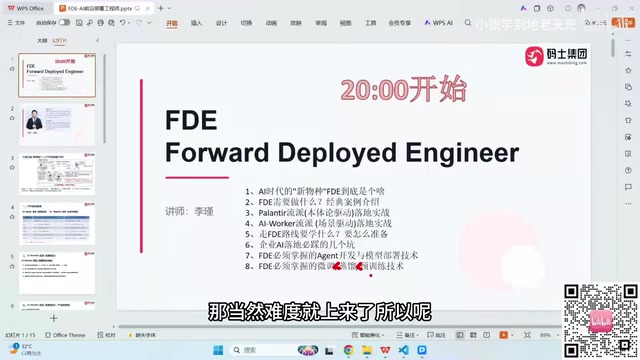
Matching model scale with business scenarios is a key judgment when FDEs design solutions. The text mentions that enterprise-level deployment should recommend models of at least 8B or above, because models with too few parameters perform unstably in core Agent capabilities such as multi-turn dialogue, complex instruction following, and tool calling, and are prone to "failing" in real business. But the larger the model, the higher the GPU memory, concurrency capability, and operational costs required for local inference. FDEs need to find a balance between "model capability" and "hardware cost" according to the customer's budget, data sensitivity, and task complexity: industries such as finance and healthcare with strong compliance requirements that data must not leave the domain are often willing to pay for high configurations; while small and medium-sized enterprises with limited budgets are more suitable to first get lightweight Agent scenarios running, then gradually upgrade.
Conclusion
FDE is a new species born after large AI models entered the deep-water zone of enterprises. It requires engineers to possess algorithmic ability, engineering ability, and business communication ability at the same time. The Palantir school emphasizes ontology-driven approaches, while other teams take a scenario-driven route, but the core logic is the same: use reusable productization capabilities to solve customers' personalized problems on site. For those who want to take this path, starting from Agent development and model deployment and gradually going deeper into fine-tuning and pretraining is a relatively pragmatic growth path.
One-line Summary
FDE is a new role stationed on site to bridge the gap between products and needs when AI is deployed in enterprises, requiring productized reuse and end-to-end capabilities.
Paragraph Summary
FDE (Forward Deployment Engineer) first emerged from Palantir's practice of serving government clients. Its core is to send engineers on site with a reusable productized foundation to solve customers' personalized needs. In the era of large AI models, changes in the input-output ratio have made this model popular again: on-site deployment and tuning can directly produce verifiable results, so enterprises are willing to pay for deep services. FDE also has product manager responsibilities and needs to understand business end-to-end and translate it into AI solutions. Technically, it is recommended to start with AI Agent development or private deployment and gradually go deeper into fine-tuning, distillation, and pretraining, with increasing difficulty. The biggest pitfall in enterprise deployment is that the value of fine-tuning is difficult to verify, which is essentially a business return problem, not a purely technical one.
Related articles

ChatGPT Space Launches: Team Collaboration and New Pages Features Explained
ChatGPT Space is OpenAI's new team collaboration feature with Pages, real-time collaboration, and Slack/Google Drive sync. We break down its privacy design, multi-platform integration, and the full workflow from conversation to document.

Migrating Apache Spark UDFs to GPU Acceleration with AI Agents
NVIDIA developer blog explains how AI Agents rewrite Apache Spark UDFs for GPU acceleration, covering migration criteria, agent rewriting and verification workflows, plus pitfalls like result consistency and CPU-GPU transfer overhead.

Zed Editor v0.40.4-rc2 Released: Usage Credits Now Available Without Upgrading
Zed editor releases v0.40.4-rc2, allowing users to use usage credits for AI features without upgrading to a paid plan, lowering the trial barrier.