FDE: The Forward Deployed Engineer Bringing AI Models Into Real Enterprises
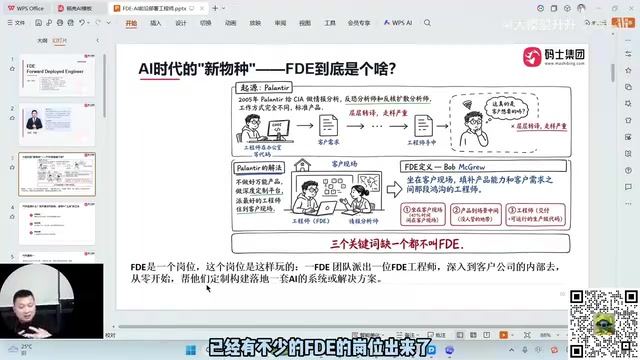
FDEs are specialized engineers who embed in enterprises to bridge the gap between AI model capabilities and real business needs.
FDE (Forward Deployed Engineer) is a critical role emerging as AI model capabilities outpace enterprise adoption. FDEs embed directly within client organizations to customize and deploy complete AI solutions from scratch. Using a chain store AI assistant manager as a case study, the article shows that FDE output goes far beyond API calls — it means deep integration of business data and logic. The biggest challenge FDEs face is requirement convergence: clients are either clueless about AI or convinced it can do everything, and vibe-coding-style sprawl typically aligns with real needs only 20–30%. In an AI-saturated market, the ability to understand business context and deliver grounded solutions is the scarcest competitive edge.
What Is an FDE? A New Role Rising in the Age of AI
As large AI model capabilities advance at a breakneck pace, a brand-new professional role is quietly gaining traction both globally and in China — FDE (Forward Deployed Engineer). Originating abroad and now increasingly popular domestically, this role carries a critical mission: embedding directly within client organizations to customize, build, and deploy a complete AI system or solution from the ground up.
Unlike traditional software engineers who write general-purpose code from an office, FDEs operate more like a special forces unit deployed inside the client's own walls. Their core value lies in bridging the last mile between "AI capability" and "real enterprise business needs." The market is already seeing a surge in FDE job postings — and an emerging wave of companies built specifically to provide FDE services.

Why the FDE Role Exists
Models Keep Getting Stronger, Yet Enterprises Can't Use Them
The AI industry faces a sharp contradiction today: models keep improving, but enterprises still can't put them to work. Flagship models from companies like DeepSeek and OpenAI have become remarkably capable — yet for most traditional enterprises, these cutting-edge models feel like something behind a glass wall: visible, but untouchable and unusable.
Multiple leading AI companies, including OpenAI, have all identified the same bottleneck: no matter how powerful a model is, if it can't be applied to a company's specific business context, its value to that company is zero. This is the fundamental driver behind the FDE role.

Traditional Delivery Models Are Breaking Down
The old approach — selling software to a customer who then follows an instruction manual — is increasingly being called "classical software development." The reason is simple: it fails to address the first-principles need of enterprises. What clients actually want is tangible business growth and competitive advantage, not a standardized, one-size-fits-all tool.
FDEs exist precisely to address this fundamental need head-on. Business owners have a very direct ask: use large AI models to boost company competitiveness and improve performance. The FDE's job is to translate that abstract goal into a customized, deployable solution.
What an FDE Actually Does: A Chain Store Case Study
A concrete example best illustrates the FDE's value. Imagine a national coffee or bubble tea chain with thousands of locations. The owner wants to use AI to improve overall operations. An FDE team would step in to:
- Conduct on-site discovery: Visit headquarters and physical stores to understand real pain points firsthand
- Build a customized solution: For example, deploying an "AI assistant store manager" for each location
- Maintain independent instances: One thousand stores means one thousand individual AI assistant manager accounts
This AI assistant store manager goes far beyond a typical chatbot. It can help track inventory, gather operational data, and diagnose performance issues. After closing, a store manager might spend thirty minutes communicating with the AI assistant — via text, photos, or simply describing the day's operations.
The key is that the AI assistant's responses are never just a simple call to some large model API. They are deeply integrated with the company's own business data. When a manager reports "low foot traffic and poor sales today," the system proactively asks about weather conditions, requests photos of the surrounding environment, and even pulls in local area data to analyze the real reasons behind the performance drop.

In real FDE engagements, even a seemingly simple feature can serve as the connective tissue between a large model and an enterprise's knowledge base. On a learning platform, for instance, when a user asks "How do I learn Redis and which instructor should I choose?", the system directly links to the platform's course catalog, jumps to the relevant chapter, and surfaces related questions and answers from past students. This kind of deep business integration is exactly what FDE work produces.
The Core Challenge: From Wild Ideas to Precise Execution
Two Extremes of Client Expectations
In practice, FDEs typically encounter clients at one of two extremes:
The first type: completely unfamiliar with AI. As a business owner, they neither understand what AI can do nor can they articulate what they want.
The second type: slightly informed, and convinced AI can do anything. This leads to boundless, sprawling ideas — they want it all.
One of the most important responsibilities of an FDE is managing requirement convergence and prioritization between these two extremes. When clients come in with a laundry list of ideas because they believe AI is capable of everything, the reality is that most of those requests simply cannot be implemented.

The Deployment Trap of Vibe Coding
An example many developers will recognize illustrates this problem well. When you use AI coding tools like Claude Code or Codex and throw out a flood of unstructured ideas all at once, the AI responds like an architect — generating ten or twenty different approaches, then beginning to implement them one by one.
The result is often:
"The AI hands you a pile of redundant code. Each piece feels like it might be useful, but none of it actually works — because it never truly connects to your real product context."
Even more sobering: the AI-generated solution might only align with your actual requirements by 20–30%. And a 20–30% match is essentially the same as no match at all.
This is precisely the best argument for the FDE role — bridging the enormous gap between AI capability and real business needs is the irreplaceable core competency that defines this position.
FDE Represents the Inevitable Direction of AI Adoption
The rise of the FDE is not a coincidence. It is the natural product of AI's development reaching a specific inflection point. Once model capabilities are strong enough, the true bottleneck shifts from "can the technology do this?" to "can the business actually use it?"
For engineers looking to enter the AI field, FDE offers a differentiated growth path. It demands not only fluency with large models, Agents, and various AI tools, but also the composite ability to deeply understand business contexts, converge requirements, and deliver precise implementations.
As AI technology becomes increasingly widespread, this "last-mile" deployment capability will emerge as one of the scarcest and most valuable core competencies in the industry. Whether you're a traditional engineer pivoting toward AI or a business leader who wants AI to generate real value, the FDE is a direction worth taking seriously.
Related articles

Invalid Source Material Notice
The source material provided lacks substantive information and is unrelated to AI/tech topics, making it impossible to produce a complete professional article.

Invalid Source Material: Unable to Generate a Valid AI/Tech Article
This Twitter source material is an irrelevant marketing tweet with no AI or tech content, making it impossible to generate a valid professional article.

Insufficient Source Material: Unable to Generate a Valid Article
The source material was limited to a single broken tweet with no usable content, making it impossible to produce a complete, high-quality article.