Fear of AI Is Spreading: A Technologist's Confession
A technologist publicly admits fear of AI—an insider view more worth reading than outside criticism.
The article discusses the Hacker News post 'I'm Scared of AI,' which earned 212 points and 247 comments, showing AI anxiety spreading from the public into the tech community. The author notes that technologists' fear stems not from ignorance but from understanding too well—what truly unsettles is the sense of losing control from the pace, depth, and unpredictability of change, and a re-examination of their own work's meaning. Publicly saying 'I'm scared' in a default-optimistic culture takes courage and adds an insider perspective to AI risk discussions.
When Technologists Start to Fear What They Helped Create
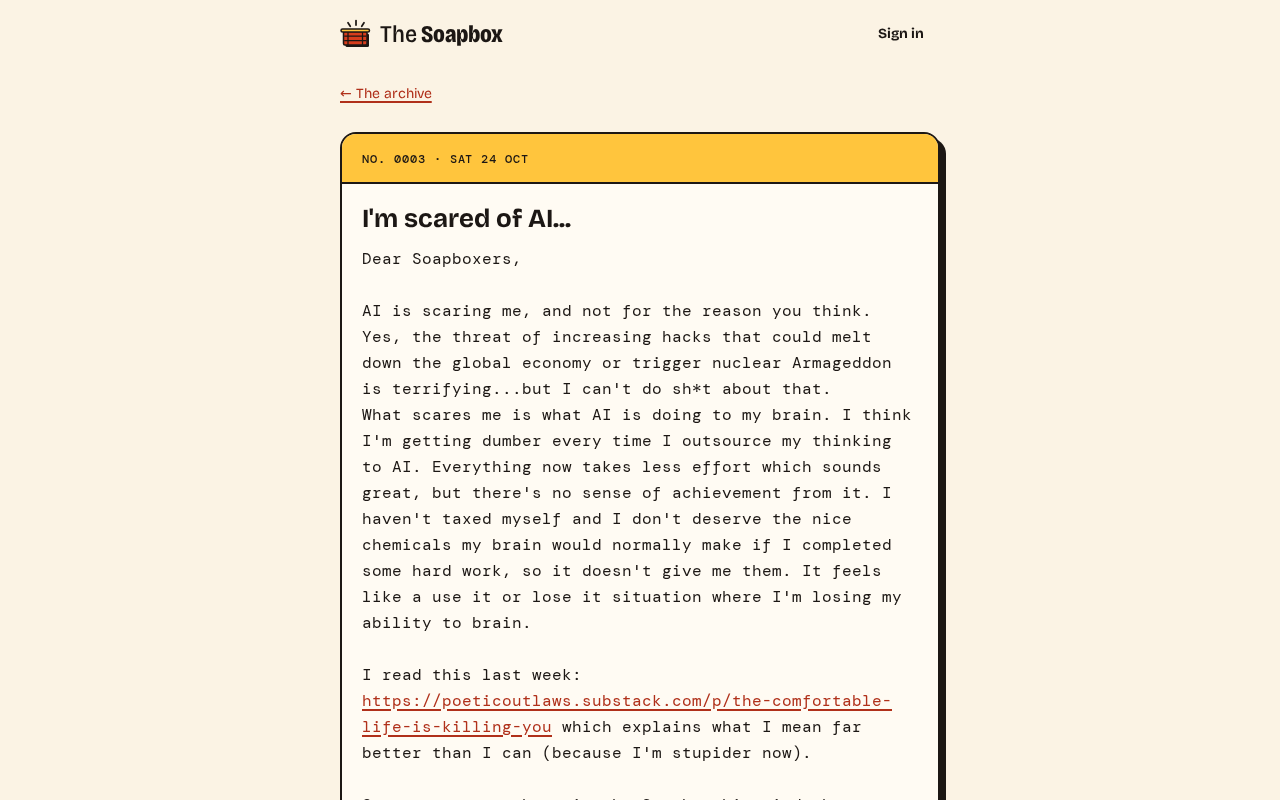
Recently, an article titled "I'm Scared of AI" sparked considerable discussion on Hacker News, earning 212 points and accumulating 247 comments. That number itself reveals a phenomenon: fear of AI is spreading from the general public's anxiety into the tech community itself.
This fear isn't a sci-fi fantasy of a "Skynet" scenario, but something more concrete and closer to daily life. The original author confesses in first person their concerns about AI technology. This kind of voice—coming from a tech practitioner or deep user—is often more worth reading closely than outside criticism, because it's not "afraid because they don't understand" but "worried because they understand too well."
Where the Fear Actually Comes From
A Vague but Real Unease
The original piece doesn't offer a single checklist of technical risks, but instead presents fear as an overall feeling. This approach is honest: what truly unsettles people is often not some quantifiable capability metric, but the sense of losing control that arises from the pace, depth, and unpredictability of technological change intertwined together.
The HN comment section is a good sample for understanding this sentiment. 247 comments mean many participants and scattered viewpoints, which typically indicates the topic has touched some kind of shared anxiety rather than isolated extreme opinions.
Technologists Doubting Their Own Role
It's worth noting that when tech practitioners express fear of AI, there's often an implicit re-examination of their own work: Is what we're building still within our understanding? This self-doubt is precisely the perspective that outside criticism struggles to provide.
Why This Voice Deserves to Be Heard
The tech community has long maintained a culture of "default optimism"—embrace new technology first, discuss problems later. In this context, publicly saying "I'm scared" requires a certain courage. It breaks the stereotype that "technologists must support technology" and adds an insider perspective to discussions about AI risk.
Fear itself is not the endpoint. Acknowledging unease is what makes it possible to move the discussion from "should we be afraid" to "what actions should we take"—whether that's a more cautious pace of development, more transparent explanations of model behavior, or more serious industry regulation discussions.
"Default optimism" (techno-optimism or the default narrative of progress) is a long-standing cultural inertia in Silicon Valley and open-source communities: new technology is presumed to be progress, and skeptics are often labeled as conservative or as not understanding technology. This atmosphere serves a function—it drives rapid experimentation and tolerance for failure—but it also systematically suppresses expressions of risk. The "build first, ask later" convention in startup culture at places like Kickstarter and YC, along with engineers' identity around "solving problems," creates social costs for publicly expressing concern. Understanding this background is essential to understanding why a post about a technologist confessing fear resonated so significantly on HN: it's not isolated emotional venting, but a voice long suppressed by culture finding its outlet.
A Common Signal Across Multiple Perspectives
Although the material here centers on a single HN post and the original article, the post's popularity and comment count themselves constitute an observable signal: this kind of expression is not isolated personal sentiment, but a topic that has gained significant resonance in the tech community. In other words, fear of AI is becoming a public experience that can be openly discussed, rather than a private feeling that needs to be hidden.
Hacker News points and comment counts are rough indicators of community consensus. Generally, a post that reaches the front page and earns hundreds of points indicates it has reached a substantial number of core users; a high comment-to-point ratio (approximately 1.17 in this case) typically means the topic is controversial and people are eager to discuss, rather than just "liking and moving on." It should be noted that HN's voting mechanism and user composition (primarily engineers, entrepreneurs, and researchers) mean it reflects signals from within the tech community and cannot be directly equated with public opinion. But precisely because of this, it has reference value for gauging "the level of unease among tech practitioners themselves."
After Fear, the Real Discussion Begins
Laying fear out in the open doesn't mean rejecting technology. On the contrary, it may be the starting point for a more mature way of discussing it. When technologists are willing to acknowledge unease, external skepticism and internal caution can converge to form a consensus that genuinely constrains AI development.
From this perspective, the value of "I'm Scared of AI" isn't in providing answers, but in giving expression space to an emotion that has long been underestimated. As for what this fear will turn into—more responsible technology practices, or just another round of forgotten hype—that depends on how many people are willing to respond to it seriously.
Related articles

Unkernel: Compiling the Linux Kernel to WebAssembly
The Unkernel project compiles a real Linux kernel to WebAssembly, making it possible to run a complete kernel in the browser. This article covers its technical principles, challenges, and prospects.
New Claude Sonnet Model Tested: Performance Approaches Opus with Less Thinking
Anthropic quietly tests a new Sonnet model in Claude Code—performance approaches Opus 5.5 with far fewer thinking tokens, plus Codex transfer optimization, xAI's low-level rewrite, Google Antigravity updates, and the AI science understanding gap.
Building a Reasoning Model from Scratch: Making Complex AI Algorithms Accessible
Mike Finley, author of Build a Reasoning Model from Scratch, shows how a few hundred lines of code, single-sample training, and code reuse make complex AI algorithms like RL and verifiers accessible to all.