Feather: Building the "Android of Robotics" for Developers

Feather bets on a $30K open, customizable robotics platform to become the "Android of robotics."
Feather is a startup positioning itself as the "Android of robotics," aiming to break the industry's closed vertical integration model by offering an open, customizable hardware-software platform. Priced at ~$30,000 and targeting software developers and R&D teams, its core thesis is that standardizing the underlying platform lowers the marginal cost of innovation, attracts a developer community, and generates network effects. However, the highly fragmented nature of robotics use cases and the absence of a unified killer application form factor make replicating Android's path far more uncertain than it was in the smartphone era.
The Robotics Industry's "Android Moment" May Be Coming
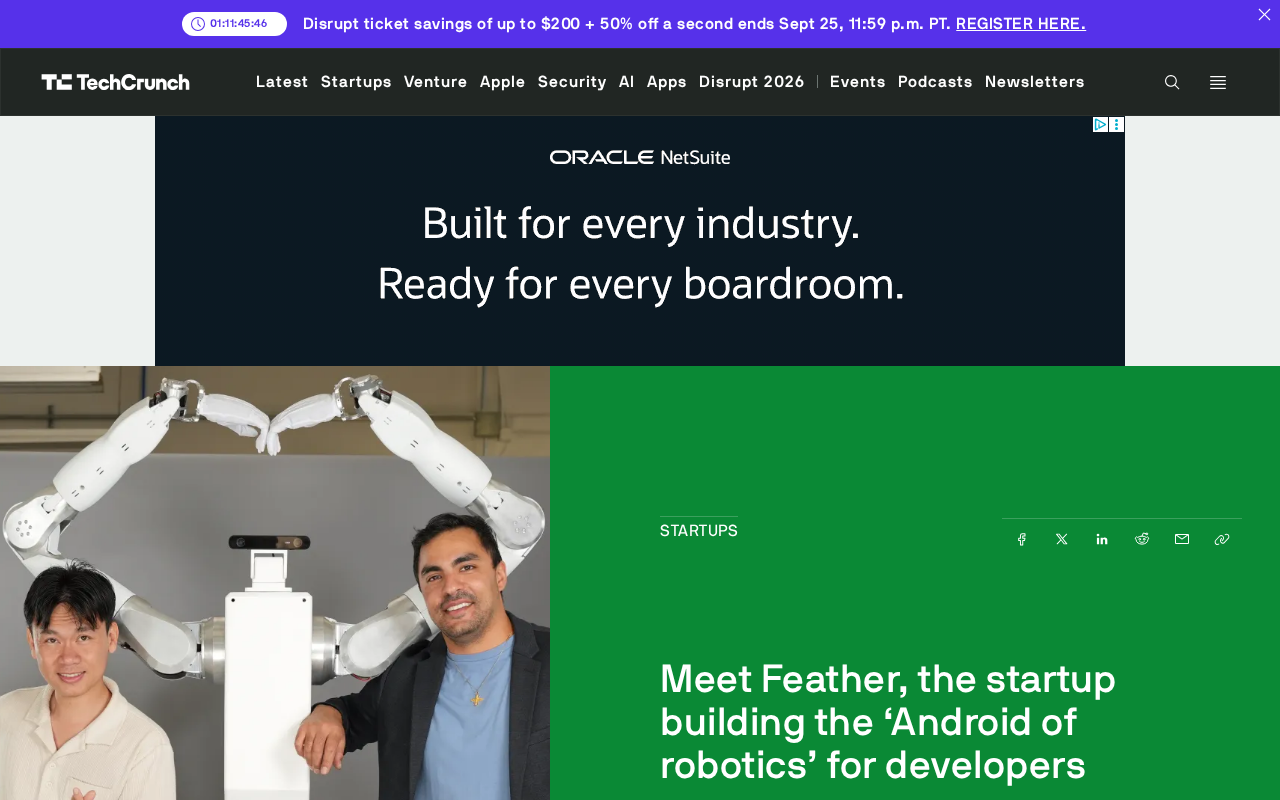
The robotics industry has long been dominated by closed ecosystems — hardware manufacturers typically bundle their own software stacks, making it difficult for developers to build and iterate across devices on a unified platform. Startup Feather is trying to break this deadlock by positioning itself as the "Android of robotics," betting on a highly customizable platform aimed squarely at software developers.
The analogy is deliberate. Android's success largely stemmed from decoupling hardware from software, enabling developers worldwide to build applications on an open, standardized foundation. Feather wants to replicate this approach in robotics: offering a customizable hardware-software base so developers can focus on innovating at the application layer, rather than building control systems from scratch.
The closed nature of the robotics software ecosystem has deep historical roots. Early industrial robots were dominated by a handful of giants — ABB, KUKA, FANUC — each with proprietary programming languages (ABB's RAPID, KUKA's KRL), where software and hardware were deeply coupled and code was nearly impossible to migrate across platforms. Even the collaborative robots (cobots) and humanoid robots that have emerged in recent years largely follow this closed model. ROS (Robot Operating System) provides some open-source foundation, but it functions more like a research community toolbox, lacking commercial-grade standardization and developer experience. What Feather is trying to fill is precisely the gap between ROS and commercial closed-source systems — a middle-layer platform that is both open and fully commercially supported.
What a $30,000 Price Tag Signals
Feather's platform is priced at approximately $30,000. This price point sends a clear message: Feather's target customers are not everyday consumers, but R&D teams, labs, and software developers looking to build products on top of robotics hardware.
Compared to industrial robots that often cost hundreds of thousands of dollars, the $30,000 threshold significantly lowers the barrier, giving more small-to-mid-sized teams and independent developers access to programmable robotic hardware. Yet it remains above purely educational or toy-grade devices, signaling that this is a productivity tool for serious development scenarios. This pricing strategy echoes the thinking behind Android's early developer devices — win over developers first, then wait for the ecosystem to flourish and drive scale.
"Customizability" Is the Core Value Proposition
Feather emphasizes the platform's "customizable" nature, which is central to its Android comparison. In closed robotics ecosystems, developers are constrained by the functional boundaries set by manufacturers. An open, customizable platform, in theory, allows developers to flexibly adjust hardware configurations and software logic based on specific use cases.
The value of this model lies in reducing the marginal cost of innovation. Once the underlying platform is standardized, developers can reuse toolchains, share code, and rapidly validate ideas. If Feather can attract a sufficiently large developer community, an ecosystem of applications, modules, and plugins could organically emerge around it — exactly the network effects that any platform-oriented company dreams of.
Platform companies' network effects typically fall into two categories: same-side effects (the more users of the same type, the more valuable the platform) and cross-side effects (growth on one side attracts the other side). For a robotics development platform, cross-side effects are particularly critical — more developers mean richer applications and modules, which in turn attract more hardware buyers, which then incentivizes more developers to join. However, compared to mobile operating system platforms, robotics platforms face a higher threshold for triggering these cross-side effects: robotic use cases are extremely diverse (warehousing, healthcare, service industries, research, etc.), and different scenarios demand vastly different hardware form factors, making it much harder to achieve the "one platform serves all applications" dynamic seen with smartphones. This means Feather may need to first establish dominance in a specific vertical before expanding horizontally, rather than pursuing universal coverage from the outset.
Challenges and Uncertainties
It's worth approaching this objectively: "the Android of robotics" is a highly ambitious narrative that carries significant risk. Android's success depended on the smartphone — a naturally mass-market device — while robotic applications remain highly fragmented, with no unified killer-app form factor comparable to the smartphone.
Furthermore, building an open ecosystem requires substantial investment in both time and capital. The core question facing Feather is: can it genuinely cultivate an active developer and application ecosystem beyond hardware sales? Can a $30,000 device achieve sufficient deployment numbers to trigger platform effects? These questions currently lack publicly available data to answer.
Conclusion
Feather's approach represents a noteworthy trend in the robotics industry — a shift from closed vertical integration toward open, platform-based competition. Regardless of whether it ultimately becomes a true "Android of robotics," this developer-centric, customizability-driven exploration offers the industry a compelling new reference point. For practitioners following robotics and embodied intelligence, Feather's progress is well worth tracking.
Related articles

Automate Job Search with AI Agents and Residential Proxies for Precise Matching
Build an AI Agent with MCP and residential proxies to bypass recruitment site anti-scraping and geo-restrictions, scrape thousands of DevOps jobs, then have Claude score and rank each against your resume. Includes proxy comparison experiments, project structure, and cost analysis—filtering only, no auto-submission.

The AI Task Assistant That Knows When to Back Off: A Cure for Activation Struggles
One Small Step is an AI assistant for task initiation struggles, using agentic decisions for guilt-free reminders, timely retreat, and cross-platform task management. The developer shares real test results on 13 tasks and architectural trade-offs.

FastAPI: A High-Performance Python Framework and a Production-Ready API Development Powerhouse
FastAPI is a high-performance web framework based on Python type hints, supporting async and automatic OpenAPI docs. With over 100k GitHub stars, this article analyzes its core strengths, production readiness, and selection advice.