Feishu Hackathon Winner: A Solo Data Analysis Agent That Does It All

A data analysis Agent using RAG + Schema validation for accuracy, with multi-source support and auto-visualization — fully open-source.
This article covers a Feishu Hackathon winning project: an AI Agent for data analysis that automates the most time-consuming parts of the workflow. It supports one-click ingestion from databases, Google Sheets, and Feishu Bitable. For accuracy, it uses RAG to retrieve data Schemas with a 0.7 similarity threshold — blocking output if validation fails, preventing LLM hallucinations. Results are visualized using 40+ built-in chart types, and workflows can be saved and scheduled. The core is fully open-source with 2,500+ GitHub stars.
Let the Agent Handle the "Dirty Work" in Data Analysis
For data analysts, the most frustrating part isn't the analysis itself — it's the data retrieval process. Pulling raw data from internal databases, cleaning it, and aligning definitions across teams is time-consuming and tedious work. In this Feishu Hackathon winning project, the creator OpenCloud takes a direct approach: offload the most repetitive, foundational parts of data analysis entirely to an Agent.
In the author's own words, the goal of this system is to let "a single person master every role that a traditional consulting firm's entire data analysis team would cover." Even more importantly, frequently-run data workflows can be saved and scheduled for automatic execution — turning one-off analyses into reusable, automated pipelines.
Multi-Source Data Import in One Click
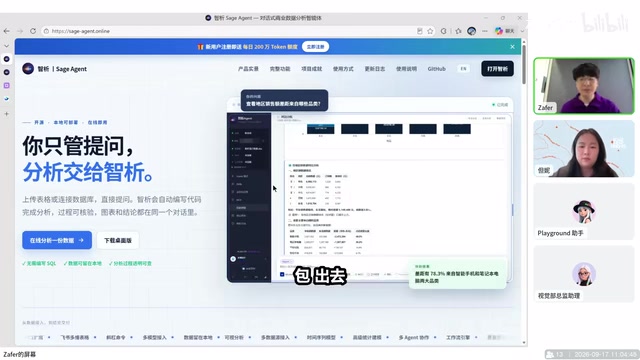
This Agent puts serious effort into data ingestion. It supports importing from multiple data sources — including company databases, Google Sheets, and Feishu Bitable (a tool widely used by domestic teams) — all with a single click.
For most small and mid-sized teams, data tends to be scattered across different tools. Just aggregating it in one place can take considerable effort. By supporting collaborative tools like Feishu Bitable, this Agent fits real-world domestic workflows rather than just serving as a polished technical demo.
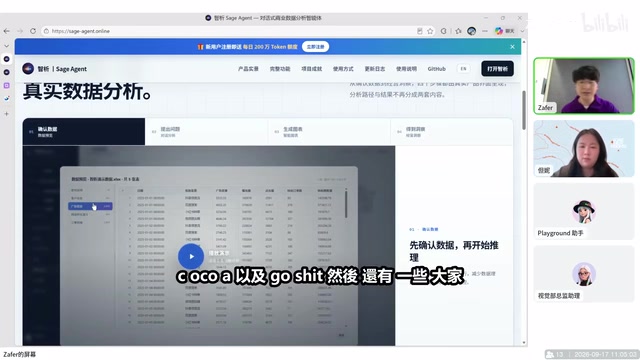
Feishu Bitable is a structured data management tool within ByteDance's Feishu office suite. Functionally similar to Airtable, it supports multiple views including tables, kanban boards, and Gantt charts, and provides API access for external systems to read and write data. Among domestic SMEs and internet teams, it's commonly used as a lightweight alternative to a business database — storing sales records, operational data, project progress, and more. Compared to traditional relational databases, Feishu Bitable is far more accessible to non-technical users, though this also means data often lacks strict format constraints, making cleaning more costly. Supporting it as a data source shows that this Agent was designed with real domestic data storage habits in mind, not just for large enterprises with mature data warehouses.
RAG-Based Schema Retrieval to Eliminate Hallucinated Data
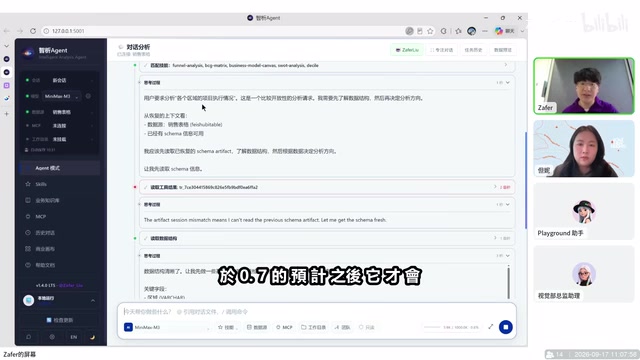
The most notable aspect of this system is how it handles accuracy. When a user submits an analysis request, the Agent uses RAG (Retrieval-Augmented Generation) to retrieve relevant fields from a built-in Schema index. Only Schema entries with a similarity score above 0.7 are passed as context to the model.
The core value of this design lies in its error-correction mechanism: if Schema matching fails, a validation checkpoint blocks the request. The Agent will not fabricate data or invent a non-existent column just to force an output.
Why This Step Matters
The biggest risk of using LLMs in data analysis is confidently generating plausible-but-wrong output — when a model can't find the right field, it may invent data that looks reasonable but is factually incorrect. By enforcing a Schema validation checkpoint, the author closes this vulnerability at the engineering level, ensuring every column in the output has a traceable, real source. For any scenario where analysis results drive decisions, this is a non-negotiable baseline.
RAG (Retrieval-Augmented Generation) is a technical architecture that combines external knowledge base retrieval with LLM generation. Traditional LLMs can only rely on knowledge encoded in their parameters at training time, while RAG allows the model to dynamically retrieve external documents or structured data at inference time, injecting retrieved results into the prompt as context to produce more accurate, traceable outputs. In data analysis contexts, "Schema" refers to the structural description of a database or spreadsheet — including field names, data types, and semantic descriptions. By building a vector index over the Schema, the Agent converts a user's natural language query into a vector, performs similarity matching against the Schema vector store, and only includes fields that exceed the threshold in the context. This approach essentially constrains the model's behavior using structural information before it ever "sees" the actual data — preventing it from guessing or fabricating fields when the table structure is unknown.
40+ Chart Types for Automatic Visualization
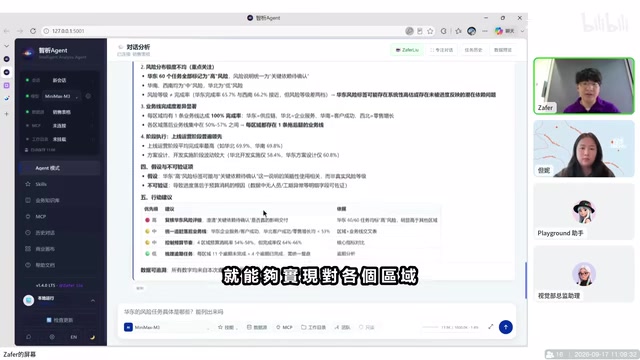
Once data retrieval and analysis are complete, the system includes over 40 built-in chart types and can automatically determine which visualization method best suits the data.
This full loop — from data retrieval to chart output — means users never need to switch between multiple tools. The author demonstrated real-time, accurate analysis across regional datasets, with the visualization step handled entirely by the Agent rather than manually configured by an analyst.
Fully Open-Source Core
The core of the project is fully open-source. It has already accumulated over 2,500 stars on GitHub and has been included in several notable open-source project lists. Developers who want to self-host or experiment with it can fork the project directly on GitHub.
The decision to open-source this work extends its value well beyond the hackathon itself. It's not just a winning demo — it's a practical tool that can be reviewed, improved, and deployed by the broader community.
Summary
This data analysis Agent has a clear proposition: automate data retrieval and cleaning, use RAG with Schema validation to maintain accuracy, and complete the loop with built-in visualization. It addresses the most real pain points in data analysis — freeing people from repetitive, foundational busywork. For teams with stable data pipelines that need regular reporting, tools like this are worth paying attention to.
Related articles

Random Pruning of the DPO Computation Graph: 1.4x Training Speedup and Lower Peak Memory
DPO training too slow and memory-hungry? This paper proposes a random pruning framework for the DPO computation graph, sampling independently across position, sequence, and branch dimensions; branch pruning achieves a 1.426x step-time speedup and cuts training time by about 30%, with in-depth attribution of memory and time gains.

Why Does JEPA Underperform MLM in Longitudinal EHR Representation Learning?
New study compares JEPA and MLM for longitudinal EHR representation learning on MIMIC-IV: three JEPA variants train stably without collapse but underperform MLM; target size, not heterogeneity, drives prediction error.

Transfer Learning + Visible Light Communication: A New Approach to Energy-Efficient Indoor Positioning
A study proposes a transfer learning-based visible light communication indoor positioning method, achieving 47% accuracy improvement on the BOSCH factory dataset, 67.5% model efficiency under high noise, and introducing the ME composite metric for energy-efficient positioning in energy-constrained industrial IoT scenarios.