FETTUCCINE: A New Breakthrough in Mobile Brain-to-Text Decoding
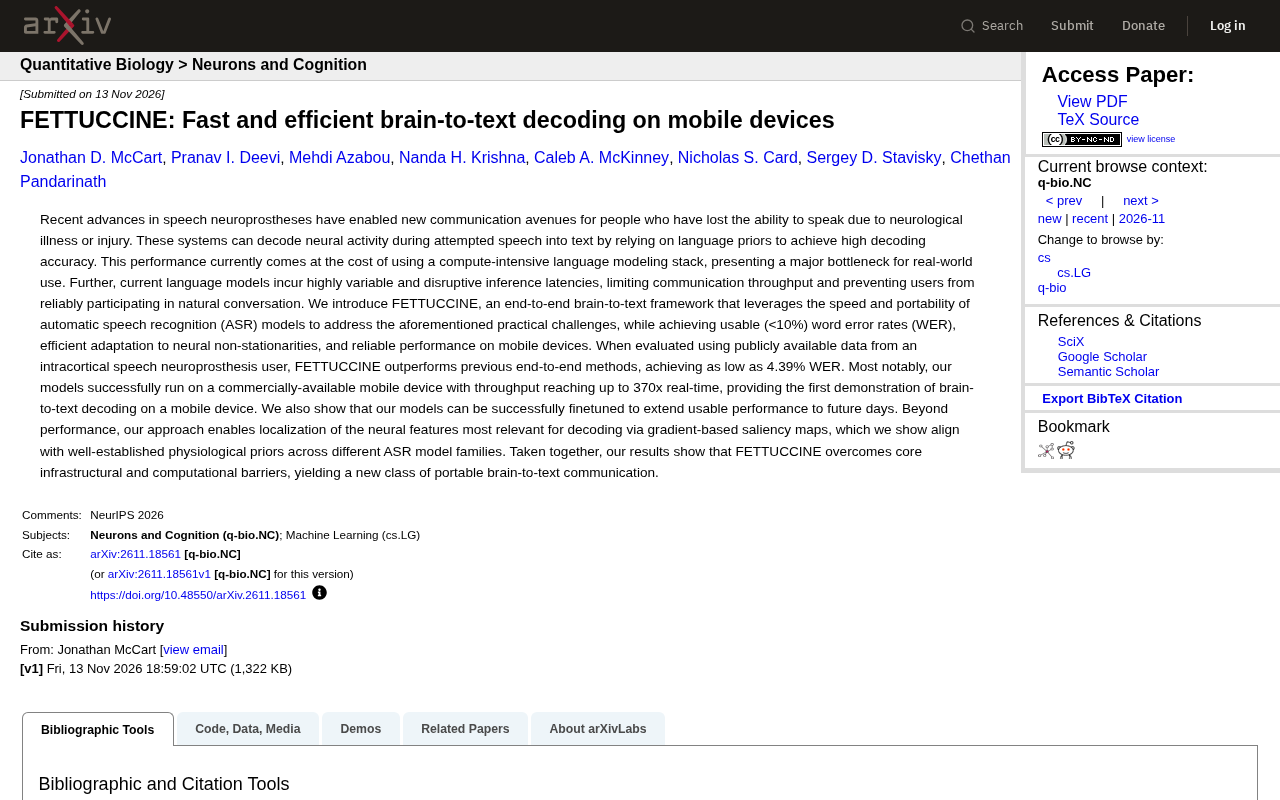
FETTUCCINE replaces language model stacks with ASR models, achieving brain-to-text decoding on mobile devices for the first time with a word error rate as low as 4.39%.
FETTUCCINE is an end-to-end brain-to-text framework that addresses the bottleneck of traditional speech neuroprostheses relying on computationally intensive language model stacks. Using ASR models, it achieves a word error rate as low as 4.39% on public intracortical speech neuroprosthesis data—a usable level—and runs on a commercial mobile device for the first time with throughput 370 times real-time. The model can be fine-tuned to adapt to neural non-stationarity and extend usable performance; gradient-based saliency maps localize key neural features consistent with physiological priors. Although currently evaluated on only a single user, this work overcomes infrastructural and computational obstacles and opens a new path for portable brain-to-text communication.
Brain-computer interfaces (BCIs) show enormous potential for helping patients who have lost the ability to speak due to neurological disease or injury regain communication. Recently, an end-to-end brain-to-text framework called FETTUCCINE was proposed. It leverages the speed and portability of automatic speech recognition (ASR) models to overcome the bottleneck of traditional methods that rely on computationally intensive language model stacks, achieving brain-to-text decoding on a commercial mobile device for the first time.
From the Lab to Mobile: The Practical Challenges of BCIs
Existing speech neuroprosthesis systems can decode neural activity during attempted speech into text and rely on language priors to achieve high decoding accuracy. However, the price of this high performance is a computationally intensive language modeling stack, which becomes a major bottleneck in practical applications. In addition, current language model inference latency is highly variable and disruptive, limiting communication throughput and preventing users from reliably engaging in natural conversation. FETTUCCINE was proposed precisely to address these practical challenges, with the goal of achieving efficient adaptation to neural non-stationarity while maintaining usable word error rate (WER) and running reliably on mobile devices.
Neural non-stationarity refers to the slow or abrupt changes over time in the statistical properties of signals recorded from the same neuron or neural population—for example, signal drift caused by slight electrode displacement, tissue reactions, or learning adaptation. This non-stationarity degrades the performance of fixed decoders, causing system accuracy to decline after days or weeks. Therefore, practical BCIs require periodic calibration or adaptive methods. FETTUCCINE addresses this challenge by fine-tuning the ASR model, continuing to optimize a trained model on new data to maintain decoding performance without retraining from scratch.
Performance Breakthrough: Word Error Rate as Low as 4.39%
According to the research team, when evaluated on public intracortical speech neuroprosthesis user data, FETTUCCINE outperforms previous end-to-end methods, achieving a word error rate (WER) as low as 4.39%. This value reaches a usable level (below 10%), meaning the accuracy of the decoded text is already sufficient for basic communication needs. More importantly, the model successfully runs on a commercial mobile device with a throughput of 370 times real-time processing—the first demonstration of brain-to-text decoding on a mobile device.
Word error rate (WER) is the most commonly used evaluation metric in speech recognition and brain-to-text decoding, calculated as the total number of substituted, deleted, and inserted erroneous words divided by the total number of words in the reference text. A lower WER indicates more accurate decoded text. In communication BCIs, a WER below 10% is generally considered usable, because users can still understand the output relatively smoothly; 4.39% is close to the performance of normal speech recognition in quiet environments, meaning users can communicate effectively with almost no additional correction. It should be noted that WER is sensitive to sentence length and vocabulary size, and cross-study comparisons should pay attention to dataset and task settings.
Technical Core: ASR Models and Neural Feature Localization
The core innovation of FETTUCCINE is the use of automatic speech recognition (ASR) models to replace traditional computationally intensive language model stacks. ASR models are inherently fast and portable, making them suitable for deployment on resource-constrained devices. Research also shows that the model can be fine-tuned to extend usable performance to future days, adapting to non-stationary changes in neural signals. In addition, the method can localize the neural features most relevant to decoding through gradient-based saliency maps, and these features are consistent with established physiological priors across different ASR model families, providing some interpretability for the decoding process.
Gradient-based saliency maps are a model interpretability technique: by computing the gradient of the output (such as the probability of a phoneme or word) with respect to the input neural features (such as signals from each electrode channel), they measure the contribution of each input dimension to the final decision. The larger the absolute gradient, the more critical the feature is for decoding. In BCIs, saliency maps can help researchers check whether the model focuses on cortical areas related to articulatory movement (such as the sensorimotor cortex), thereby verifying whether the decoder relies on physiologically plausible signals rather than data artifacts. This method does not change the model structure and has low computational cost, making it suitable for quickly inspecting model behavior after deployment.
Multi-Source Cross-Validation and Industry Significance
According to analyses of the related research by Bilibili uploaders and YouTube channels, FETTUCCINE's results have been corroborated by multiple independent sources. The consensus is that this work demonstrates for the first time the feasibility of brain-to-text decoding on mobile devices, opening a new path for portable BCI communication. However, some analyses point out that the current evaluation is based on only a single user in public data, and future work needs to verify its generalization ability across more users and longer time spans. Nevertheless, FETTUCCINE overcomes core infrastructural and computational obstacles and is expected to drive the development of a new class of portable brain-to-text communication systems.
Future Outlook: Portable BCI Communication
FETTUCCINE demonstrates the potential of running the complete pipeline for decoding brain signals into text in real time on mobile devices, which is significant for users who need reliable, low-latency communication. With further research and optimization, this ASR model-based approach may become an important direction in the BCI field, enabling patients who have lost the ability to speak to communicate with others more naturally.
One-line Summary
FETTUCCINE replaces language model stacks with ASR models, achieving brain-to-text decoding on a mobile device for the first time, with a word error rate as low as 4.39%.
Paragraph Summary
FETTUCCINE is an end-to-end brain-to-text framework designed to address the bottleneck of traditional speech neuroprostheses that rely on computationally intensive language model stacks. It uses automatic speech recognition (ASR) models to achieve a word error rate as low as 4.39% on public intracortical speech neuroprosthesis data, reaching a usable level, and runs on a commercial mobile device for the first time with a throughput of 370 times real-time processing. The model can be fine-tuned to adapt to neural non-stationarity and extend usable performance; gradient-based saliency maps can localize key neural features that are consistent with physiological priors. Although the current evaluation is based on only a single user, this work overcomes infrastructural and computational obstacles and opens a new path for portable brain-to-text communication.
Related articles

AI Teams Up with Mathematicians to Attack the Riemann Hypothesis: 17 Million Lines of Code Tear Open a 167-Year Gap
In November 2026, Anthropic mathematicians and Claude claimed to have discovered a proof of the Riemann Hypothesis, publishing 17 million lines of Lean formalized code that passed machine verification. This article analyzes the event's impact on mathematics and cryptography, and the deeper questions raised by the separation of discovery and understanding.

AI Claims Formal Proof of the Riemann Hypothesis — But Machine Verification Isn't a Mathematical Proof
In Nov 2026, Anthropic's Levent Alpöğe released a Riemann Hypothesis proof of 175,000 code files that passed machine formal verification. But machine verification isn't a mathematical proof: the kernel can't confirm the proposition is the Riemann Hypothesis humans understand, and there's no human-readable paper. This article breaks down how ζ function zeros determine prime-count deviation, and the core of the controversy.

Anthropic Raises Over $80 Billion in IPO, DeepSeek Secures $100 Billion in Funding: AI Weekly Roundup
This week in AI: Anthropic's Nasdaq IPO raises $93.5B in the largest ever, DeepSeek closes ~100B yuan round, AI claims formal Riemann proof, MiniMax breaks crypto candidates in seconds.