Fields Medal Winner Joins OpenAI: A Triple Signal of Talent, Capital, and Capability

A Fields Medal winner's move to OpenAI, NVIDIA's $250B bet, and Kimi K3's open-source release signal AI's reshaping of everything.
Jacob Tsimerman won the Fields Medal and immediately announced he was leaving academia to join OpenAI's safety team, declaring mathematics careers will fundamentally change. Simultaneously, NVIDIA moved to finance a $250 billion, 10-gigawatt data center for OpenAI, and Kimi K3 released a 2.8-trillion-parameter open-source model. Together, these three developments—talent, capital, and capability—signal that AI is no longer a vertical tool but a force reshaping the foundations of every field.
An Unusual Turn
This week, the choice made by a towering figure in mathematics sent shockwaves through the industry far exceeding expectations. According to a viral Reddit post, Jacob Tsimerman had just been awarded the Fields Medal — the highest honor in mathematics, bestowed only once every four years and often called the Nobel Prize of mathematics.
The Fields Medal was established by the International Mathematical Union in 1936 and is awarded every four years at the International Congress of Mathematicians to up to four mathematicians under the age of 40. Unlike the Nobel Prize, the Fields Medal recognizes not only existing achievements but also the laureate's future potential. Only about 70 people in history have received this honor, including Terence Tao and Grigori Perelman. The age restriction makes it one of the most difficult accolades to obtain in mathematics — recipients must make breakthrough contributions relatively early in their academic careers.
Tsimerman is a mathematics professor at the University of Toronto, specializing in number theory and arithmetic geometry. His research focuses on the arithmetic properties of abelian varieties, applications of o-minimal structures in number theory, and deep mathematical problems such as the André-Oort conjecture. The André-Oort conjecture concerns the distribution of special points in Shimura varieties and has been one of the central open problems in arithmetic geometry for decades. Tsimerman was awarded the Fields Medal for resolving this conjecture, which had remained unsolved for nearly 40 years.
Yet a dramatic scene unfolded at the press conference that same day: the mathematician who had just reached the pinnacle of academia announced he would leave his university position to join OpenAI's safety team. In his own words: "The mathematical profession as we understand it today — I don't think it will continue to exist in its current form."
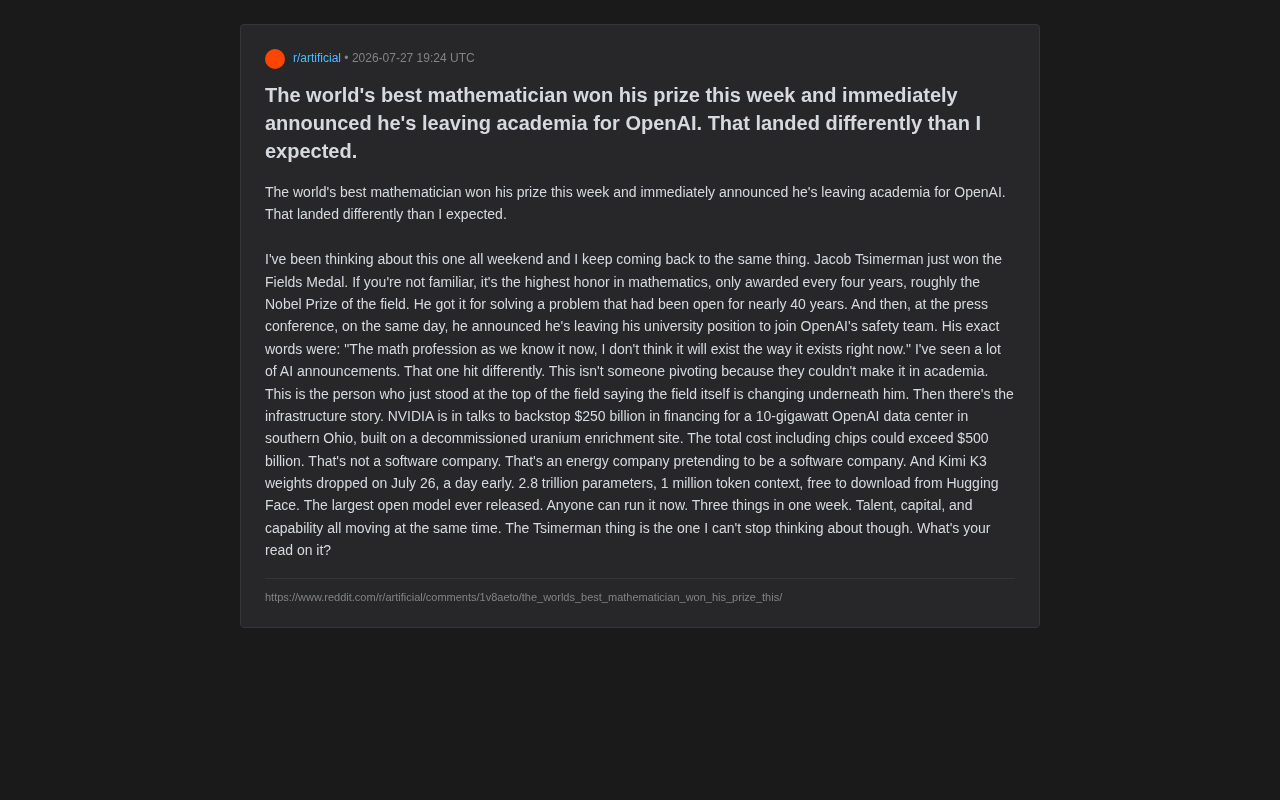
What makes this statement so striking is not the act of "moving to industry" itself — academics joining corporations is nothing new. The real weight lies in who said it: someone who had just reached the very summit of the field. He wasn't pivoting because of frustration with academia; he was declaring, at the very moment of receiving its highest recognition, that the ground beneath the entire field was fundamentally shifting.
When Top Scholars Begin to Question the Field Itself
Not an Escape, but a Judgment About the Future
What deserves deep reflection is the timing and the identity of the speaker. Someone who just received the Fields Medal should, by all accounts, be the person with the most reason to stay in academia — to enjoy the prestige and influence that come with it. His decision to walk away is essentially a judgment about the future, not a fallback plan.
When the person most qualified to assess the value of a field chooses to turn away at its peak, the signal is often more persuasive than any industry report. What he was implying is AI's deep transformation of mathematical research — not just assisting with computation, but potentially redefining what "mathematical work" means altogether.
In recent years, AI's advances in mathematics have gone far beyond auxiliary computation. DeepMind's AlphaProof solved silver-medal-level problems at the 2024 International Mathematical Olympiad. The combination of formal proof languages like Lean 4 with AI is changing the way theorems are proved. Large language models can already perform at a graduate level in certain math competitions. The deeper shift is this: AI is exploring mathematical structures that human mathematicians have not yet touched — for example, DeepMind collaborated with mathematicians to discover new patterns in combinatorics and topology. These developments suggest that mathematical research may be transitioning from a paradigm of "individual inspiration" to one of "human-AI collaboration or even AI-led exploration."
The Future of Mathematics as a Profession
Tsimerman's statement touches on an emerging question: if AI systems can independently prove theorems and explore mathematical structures, how will the traditional model of mathematical careers — centered on "individual intellectual breakthroughs" — evolve?
The detail that he chose to join the safety team rather than a pure research role is also thought-provoking — it suggests his concern extends beyond the boundaries of capability to the risks of capability running unchecked. OpenAI's safety team is responsible for research on ensuring advanced AI systems remain aligned with human intent, preventing potentially catastrophic failure modes. Their work includes interpretability research, red-teaming, and improvements to Reinforcement Learning from Human Feedback (RLHF). Notably, in 2024, OpenAI experienced the departure of core safety team members — Superalignment team leaders Ilya Sutskever and Jan Leike both left, raising external doubts about whether OpenAI truly prioritizes safety. Against this backdrop, Tsimerman's arrival both injects top-tier mathematical thinking into the safety team and may reflect his serious attitude toward AI risk.
Capital and Infrastructure: An Energy-Scale Gamble
NVIDIA's $250 Billion Data Center Financing
If talent migration is a soft signal, then the flow of capital provides a hard footnote. According to the post, NVIDIA is in talks to provide up to $250 billion in financing for an OpenAI data center in southern Ohio with a capacity of 10 gigawatts. The data center is being built on the site of a retired uranium enrichment facility, and the total cost including chips could exceed $500 billion.
To understand the scale of 10 gigawatts, some reference points help: a typical nuclear power plant generates about 1–1.5 gigawatts, and New York City's peak electricity consumption is approximately 11 gigawatts. This means a single data center planned by OpenAI would require the equivalent of 7–10 nuclear power plants to supply its electricity. For comparison, the combined power consumption of all Google data centers worldwide in 2023 was approximately 2.9 gigawatts of sustained power. The strategic choice of the retired uranium enrichment plant in Piketon, Ohio is highly sound from an engineering standpoint: the facility was formerly a gas diffusion plant operated by the U.S. Department of Energy, equipped with high-capacity transmission lines connected to the regional high-voltage grid, and the surrounding land has already undergone environmental assessment, significantly shortening the project approval timeline.
The author's incisive comment: "This is not a software company. This is an energy company pretending to be a software company."
This metaphor captures the core transformation in the current AI arms race. When the bottleneck for compute extends from chips to electricity, land, and infrastructure, AI competition fundamentally escalates from a technology race to an industrial and energy race.
NVIDIA's act of providing $250 billion in financing also marks a deep shift in its business model. Traditionally, NVIDIA has been a designer and seller of GPU chips; now it is evolving into a full-stack provider of AI infrastructure and a financial intermediary. This is analogous to how General Electric (GE) used GE Capital in the 20th century to finance customers' purchases of its power generation equipment. By financing data center construction, NVIDIA not only locks in chip orders (the project will procure massive quantities of H100/B200-class GPUs) but also embeds itself in its customers' capital structures, forming deeply bound relationships. This "sell the shovels + provide the loans" model elevates NVIDIA's position in the AI value chain from supplier to core node of the ecosystem.
Industry Concerns from Capital Concentration
Capital concentration at this scale also means a handful of companies are building nearly insurmountable moats. When individual projects require investments measured in "hundreds of billions of dollars," the list of players who can participate in this game shrinks dramatically. This has profound implications for the competitive landscape of the entire industry and even for the democratization of technology.
Capability Goes Open: The Largest Open-Source Model in History — Kimi K3
The Staggering Scale of 2.8 Trillion Parameters
Just as capital was concentrating at unprecedented levels, the capability side saw movement in the opposite direction. According to the post, Kimi K3's model weights were released a day early on Hugging Face on July 26: 2.8 trillion parameters, a 1-million-token context window, free to download. It was described as "the largest open-source model ever released" — and anyone can now run it.
Running a 2.8-trillion-parameter model presents enormous engineering challenges. At FP16 precision, simply storing the model weights requires approximately 5.6TB of GPU memory, meaning dozens of high-end GPUs (such as the NVIDIA H100 with 80GB of memory each) are needed just for inference. The million-token context window further amplifies memory requirements — the memory usage of standard attention mechanisms scales quadratically with sequence length. In practice, "anyone can run it" would be more accurately stated as "any organization with a sizable GPU cluster can run it." However, quantization techniques (such as INT4/INT8), model parallelism, and Mixture of Experts (MoE) architectures (if K3 uses one, the active parameter count would be far smaller than the total) can significantly lower the barrier to entry.
Hugging Face is currently the largest hosting platform for AI models and datasets, often called "the GitHub of AI." It provides model weight downloads, inference APIs, dataset hosting, and collaborative development tools, and has become the core infrastructure of the open-source AI community. As of 2025, the platform hosts over 1 million models. Releasing open-source models through Hugging Face has become industry standard — from Meta's LLaMA series to Mistral and Qwen, virtually all major open-source releases choose this platform.
Note: The parameter counts and release details above come from a single Reddit post and have not been independently cross-verified. Readers should exercise appropriate caution.
The Deep Tension Between Open Source and Closed Source
The open-source release of Kimi K3 stands in stark contrast to OpenAI's hundred-billion-dollar private infrastructure. On one side, extreme concentration of capital and infrastructure; on the other, the public release of cutting-edge capabilities. The coexistence of these two forces constitutes the most profound tension in today's AI ecosystem: will capability trend toward monopoly by a few giants, or diffuse broadly through open source?
For developers and researchers, a 2.8-trillion-parameter, million-token-context open-source model means that capabilities previously accessible only to Big Tech are being pushed out to the broader community. This represents both opportunity and new challenges in safety and governance — when top-tier capabilities can be obtained by any organization, the risk of misuse expands accordingly. This echoes precisely the logic behind Tsimerman's choice to join the safety team.
Where Three Threads Converge: Signals That AI Is Reshaping Everything
The author's final summary: three things happened within a single week — talent, capital, and capability all moved simultaneously. Top talent voted with their feet, declaring that the field is changing; capital bet on infrastructure at energy-industry scale; and capability diffused outward through the largest open-source model in history.
The synchronized movement of these three threads may be the key to understanding the current pace of AI development. They represent the redistribution of intellectual resources, material resources, and technological resources, respectively — and all three point toward the same conclusion: AI is no longer a tool for a single vertical industry but is becoming a force that reshapes the foundational logic of every discipline and every sector.
As for Tsimerman's statement that "the mathematical profession will not continue to exist in its current form," we might extend it into a more universal question: how many other fields will hear similar pronouncements from their own top practitioners in the coming years? This is a question every professional should think about seriously.
Related articles

The Shoggoth Metaphor: Deep Anxieties and Reflections on AI Alignment
The Shoggoth metaphor compares LLMs to Cthulhu monsters wearing smiley masks, revealing core AI alignment challenges. Explore this AI cultural symbol's origins and its implications for RLHF limitations and the capability-understanding gap.

A Beginner's Guide to AI Economics Research: A Systematic Roadmap for Economics PhD Students
How should economics PhD students systematically enter the vast field of AI economics? This guide maps four research threads, literature methods, and technical priorities for building expertise.

Self-Hosted ASR Models vs. Cloud APIs: A Comprehensive Cost and Reliability Comparison
In-depth analysis comparing self-hosted ASR open-source models vs. cloud speech recognition APIs like Google, covering cost differences, reliability, and break-even calculations for Whisper, IBM Granite, and more.