A Beginner's Guide to AI Economics Research: A Systematic Roadmap for Economics PhD Students

A systematic roadmap for economics PhD students to navigate the four main research threads of AI economics.
This article addresses a common challenge for economics PhD students entering AI economics research. It maps four main research threads—AI as prediction technology, automation and labor markets, productivity paradoxes, and behavioral economics intersections—and provides practical guidance on literature navigation, technical skill priorities, and finding a research entry point.
A Real Dilemma: Where to Start with AI Economics?
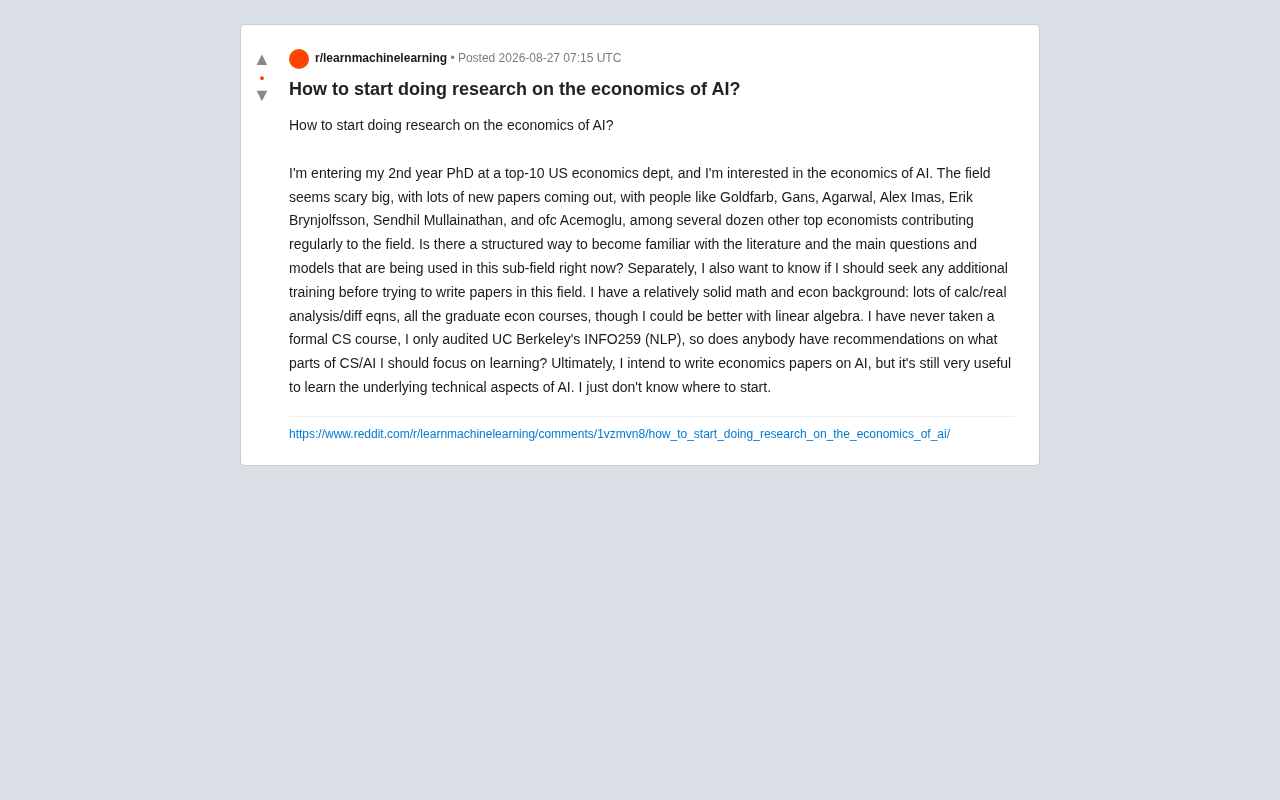
Recently, a second-year PhD student at a top-ten U.S. economics department posed a highly representative question on Reddit: How do you start doing research on the Economics of AI?
The student admitted that the field is "intimidatingly vast"—new papers emerge daily, and dozens of top economists including Avi Goldfarb, Joshua Gans, Ajay Agrawal, Alex Imas, Erik Brynjolfsson, Sendhil Mullainathan, and the unavoidable Daron Acemoglu (co-recipient of the 2024 Nobel Prize in Economics) are continuously contributing to it. These scholars represent the core forces of different schools within AI economics: Goldfarb, Gans, and Agrawal are all based at the University of Toronto's Rotman School of Management, where they co-founded the Creative Destruction Lab, focusing on applying economic thinking to AI commercialization analysis; Brynjolfsson is the director of Stanford's Digital Economy Lab, with long-standing research on the relationship between information technology and productivity; Mullainathan, formerly a Harvard professor now at the University of Chicago, is a pioneer in bringing machine learning methods into social science research; and Acemoglu, an MIT economics professor, whose task-based framework for analyzing technological change and labor markets has become the standard tool for analyzing the effects of automation.
The student's confusion pointed to two core questions: First, how to systematically master the literature, core questions, and mainstream models of this subfield; and second, whether additional technical training is needed before writing papers—especially since he had never taken a formal computer science (CS) course, having only audited UC Berkeley's INFO259 (Natural Language Processing).
This question deserves deeper exploration because it touches on a more universal reality: when AI becomes a hot direction in economics research, how should researchers with traditional economics backgrounds build their knowledge systems.
The Four Main Research Threads in AI Economics
To get started in any field, you first need to understand its problem landscape. AI economics can be roughly divided into four main threads, and mapping these out is more important than blindly reading papers.
Thread One: Economic Analysis of AI as a "Prediction Technology"
Represented by Agrawal, Gans, and Goldfarb's co-authored Prediction Machines, this school abstracts the essence of AI as "a dramatic reduction in the cost of prediction." When prediction becomes cheap, it changes the relative value of "prediction" and "judgment" in economic activity, thereby reshaping corporate decision-making, task allocation, and even business models. The core economic intuition of this framework derives from a fundamental principle in microeconomics: when the price of a certain input drops significantly, demand for that input rises, while demand for complements (in this case, human judgment) also rises, and the value of substitutes declines. This is the most elegant framework for understanding AI's economic impact and the most natural entry point for economists—strongly recommended as a starting point.
Thread Two: AI Automation's Impact on Labor Markets
This is the core battlefield of Acemoglu and his collaborators (such as Pascual Restrepo). They constructed the "task-based framework," analyzing how automation can simultaneously displace labor while also potentially creating new tasks, and exploring the distributional effects of technological progress on wages, employment, and inequality. This framework represents an important breakthrough from traditional production function approaches—traditional models typically model technological progress as "labor-augmenting" or "capital-augmenting," unable to precisely capture automation's differentiated impact on different types of work. The task model decomposes the production process into a series of discrete tasks, each of which can be performed by humans or machines. The key insight is that automation, while eliminating old tasks, also creates new tasks where humans have comparative advantage through a "reinstatement effect." This explains why historically massive technological changes haven't led to persistent large-scale unemployment, while also pointing out that when the pace of automation exceeds the pace of new task creation, workers may face wage declines and rising inequality. Acemoglu's estimates of AI's macroeconomic impact—relatively conservative productivity growth predictions—have also sparked widespread academic debate.
Thread Three: AI-Driven Productivity and Innovation Research
Erik Brynjolfsson is the representative figure in this direction, focusing on how AI affects firm productivity, the productivity paradox (why powerful technologies aren't immediately reflected in statistical data), and generative AI's actual productivity gains for knowledge workers (such as the widely discussed customer service experiment). The Productivity Paradox was first articulated by Robert Solow in 1987 with his famous observation that "you can see the computer age everywhere except in the productivity statistics." Brynjolfsson has proposed multiple explanations: measurement lag—the benefits of new technologies require organizational change and complementary investments to manifest; limitations of statistical methods—traditional GDP accounting struggles to capture consumer surplus from digital products; implementation delays—from technology availability to large-scale adoption to productivity gains typically takes decades, with electricity and steam engines having experienced similar delays historically. This framework is extremely important for current AI discussions: despite ChatGPT and similar tools appearing revolutionary, macroeconomic productivity data may take years to reflect their impact.
Thread Four: The Intersection of AI and Behavioral Economics
Alex Imas, Sendhil Mullainathan, and others use AI (especially machine learning methods) as tools to study human behavior and decision-making biases, or conversely study behavioral patterns in human-AI interaction. One of Mullainathan's important contributions is demonstrating how machine learning algorithms can detect systematic biases in human decision-making—for example, using algorithms to predict bail decisions by judges, revealing potential racial bias. What makes this research direction unique is its bidirectionality: AI is both a research subject (how people interact with AI, whether they over-trust or under-trust AI recommendations) and a research tool (using machine learning to discover behavioral patterns that traditional econometric methods struggle to identify).
Once you've mapped out these four threads, the anxiety of the field being "intimidatingly vast" diminishes considerably—you don't need to master everything, but rather find your most interesting entry point first.
Practical Methods for Building an AI Economics Literature Map
Facing a flood of new papers, passively reading them one by one is extremely inefficient. The following structured approaches can help you build your knowledge system faster.
Start with surveys and top conferences. NBER (National Bureau of Economic Research) regularly hosts "Economics of AI" conferences and publishes proceedings, making this the most concentrated resource for grasping frontier issues. NBER is one of the world's most influential economics research organizations, and its working paper series is the de facto preprint standard in economics. This AI-focused conference has been organized since 2017 by Agrawal, Gans, and Goldfarb, with roughly 20 papers invited for in-depth discussion each time. Conference papers are later compiled into books such as The Economics of Artificial Intelligence: An Agenda, not only showcasing the latest research but also helping shape the subfield's research agenda and methodological consensus through concentrated discussion. Additionally, reading survey articles on AI from top journals (AER, QJE, JPE, Econometrica) in recent years can quickly build framework-level understanding.
Use citation networks to trace intellectual lineages. Rather than working backward from the latest papers, start by carefully reading a few foundational works, then trace forward along their citation chains. Tools like Google Scholar, Connected Papers, and Semantic Scholar can visualize citation relationships between papers, helping you quickly identify which are must-reads and which are peripheral works.
Track core authors' latest work. Since you've already identified names like Acemoglu, Brynjolfsson, and Goldfarb, directly following their personal pages and working papers often captures research trends better than waiting for formal publication. Economics publication cycles are typically long, often taking two to four years from submission to formal publication, making working papers the real window into the academic frontier.
Leverage PhD course resources. Some top institutions have already developed PhD courses on AI economics, and their syllabi are carefully curated reading lists that are publicly available.
How Much AI Technical Knowledge Do Economics PhDs Need?
What this PhD student was most conflicted about was really the technical threshold question. Here's a pragmatic principle: Your goal is to write economics papers, not to become a machine learning researcher. Technical learning should serve research needs, not pursue comprehensiveness.
Mathematical Foundations: Linear Algebra Is the Key Gap
He mentioned having solid training in calculus, real analysis, differential equations, and graduate economics—this is already quite sufficient. He also recognized that his linear algebra is weak—this indeed needs to be addressed, because virtually all machine learning methods are built on linear algebra (matrix operations, eigendecomposition, singular value decomposition, etc.). Specifically, Principal Component Analysis (PCA) is essentially solving the eigendecomposition of a covariance matrix, neural network forward propagation is matrix multiplication, recommender systems rely on matrix factorization, and the attention mechanism in large language models is also implemented through matrix operations. For economics PhDs, Gilbert Strang's Introduction to Linear Algebra or his MIT open course is an excellent supplementary resource—the key is to understand the geometric intuition behind vector spaces, matrix decomposition, and least squares. Additionally, probability theory, statistical learning theory, and optimization theory are also critical for understanding modern AI methods.
Machine Learning Techniques: Master Them in Priority Order
For researchers with an economics background, the recommended learning sequence by priority is:
- Machine learning fundamentals: Supervised/unsupervised learning, regularization, cross-validation, and basic principles of tree models and neural networks. Classic textbooks like An Introduction to Statistical Learning (ISL) are extremely accessible for those with an economics background. ISL, co-authored by Gareth James, Daniela Witten, Trevor Hastie, and Robert Tibshirani, is characterized by its intuition- and application-oriented approach, moderate mathematical derivations, and R code implementations, making it ideal for readers transitioning from statistics and econometrics to machine learning.
- Causal machine learning methods: This is currently the hottest methodological direction in economics. The intersection of causal inference and machine learning pioneered by Susan Athey, Guido Imbens (2021 Nobel laureate in Economics), and others has become standard in empirical research and deserves priority investment. Double/Debiased Machine Learning (DML), proposed by Victor Chernozhukov et al., allows researchers to use machine learning for "debiasing" in the presence of many confounding variables while maintaining valid inference on core causal parameters. Causal Forest, developed by Athey and Imbens, is used to estimate heterogeneous treatment effects—the differentiated impact of policies or interventions on different individuals. These methods are now widely applied in policy evaluation, personalized pricing, and platform economy research.
- Deep learning and large language model principles: If your research direction involves generative AI, understanding the Transformer architecture, pre-training, and fine-tuning mechanisms will be very helpful. The Transformer architecture was proposed by a Google team in the 2017 paper Attention Is All You Need, with its core innovation being the self-attention mechanism, which allows models to attend to information at all positions simultaneously when processing sequential data, rather than processing step by step as previous recurrent neural networks did. This architecture is the foundation of all mainstream large language models including the GPT series, BERT, and Claude. The NLP course he audited is a good starting point for this.
- Python programming ability: Combined with tools like PyTorch and scikit-learn, having the ability to reproduce and call models is sufficient—there's no need to pursue engineering-level mastery.
It's worth emphasizing that understanding AI's technical underpinnings isn't just about "using" it, but more about accurately "modeling" it—only by truly understanding a technology's capability boundaries and cost structure can you write rigorous economic analysis.
Core Advice for All Interdisciplinary Researchers
This PhD student's confusion is actually a microcosm of what many researchers face today. The boom in AI economics fundamentally reflects a deeper trend: AI is becoming a General Purpose Technology (GPT), whose economic impact requires serious academic research to clarify.
The concept of General Purpose Technology was formally proposed by economic historians Timothy Bresnahan and Manuel Trajtenberg in 1995, referring to technologies with broad applicability, continuous improvement potential, and the ability to catalyze extensive complementary innovations. Technologies historically classified in this category include the steam engine, electricity, the internal combustion engine, and semiconductors. The core economic characteristic of GPTs is that they not only directly improve efficiency in their areas of use but, more importantly, stimulate waves of secondary innovation in downstream application domains through "innovational complementarities." If AI is indeed a GPT, its economic impact will far exceed any single industry application, but it also means that releasing its full potential requires extensive institutional adjustment, human capital investment, and organizational restructuring—a process that may span decades.
For researchers looking to enter AI economics, several core pieces of advice can be summarized as follows:
- Build the framework first, then read the details: Use the four main threads to construct a cognitive map and avoid getting lost in the sea of papers.
- Technology serves research: Shore up linear algebra and machine learning fundamentals, focus on mastering causal machine learning, and don't try to become an AI expert.
- Find a specific entry question: A vast field needs to be tackled through a specific, actionable research question, and exchanging ideas with advisors and scholars in the field is often more efficient than exploring alone.
Perhaps the most important point: in a rapidly evolving field, the best way to learn is often not to wait until you feel "fully prepared" before getting started, but to learn as you go while pursuing a specific question. No matter how large the field, it's never larger than a clear research question.
Related articles

Workbuddy for Absolute Beginners: How a Desktop AI Agent Fits Into Real Workflows
A beginner's guide to the Workbuddy desktop AI agent: installation, claiming credits, file management, and building automated workflows—compared with CodeX for fit and cost, helping professionals shift from AI question-askers to AI managers.

OpenAI's New Agent Stack: Computer Use, Decisions API, and Ultra-Fast Workflows
OpenAI Dev Day unveiled a new agent stack: Computer Use outperforms humans, Decisions API delivers ultra-low-latency classification via Luna, Agents API opens the same Computer Use capabilities, and GPT-6.1 Sol costs only one-seventh of Astra. Core updates, benchmark data, and developer insights.

Liang Wenfeng Open-Sources DeepInfo Inference Framework, Takes On U.S. Ban
DeepSeek open-sources its DeepInfo inference framework after its models, featuring GPU/CPU cross-pipelining, small-model prediction with large-model verification, and full Huawei Ascend and NVIDIA chip support—facing the U.S. federal ban head-on. This article analyzes its significance for AI deployment and open-source strategy.