Financial Credit AI Large Models in Practice: How the Decision Layer Integrates Machine Learning and Agents

Financial risk control should integrate traditional machine learning with large models at the decision layer, balancing recognition and credibility.
Based on Bilibili's Financial Credit AI Large Model Bootcamp first lesson, the article proposes a four-layer architecture for online AI risk control: data, features, models, and decision layers, with the decision layer as the key to integration. The core idea is to combine machine learning with Agent large models rather than relying on either alone—improving recognition coverage while constraining large model bias through traditional model threshold control. Using a 5,000 yuan credit transaction as an example, it explains setting cutoff thresholds based on lift distribution, making hard decisions only in high-discrimination intervals, and requiring refined integrated judgment for gray-zone customers between 0.3 and 0.7.
In the field of financial credit risk control, the application of large models is moving from proof of concept to production deployment. But a common confusion remains: large models have strong recognition capabilities but are hard to fully trust; traditional machine learning models are stable and controllable but fall short in accuracy and coverage. The approach offered in the first lesson of Bilibili's "Financial Credit AI Large Model Bootcamp" is to integrate the two at the decision layer, forming a complementary rather than substitutive relationship.
Four-Layer Architecture: A Complete Chain from Data to Decision
According to the course summary, before making online production calls to an AI risk control system, one needs to understand four layers: the data layer, feature layer, model layer, and decision layer. The data layer is responsible for collecting input materials—no matter what large model or machine learning method is used, nothing works without data. The feature layer does not necessarily depend on large models; conventional machine learning, deep learning, and statistical methods can all accomplish feature engineering. The model layer offers even more choices: tree models like XGBoost and GBM, graph algorithms like Bolt and SAGE, and LLM-based Agent solutions are all used in real scenarios.
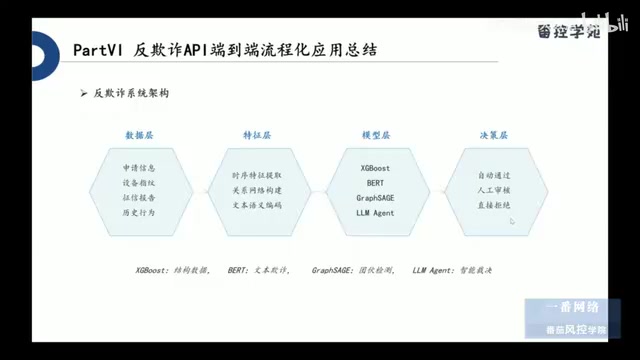
The truly critical point lies in the decision layer. The core viewpoint emphasized in the course is: don't rely solely on a large model—that leaves you uneasy; and don't rely solely on fast models (traditional quick models)—though capable, their accuracy and recognition coverage always feel incomplete. Combining machine learning with Agent large models for decision-making can both improve recognition and avoid the bias that large models may introduce. This is the more realistic and compelling application scenario in current financial risk control.
A Risk Control Decision Example for a Transaction Request
The course uses a concrete example to illustrate how the decision layer operates. Suppose a user has already been granted a 5,000 yuan credit limit and now submits a transaction request. The production decision engine API call behind it has a model score with "boundary judgment capability" (transliterated as "擦机壁"), a score trained in advance and deployed online, scoring by calling third-party features and outputting a value between 0 and 1.
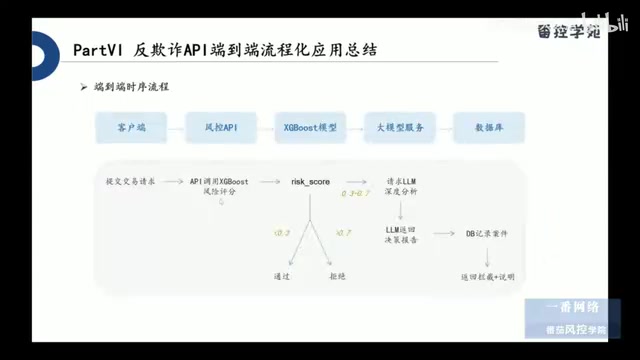
The next key step is strategy formulation. Strategy analysts need to set cutoff thresholds based on the lift distribution. The course points out that if the score is above 0.7 and the lift is roughly three times or higher, the request can be directly rejected. Here's an important reminder: when doing lift distribution and cutoff analysis, you must find intervals with particularly high discrimination. If the lift at a certain threshold is only 1.5 times, never reject customers based on it—because the goal of risk control strategy is to precisely reject those reliably bad customers. Rejecting when lift isn't high enough will wrongly harm good customers and cause unnecessary attrition.
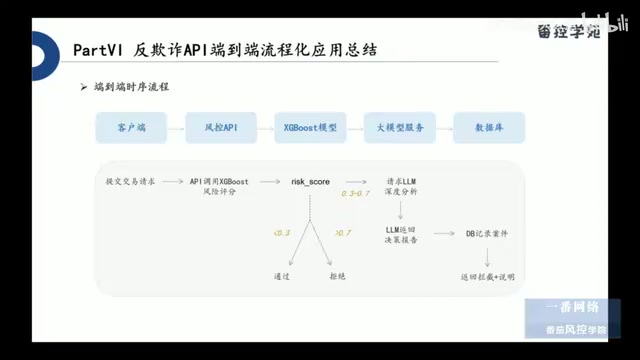
The same logic applies to the low-score segment. If a user's score is below 0.1 and the lift in that interval performs particularly well, the request can be directly approved. What's truly tricky is the gray-zone customers between 0.3 and 0.7—the model identifies 0.6 and 0.7 as leaning bad, 0.3 and 0.7 as leaning good, but all are relatively close to the 0.5 midpoint prediction. The course assumes a normal distribution scenario to illustrate that these customers are in a gray zone—they can neither be simply rejected nor directly approved, and require more refined strategy handling.
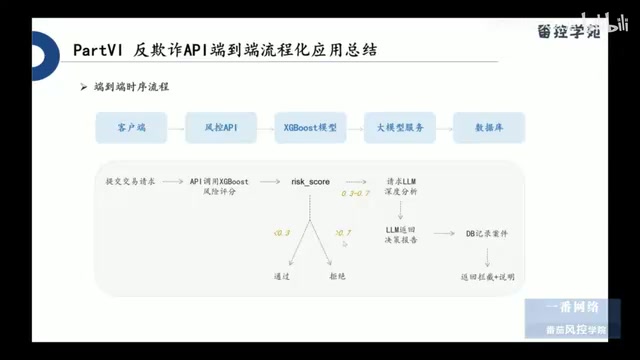
Interestingly, the 0.3 to 0.7 interval mentioned in the course is not a real risk control step size, but rather an illustration of the gray zone near 0.5 under a normal distribution assumption. The point of this example is that the probability scores output by large models need to be combined with traditional risk control's lift analysis and cutoff strategies to be translated into executable decision rules.
lift (Lift) is a core metric in risk control strategy for measuring a model's discrimination ability. It is typically defined as the ratio of the bad customer proportion within a score interval to the bad customer proportion in the overall sample. For example, if the overall bad debt rate is 5%, and the bad debt rate in the interval with scores above 0.7 reaches 15%, then the lift for that interval is 3x. The higher the lift, the stronger the "capture efficiency" for bad customers in that interval, and only then can strategy analysts confidently set hard rejection rules based on it. If lift is only 1.5x, it means the bad debt rate in that interval is only 50% higher than average, and the probability of wrongly harming good customers rises significantly—making the cutoff not worth it. Therefore, lift distribution analysis is the bridge connecting model scores to business decisions, and the quantitative basis for determining "which score ranges can be safely rejected or approved."
cutoff threshold is the decision boundary in risk control strategy. After the model outputs a probability score between 0 and 1, strategy personnel need to set one or more cut points to map continuous scores into discrete actions such as "reject," "approve," or "manual review." Cutoffs cannot be set arbitrarily but must incorporate multiple constraints including lift distribution, approval rate targets, and bad debt tolerance. High-segment cutoffs are used for precise rejection, low-segment cutoffs for quick approval, and the intermediate gray zone retains more complex judgment logic. The cutoff is essentially the key parameter that translates model capabilities into business rules.
The Deeper Logic of Integrated Decision-Making
Why combine machine learning with Agent large models? The course offers a two-way rationale: machine learning models provide a stable recognition baseline and interpretable segmentation strategies, while large models supplement the understanding of complex patterns and unstructured information. Using either alone means missing either coverage or credibility. After integration, the decision layer can ensure both the breadth of recognition and constrain the bias risk of large models through traditional model threshold control.
This approach also responds to the essential requirement of financial risk control—not pursuing the optimal metrics of a single model, but making risk-return balanced decisions under production constraints of interpretability, auditability, and rollback capability. The handling of gray-zone customers particularly reflects this: high and low score segments are quickly routed using lift rules, while the middle zone is left to more complex integrated judgment, rather than letting any single model make the call alone.
Agent large models in the risk control context typically refer to large language model applications with tool-calling, multi-step reasoning, and external information retrieval capabilities. Unlike traditional classification models that output only a score, an Agent can autonomously orchestrate the calling workflow: first read the user's transaction context, then call third-party feature interfaces, then combine unstructured information (such as text descriptions and device information) for comprehensive judgment, ultimately outputting a probability or decision recommendation. The advantage of this form lies in handling complex, long-tail scenarios where rules are hard to enumerate; the disadvantages are unstable output, opaque reasoning chains, and higher cost. Therefore, Agent large models are more suitable for intervening in gray zones or complex cases, rather than replacing traditional models for full-scale hard decisions.
Practical Insights
For teams advancing AI risk control deployment, this lesson conveys several actionable points. Before production calls, clarify the responsibilities of the four layers—data, features, models, and decisions—and avoid pinning all hopes on a single large model. When formulating strategies, rigorously examine the lift distribution and set hard cutoffs only in intervals with sufficient discrimination, leaving room for manual or integrated rule intervention in gray zones. The relationship between machine learning and large models is not substitution, but each fulfilling its role at the decision layer with cross-validation.
These experiences come from the bootcamp's interim summary. Although the cases are simplified, the four-layer architecture and integrated decision-making approach have direct reference value for financial credit scenarios.
One-line Summary
Financial risk control should integrate traditional machine learning with large models at the decision layer, balancing recognition and credibility.
Paragraph Summary
Based on the first lesson of Bilibili's "Financial Credit AI Large Model Bootcamp," the article proposes that online AI risk control should understand a four-layer architecture: data layer, feature layer, model layer, and decision layer, with the decision layer being the key to integration. The core viewpoint is not to rely solely on large models or traditional models, but to combine machine learning with Agent large models—improving recognition coverage while constraining large model bias through traditional model threshold control. Using a 5,000 yuan credit transaction request as an example, the article explains that strategy analysts need to set cutoff thresholds based on lift distribution, making hard reject or approve decisions only in intervals with sufficient discrimination, while gray-zone customers between 0.3 and 0.7 require more refined integrated judgment. Ultimately, it emphasizes that the essence of risk control is making risk-return balanced decisions under constraints of interpretability, auditability, and rollback capability.
Related articles

A 19-Year-Old's Rental Horror Story: Ceiling Collapse, Bug Infestation, and the Lessons It Taught Me
At 19, my first off-campus rental brought bug infestations, no heat, a collapsed ceiling, and a ruined laptop with no renter's insurance. Here are the hard-won lessons for first-time student renters.

Veda Nurse's Cranial Nerve Exam: Why ASMR Role-Play Is Going Viral
Bilibili creator Veda's cranial nerve exam ASMR video goes viral, blending humor and sensory triggers through nurse role-play. This article analyzes its unique appeal and the audience psychology behind ASMR role-play.

LG Cinebeam AI Review: 120-Inch Giant Screen + 3000 Lumens, a New Choice for the Living Room Theater
LG Cinebeam AI projector review: 3000 ANSI lumens, 4K, 100 inches from about 8 cm and 120 inches from about 18 cm. Built-in webOS, AI Concierge voice recommendations, AI Sound Pro 11.1.2 virtual surround, and Game Optimizer—positioned for fixed living room installation, complementing the portable Cinebeam S.