Fine-Tuning DETR with 500 Images: A Practical Guide to Efficient and Accurate Annotation

Annotation workflow for fine-tuning DETR with 500 images: tool selection, dual-model pre-annotation, and quality control strategies.
Addressing the small-scale annotation challenge of fine-tuning Meta DETR with only 500 images, this article proposes a workflow balancing quality and labor cost. It compares CVAT and Roboflow—CVAT for self-hosted refinement and dual review, Roboflow for quick draft generation, usable together. It recommends chaining Grounding DINO and OWLv2 to reduce miss rates via high-recall drafts plus secondary detection. For cold start, annotate 80–100 seed images to fine-tune a lightweight detector, then re-pre-annotate the rest and take the union. Quality control uses cross-comparison, category cards, and blind reviews. It also covers COCO format notes—coordinate conversion, category IDs starting at 1, keeping empty annotations—and a pre-training checklist.
Why the Annotation Strategy for 500 Images Matters So Much
When fine-tuning Meta DETR, 500 images represent a typical small-scale custom dataset. Annotation quality directly determines the model's upper bound—incorrect boxes, missed annotations, and inconsistent categories get amplified by DETR's set prediction loss, leading to training instability or convergence to suboptimal solutions. The community's core demand is clear: build high-quality annotations with as little manual effort as possible while ensuring reliability.
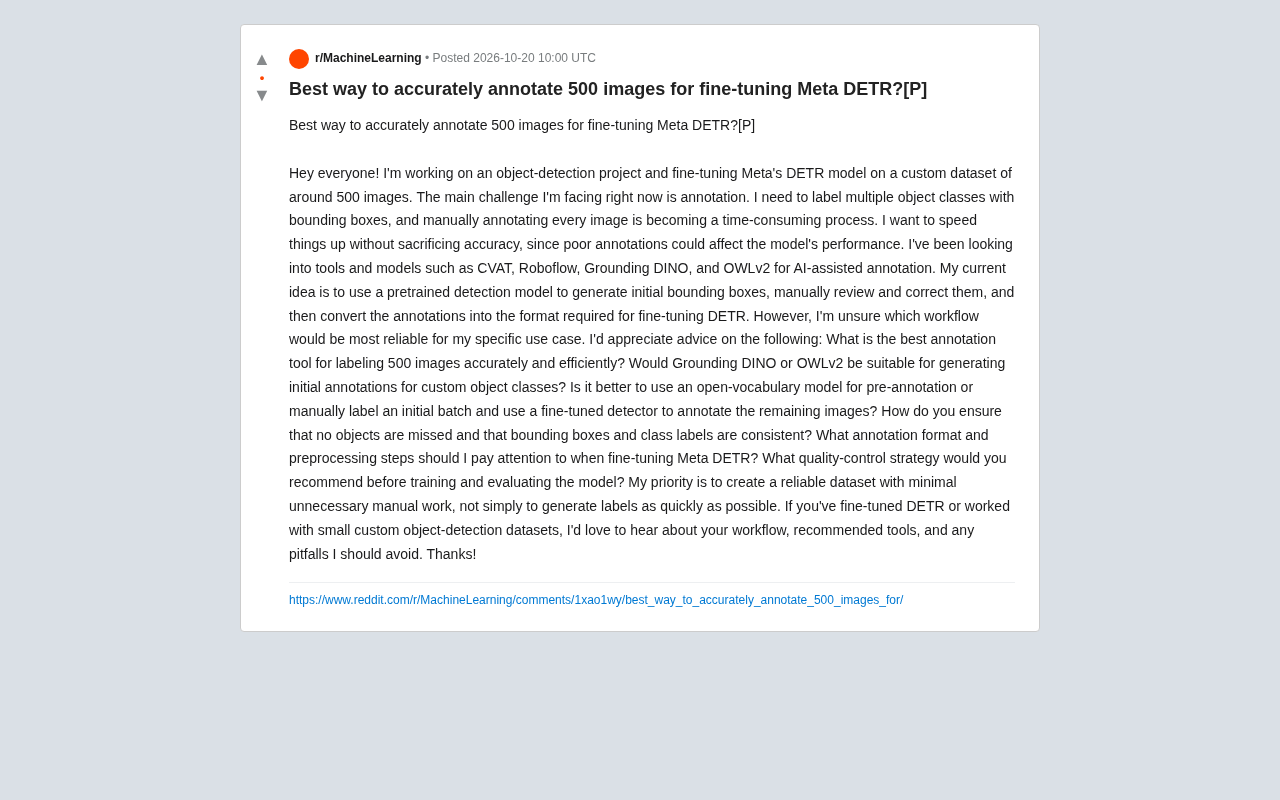
This post proposes a pragmatic workflow: use a pretrained detection model to generate initial boxes, manually correct them, then convert to the format DETR requires. The direction is right, but the tool selection, pre-annotation models, and quality control steps need more careful trade-off analysis.
How to Choose an Annotation Tool: CVAT vs. Roboflow
CVAT is one of the most feature-complete open-source options, supporting polygons, bounding boxes, keypoints, built-in interpolation tracking, and multi-person collaborative review workflows. For 500 images with multi-category bounding box annotation, CVAT's Review mode allows one person to annotate and another to review—ideal for two-person quality control. Its API and Python SDK also make batch export convenient.
Roboflow's strengths lie in its hosted service and ecosystem integrations: the Auto-Label feature can directly call pretrained models to generate drafts, the annotation interface is lightweight, and export formats cover COCO, YOLO, Pascal VOC, and more. However, the free tier is limited, and data must be uploaded to the cloud, which requires consideration for privacy-sensitive projects.
Recommendation: If your team has DevOps capability and values data autonomy, choose self-hosted CVAT; if you want out-of-the-box usability and fast iteration, Roboflow is less hassle. Both support importing pre-annotation results, so they can be combined—use Roboflow to generate drafts and import them into CVAT for refinement.
Pre-Annotation Models: Grounding DINO or OWLv2?
The core value of open-vocabulary detection models is generating candidate boxes from text prompts, reducing the work of drawing boxes from scratch.
Grounding DINO performs strongly on zero-shot detection benchmarks and has high recall for custom categories (described in natural language), making it suitable as a draft generator. Its output boxes tend to be "loose" and need manual tightening, but it has relatively few misses—which is friendlier for the goal of "ensuring nothing is missed."
OWLv2 also supports open-vocabulary detection and has better precision on some fine-grained categories, but it is more sensitive to prompt wording and may require multiple adjustments to the text query to achieve ideal recall.
Practical recommendation: Don't choose one over the other—use them in series. First use Grounding DINO with a higher recall threshold to generate candidate boxes, then use OWLv2 to perform secondary detection on low-confidence regions, and merge the results for manual review. The two models complement each other and can significantly reduce the miss rate.
Open-Vocabulary Detection is a detection paradigm that lets a model accept arbitrary text descriptions as category queries at inference time, rather than only recognizing categories fixed in the training set. A typical approach aligns image region features with text embeddings, turning "detect a certain category" into "find the region in the image that best matches the text semantics." This allows users to describe custom targets in natural language (e.g., "rusted bolt") without retraining, making it very suitable for cold-start pre-annotation of small datasets. However, the recall of such models is strongly correlated with prompt wording, and performance may be unstable on domains outside the training distribution (e.g., industrial, medical), so they are usually only used as draft generators and still require manual review and correction.
Cold-Start Strategy: Open-Vocabulary Pre-Annotation vs. Annotate a Batch First, Then Fine-Tune
This is the most critical question in the post. The two routes have different applicable scenarios:
Route A: Use an open-vocabulary model to directly pre-annotate all 500 images
- Pros: No waiting; get drafts immediately
- Cons: Open-vocabulary models may have insufficient recall for domain-specific categories (e.g., industrial parts, medical imaging), and draft quality is unstable
Route B: Manually annotate 50–100 images precisely first, fine-tune a detector, then use it to annotate the remaining images
- Pros: The fine-tuned model better understands your data distribution, and pre-annotation quality improves with iteration
- Cons: Requires an initial round of manual annotation
Recommended compromise: First manually annotate 80–100 images precisely as a "seed set," while using Grounding DINO to generate drafts for all images. Fine-tune a lightweight detector (possibly even a small-scale version of DETR itself) on the seed set, then use it to re-pre-annotate the remaining 400 images. Take the union of the two rounds of pre-annotation results, and have humans only confirm and correct. This controls cold-start costs while leveraging the data's own distribution information.
How to Ensure No Misses and Category Consistency
Missed annotations and category drift are the two hidden killers of small-dataset annotation. Actionable quality control measures include:
- Two-person independent annotation + cross-comparison: Sample 10%–15% of images for independent annotation by two people, and calculate IoU and category agreement rate. Disagreement samples should be reviewed first, as they often expose ambiguities in the annotation guidelines.
- Pre-annotation union strategy: Take the union of outputs from the open-vocabulary model and the fine-tuned detector; humans only need to delete false positives rather than add missed detections from scratch—both the psychological burden and the miss rate decrease.
- Category definition cards: Write a one-sentence criterion for each category (with positive and negative example screenshots) and display it pinned during annotation. DETR is sensitive to category semantic confusion; clear boundary definitions are more effective than after-the-fact corrections.
- Periodic "blind review": After every 100 images, randomly sample 10 and re-annotate them without looking at existing annotations, then compare differences.
IoU (Intersection over Union) is a metric measuring the degree of overlap between two bounding boxes, calculated as the intersection area divided by the union area, ranging from 0 to 1. In annotation quality control, it is often used to compare whether two annotators drew consistent boxes for the same target: typically IoU ≥ 0.5 is considered an acceptable match, and below that threshold is considered a disagreement sample. Combined with category agreement rate (the proportion of the same target labeled as the same category), it can quantify annotation reliability. For models like DETR that are sensitive to annotation noise, using IoU and category agreement rate as sampling inspection metrics can more objectively reveal ambiguities in annotation guidelines than visual inspection alone, and guide subsequent revisions.
Format and Preprocessing Essentials for DETR Fine-Tuning
The official Meta DETR implementation (Facebook Research's DETR repository) uses COCO format annotation files. Key points to note:
- Bounding box format: COCO uses
[x_min, y_min, width, height]absolute pixel values, while many annotation tools export normalized[x_center, y_center, w, h]—be sure to verify during conversion. - Image size consistency: DETR by default scales the short side to 800 pixels and limits the long side to 1333 pixels. Annotation coordinates are based on the original image; the data loader automatically scales during preprocessing—do not manually change annotation coordinates.
- Category IDs start from 1: In COCO format, 0 is usually reserved for background, and DETR's category mapping must align with this.
- Images with empty annotations: Images containing no targets should also be kept in the dataset (with empty annotations), which helps the model learn to suppress background false positives.
Set Prediction Loss is the core training mechanism of DETR: the model outputs a fixed number of prediction boxes at once, and during training uses the Hungarian algorithm to perform optimal bipartite matching between predictions and ground-truth boxes, then computes classification loss and box regression loss on matched pairs, while unmatched predictions are pushed toward "no object." This means each ground-truth target must correspond to exactly one prediction; missed or duplicate annotations will disrupt matching stability, causing loss oscillation or convergence to suboptimal solutions. Therefore, annotation completeness (no misses) and uniqueness (no duplicates) are especially critical for DETR fine-tuning, which also explains why the strategy of taking the union of two-model pre-annotations and having humans delete false positives rather than add from scratch is adopted.
Pre-Training Quality Checklist
Before starting fine-tuning, it is recommended to run the following checks:
- Randomly visualize 30–50 "image + annotation box" samples and visually confirm box tightness
- Count instances per category; consider oversampling or adjusting loss weights when categories are severely imbalanced
- Check for abnormal boxes with width or height less than 2 pixels (usually operational errors)
- Confirm that the training/validation split is stratified by scene or source to avoid inflated validation metrics from same-source images crossing sets
- Run 10–20 epochs on a small amount of data (e.g., 50 images) and observe whether loss decreases normally—annotation format errors often surface at this step
Common Pitfalls and Summary
In the annotation workflow for DETR fine-tuning, the most common pitfalls include: over-relying on open-vocabulary model drafts without validating recall, mixing up coordinate systems during annotation format conversion, and ignoring category definition consistency. The core principle is: pre-annotation handles recall, humans handle precision, and quality control handles consistency. The scale of 500 images can be completed with manageable manual effort using the process of "seed set fine-tuning + dual-model pre-annotation + sampling review," and the quality is sufficient to support stable DETR fine-tuning.
Related articles

Amphibious Transforming Drone: Beyond 100x Power Savings, What Are the Real Needs?
Is the amphibious transforming drone just a gimmick? Starting from the 100x power difference of the M4 Morphobot, explore real application scenarios and thesis topic ideas, analyzing boundary conditions where pure drones and pure ground robots both fail.

Warhound Raises $200 Million: Genetically Engineered "War Dogs" Paired with Anduril Gear
Warhound raises $200M, backed by Ben Lamm and Palmer Luckey, to genetically engineer dogs for military and law enforcement use and equip them with Anduril gear. This article analyzes its technology direction, funding logic, and ethical controversy.

Claude API Comes to Google Cloud: IAM Integration and SDK Access Guide
Anthropic hosts the full Claude API on Google Cloud with IAM-controlled permissions and unified billing. This guide covers the Vertex AI and Anthropic-hosted entry points, IAM role configuration, and SDK access.