Fireworks Forge Closing Fireside Chat: Spotlighting the Future of Specialized Open-Source Models

Fireworks Forge closing chat spotlights specialized open-source models with policy, capital, and tech perspectives.
Fireworks announced a closing fireside chat at Fireworks Forge next week on "the future of specialized open-source models." Speakers include PCAST Co-chair David Sacks, Atreides Management investor Gavin Baker, and Fireworks CEO Lin Qiao, representing policy, capital, and technology. The article notes that specialized open-source models—open-weight models optimized for specific tasks—are an underestimated path beyond general-purpose models, shaped by regulation and commercial feasibility as much as technology. A livestream will be available.
Fireworks recently announced via Twitter that its hosted Fireworks Forge event will feature a closing fireside chat next week, with a theme that goes straight to "the future of specialized open-source models." The conversation brings together representatives from three key domains—policy, investment, and technology—making for a lineup worth watching.
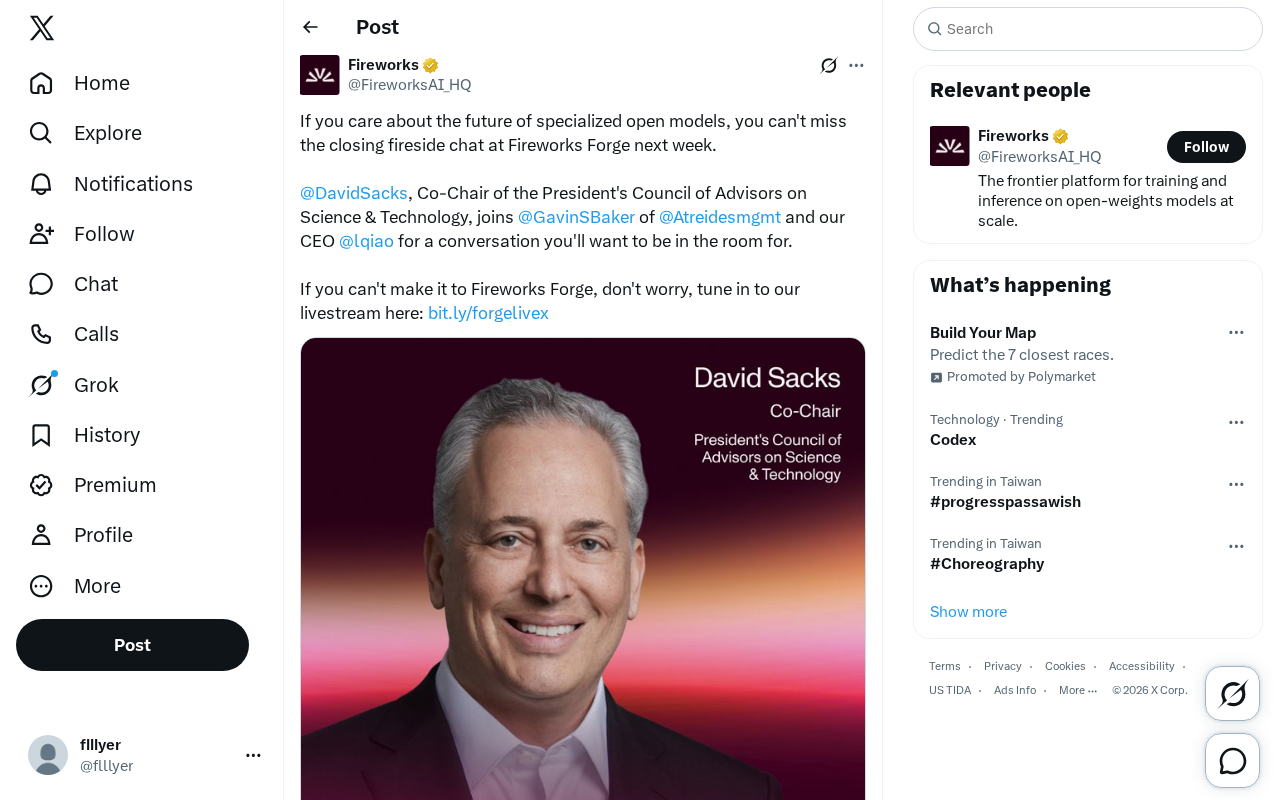
Speakers: Where Policy, Capital, and Technology Intersect
According to the official tweet, the fireside chat will feature:
- David Sacks: Co-chair of the President's Council of Advisors on Science and Technology (PCAST), with significant influence at the level of science and technology policy and industrial strategy;
- Gavin Baker: An investor at Atreides Management, with long-standing focus on capital trends in technology and AI;
- Lin Qiao: CEO of Fireworks, directly involved in building infrastructure for specialized model inference and deployment.
The combination of these three identities means the discussion won't stay at the level of technology demos—it will touch on the real tensions open-source models face in policy environments, commercial deployment, and engineering feasibility. For practitioners who care about where the open-source ecosystem is heading, this is a rare cross-cutting perspective.
PCAST (President's Council of Advisors on Science and Technology) is an advisory body under the U.S. Executive Office of the President, composed of experts from industry, academia, and nonprofit organizations, tasked with providing independent advice to the President on science and technology policy. Unlike OSTP (the White House Office of Science and Technology Policy), which handles implementation, PCAST leans toward long-term strategic judgment. Historically, PCAST reports have influenced U.S. policy orientations on nanotechnology, broadband adoption, and AI R&D investment. As a result, when a PCAST co-chair speaks publicly about open-source AI, it is often read as a bellwether for federal regulatory thinking.
Why "Specialized Open-Source Models" Deserve a Headlining Conversation
Competition in general-purpose large models is already crowded enough, while specialized open-source models—open-weight models optimized for specific tasks, industries, or deployment scenarios—are emerging as another underestimated path. They matter for whether enterprises can obtain auditable, customizable model capabilities at controllable cost, and for whether the open-source community can maintain its pace of innovation in the shadow of closed-source giants.
Fireworks scheduling this conversation as the closing segment of the event itself sends a signal: the future of specialized open-source models is not purely a technical question, but the result of policy, capital, and engineering shaping it together. David Sacks's participation is particularly noteworthy, as PCAST's positions often influence the direction of U.S. regulation of open-source AI.
Open weights refers to a release approach in which, after a model is trained, its weight parameters can be publicly downloaded and used. It is not entirely equivalent to "open source": full open source also requires disclosure of training data, code, and training process. In practice, most so-called open-source large models only open their weights, and licenses may carry commercial restrictions or user-scale thresholds. For enterprises, the value of open weights lies in local deployment, fine-tuning, and auditability, thereby avoiding data export and vendor lock-in risks; but whether true "customization" is possible still depends on license terms and the transparency of the model architecture.
Inference and deployment infrastructure is the critical link between training and production for large models. Training focuses on fitting parameters with large-scale compute, while inference focuses on responding to user requests under latency, throughput, and cost constraints. Specialized models typically have fewer parameters and more focused tasks, so inference costs can be further compressed through techniques such as quantization, distillation, and speculative decoding. The core business of companies like Fireworks is precisely providing inference optimization and deployment platforms, which explains why its CEO would appear in a conversation about specialized open-source models—whether a model can be deployed depends heavily on engineering efficiency at the inference layer.
Can't Attend? The Livestream Is Open Too
The official tweet specifically notes that those unable to attend Fireworks Forge in person can watch the conversation via livestream, with the link provided in the tweet. For readers interested in open-source model policy trends, investment logic, or inference infrastructure, this closing conversation offers a window to gather three perspectives in one place.
The specific agenda and further details have not yet been elaborated in the tweet, but based on the speaker lineup and theme alone, this fireside chat already has ample discussion value.
One-line Summary
Fireworks Forge closing conversation focuses on specialized open-source models, bringing together policy, capital, and technology perspectives.
Paragraph Summary
Fireworks announced that its hosted Fireworks Forge event will hold a closing fireside chat next week on "the future of specialized open-source models." Speakers include PCAST Co-chair David Sacks, Atreides Management investor Gavin Baker, and Fireworks CEO Lin Qiao, representing policy, capital, and technology respectively. The article argues that specialized open-source models—open-weight models optimized for specific tasks or scenarios—are becoming an underestimated path beyond general-purpose large models, with their development shaped not only by technology but also by regulatory trends and commercial feasibility. The conversation will be open to remote viewers via livestream.
Related articles

Qwen 3.8 Beats Opus at Coding—But Can Your Mac Run It?
Open-source Qwen 3.8 beats Opus 4.6 at coding at just 18GB, but how much Mac memory do you need? 24GB crashes; 32GB is the sweet spot. Full config guide inside.

Claude Code + Agent: Building a Fully Automated AI Testing Loop
Bilibili course breakdown: how test developers can use Claude Code terminal-based Agents to build a fully automated AI testing loop. Compares permission boundaries of terminal vs. device Agents, explains why enterprise projects choose Claude Code over Open Claude-type tools, and outlines the Node.js environment setup and DeepSeek model integration path.

Working with AI Agents Requires Nerves of Steel
The more autonomous AI agents become, the heavier the user's psychological burden. Drawing from a Hacker News discussion, this article analyzes black-box anxiety, behavior drift, and monitoring fatigue in agent collaboration, and offers practical approaches like sandbox isolation, permission control, and task granularity management to reduce cognitive load.