Fireworks Open-Model Challenge Registration Closes Soon, $10K Prize for Champion
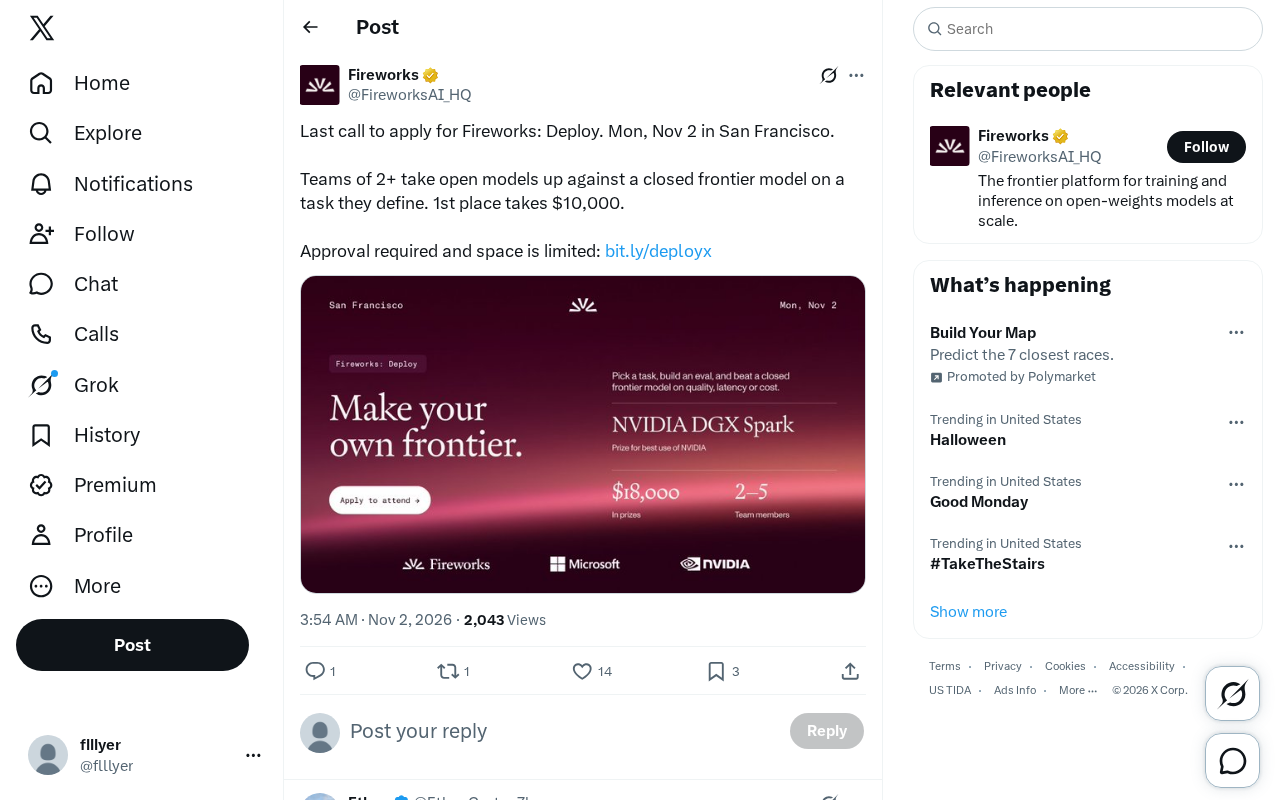
Fireworks hosts a San Francisco hackathon pitting open-source models against closed-source frontier models, with a $10K champion prize.
Hosted by Fireworks AI, the "Fireworks: Deploy" challenge takes place November 2 in San Francisco with registration closing soon. Teams of 2+ define their own tasks and pit open-source models directly against closed-source frontier models, competing for a $10,000 top prize. This "choose-your-own-track" format assesses task understanding, prompt design, fine-tuning strategy, and engineering optimization — not just model performance. Approval is required and spots are limited. The article frames such competitions as a window into open-source AI progress, showing where open models already suffice and where gaps remain, with the value for developers being a chance to benchmark against frontier models.
Hosted by Fireworks AI, the "Fireworks: Deploy" challenge is closing registration soon. The event is scheduled for Monday, November 2, in San Francisco. Teams must consist of 2 or more members and will use open-source models to take on closed-source frontier models on custom tasks, with the champion taking home a $10,000 prize.
A Head-to-Head Showdown Between Open and Closed Source
The core design of this hackathon is quite compelling: participating teams define their own tasks and pit open-source models directly against closed-source frontier models on the same task. This "choose-your-own-track" mechanism means the competition isn't just about raw model performance — it's also about the team's understanding of the task, prompt design, fine-tuning strategy, and engineering optimization skills.
For the open-source model ecosystem, this is both a real-world validation and a public "capability statement." Participants need to prove that, in specific scenarios, open-source models can narrow or even close the gap with closed-source frontier models.
The Divide Between Open-Source and Closed-Source Frontier Models
Open-source models refer to models whose weights can be publicly downloaded and that allow local deployment and retraining. Typical examples include the Llama series, Mistral, and Qwen, whose licenses usually permit commercial use or come with limited restrictions. Closed-source frontier models, on the other hand, are accessible only via API with undisclosed weights — such as the flagship versions of the GPT, Claude, and Gemini series — and they often lead in training data scale, compute investment, and alignment techniques. The core differences between the two lie not only in performance but also in cost structure (API call fees vs. self-hosted inference costs), data privacy (whether data leaves the local environment), customizability (whether fine-tuning, distillation, and quantization are possible), and iteration pace. Understanding this divide is a prerequisite for interpreting the significance of such head-to-head competitions: even when open-source models match closed-source models on a single task, they often require additional engineering investment to do so.
Prompt Design and Fine-Tuning Strategy
Prompt design refers to improving a model's performance on a specific task without changing its weights — through instruction wording, few-shot examples, chain-of-thought guidance, and output format constraints. It's low-cost, but its ceiling is limited by the model's inherent capabilities. Fine-tuning, by contrast, involves continuing to train model weights with task-relevant data. Common forms include full-parameter fine-tuning, low-rank adaptation methods such as LoRA, and preference alignment (e.g., DPO). Fine-tuning can significantly boost performance on domain tasks, but it requires high-quality data and additional compute, and carries the risk of overfitting and reduced generalization. In time-constrained settings like hackathons, teams typically must trade off between prompt engineering (fast trial-and-error) and fine-tuning (stronger results but longer cycles) — and this trade-off itself is one of the skills the competition assesses.
Eligibility and Registration Details
The event is not open to all upon registration. According to official information, participation requires approval (approval required), and space is limited, so interested teams should submit their applications as soon as possible.
Teams must have 2 or more members, which suggests the competition values collaboration and division of labor — from task design and model selection to engineering implementation, it's difficult for a single participant to cover everything. As for prizes, first place will receive $10,000.
Why It's Worth Watching
Head-to-head competitions like this — "open models VS closed-source models" — are becoming a window into the progress of open-source AI. Closed-source frontier models typically represent the current capability ceiling, while open-source models offer advantages in cost, controllability, and customizability. When the two are compared on the same task, the results often reveal which scenarios open-source models already handle well enough and which still have a clear gap.
For developers and AI teams, the value of participating in such competitions lies not only in the prize money but also in gaining a benchmarking opportunity to compete on the same stage as frontier models, as well as an environment to exchange deployment experience with peers.
Event information at a glance:
- Time: Monday, November 2
- Location: San Francisco
- Format: Teams of 2 or more, self-defined tasks, open-source models challenge closed-source frontier models
- Prize: $10,000 for first place
- Registration: Approval required, space is limited
Teams interested in participating can submit applications through Fireworks' official channels.
The Significance of Benchmarking and Head-to-Head Competition
Benchmarking is a method of measuring model capabilities using standardized tasks and scoring methods; common public benchmarks include MMLU, HumanEval, and others. However, public benchmarks carry contamination risk — test data may have already entered model training sets, inflating scores and making it difficult to reflect real business scenarios. Head-to-head showdowns on custom tasks partially avoid this problem: tasks are designed by participants and are closer to real needs, but this also brings limitations such as inconsistent scoring standards and limited comparability of results. Therefore, the value of such competitions lies in providing directional reference rather than absolute rankings. When interpreting results, readers should focus on the specific task types, evaluation methods, and engineering investment, rather than simply concluding that "open source has caught up with closed source" or the opposite.
One-line Summary
Fireworks hosts a hackathon in San Francisco pitting open-source models against closed-source frontier models, with a $10,000 champion prize.
Paragraph Summary
Hosted by Fireworks AI, the "Fireworks: Deploy" challenge will take place on November 2 in San Francisco, with registration closing soon. The competition requires teams of 2 or more, with teams defining their own tasks and pitting open-source models directly against closed-source frontier models on the same task, with a $10,000 prize for the champion. This "choose-your-own-track" mechanism assesses not only model performance but also task understanding, prompt design, fine-tuning strategy, and engineering optimization skills. Participation requires approval and space is limited. The article argues that such head-to-head competitions are a window into the progress of open-source AI, revealing which scenarios open-source models already handle well enough and where gaps remain; for developers, the value lies in gaining a benchmarking opportunity to compete on the same stage as frontier models.
Related articles

AI Can Read Neural Network Weights Directly: Do Models Already Exceed Expectations?
A Reddit developer experiment shows language models can directly read neural network weights and infer their function. Astra, Opus 5.5, and Muse Spark 1.3 all passed the test, sparking discussion on model generalization and training sources.

India's Microdrama Market Explodes: EloElo Secures $80M Investment from NBCUniversal
EloElo secures $80M from NBCUniversal to boost StoryTV, its microdrama platform with over 33M monthly active users, as India's microdrama market draws global capital.

Acoustic Detection of Multi-Rotor UAVs: Fusing Handcrafted Features with Pre-Trained Embeddings
Study reveals data leakage from random splits in UAV acoustic detection, proposes source-disjoint protocol with stacked ensemble of handcrafted features and YAMNet embeddings, achieving 95.29% accuracy for low-cost drone detection.