First Principles Thinking: A Practical Framework for Breaking Down Problems

First Principles Thinking cuts through industry defaults by returning to irreducible facts — a practical antidote to inertial thinking.
First Principles Thinking requires decomposing problems to their most irreducible foundational facts, then rebuilding solutions from scratch rather than borrowing from existing approaches. This concept from physics and philosophy is especially valuable in tech: architecture decisions, stack choices, and pricing strategies are often passive copies of industry convention riddled with unexamined assumptions. The practice involves three steps — identifying and challenging assumptions, breaking down to foundational facts, and reconstructing from zero. However, the cognitive cost is high, and Hacker News discussion reinforces that complete bottom-up reasoning is rarely feasible in practice. The pragmatic approach is treating it as one tool among many: deploy it on high-stakes, hard-to-reverse decisions, and rely on validated experience for everything else.
First Principles Thinking: A Practical Framework for Breaking Down Problems
In tech and product development, most people default to reasoning by analogy — looking at what others have done and iterating from there. First Principles Thinking offers a fundamentally different path: decompose a problem down to its most basic, irreducible facts, then rebuild a solution from that foundation.
This article, originally published on Sunil Sadasivan's personal blog, earned 203 points and 95 comments on Hacker News — a testament to the tech community's enduring interest in this way of thinking.
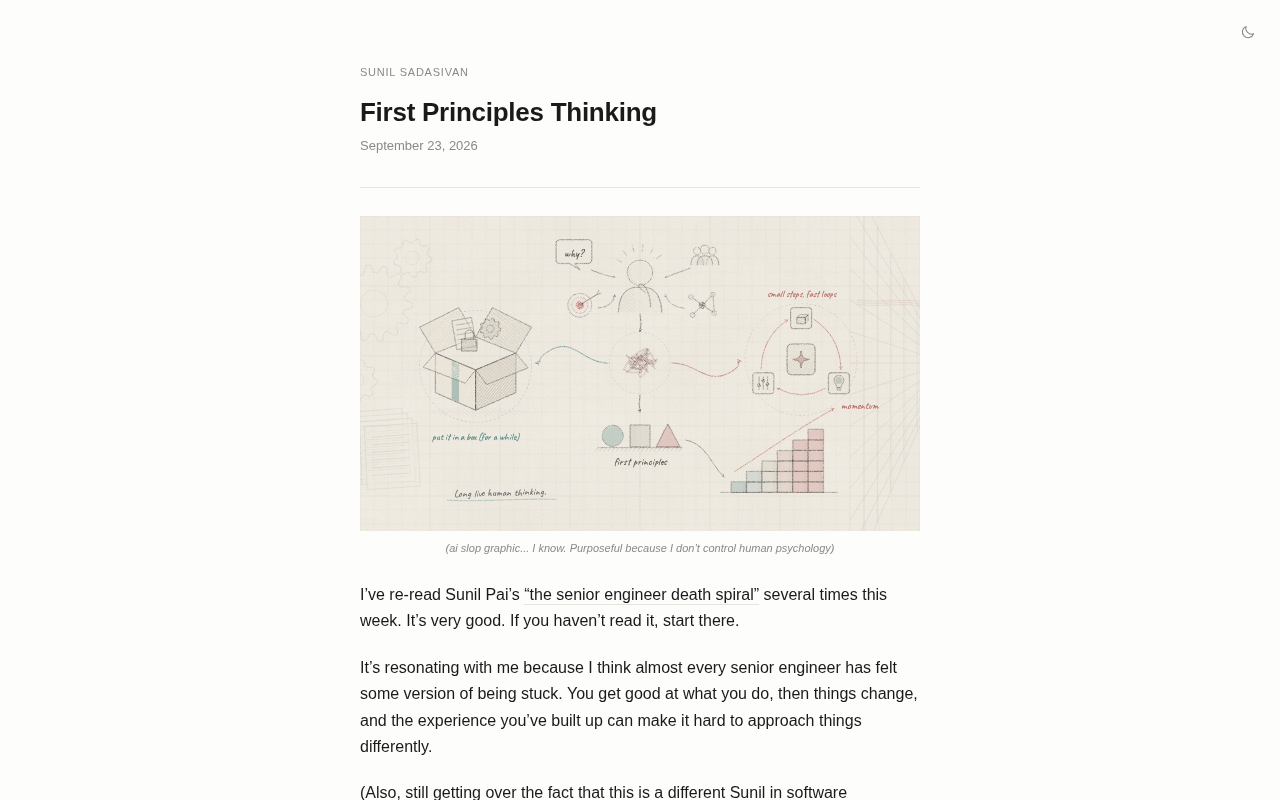
What Is First Principles Thinking?
First principles thinking has its roots in physics and philosophy. At its core, it means stripping away all assumptions, conventions, and inherited conclusions until only verifiable, foundational truths remain. Aristotle defined it as "the first basis from which a thing is known."
The contrast is reasoning by analogy — how most people make decisions day to day. Analogical reasoning is fast and efficient: you look at what already exists, tweak it slightly, and arrive at your own answer. But it carries a hidden cost: you inherit all the assumptions baked into the original solution, including those that may be outdated or fundamentally flawed.
The value of first principles thinking lies precisely in breaking this inheritance. When you stop asking "how does everyone else do this?" and start asking "what are the actual physical, economic, or logical constraints here?", you often uncover possibilities that industry convention has long obscured.
The popularization of first principles thinking in modern business contexts owes much to Elon Musk's public statements on the subject. He describes it as "looking at the world through the lens of physics" — physicists don't accept "that's just how things work" as an answer; they trace causality all the way down to its roots. The concept also has deep philosophical ties to Descartes' methodological doubt: the practice of suspending judgment on any belief that could be questioned, retaining only what is beyond doubt. Worth noting: in physics, "first principles" has a stricter technical meaning — fundamental laws derivable directly from experiment rather than from other laws (e.g., Newton's laws of motion, the laws of thermodynamics). In the context of thinking frameworks, it's borrowed as a metaphor emphasizing the spirit of "seeking irreducible truths," rather than literally requiring mastery of all physical axioms.
Why It Matters Especially in Tech
Software and product development is full of default choices that exist simply because "everyone does it this way." Stack choices, architectural patterns, pricing strategies — many of these decisions are reproductions of industry convention rather than the product of deep analysis applied to the specific problem at hand.
This is why first principles thinking resonates with engineers. When a team is willing to question "why does this cost so much?" or "why does this process need to exist at all?", they often find optimization opportunities that have been overlooked for years. SpaceX recalculating the raw material cost of rocket launches is the canonical example — by breaking down the physical components of a rocket, they found that manufacturing costs were far below what the industry was paying on the open market.
The underlying insight is refusing to treat the status quo as inevitable. The current state of affairs is simply the accumulated residue of historical decisions — decisions that may not hold up under today's constraints.
The SpaceX rocket cost case is worth unpacking to understand how first principles works in practice. The aerospace industry had long treated rocket costs as a fixed constraint; a Falcon 9 was priced at around $65 million on the market. Musk's team took a different approach: they listed the raw materials that make up a rocket (aluminum alloys, titanium, copper, carbon fiber, etc.) and repriced them at commodity market rates. The result? Raw materials accounted for roughly 2% of the final sticker price. That finding alone doesn't build a rocket — but it proved that the high cost was a product of supply chain structure and monopolistic pricing, not physical necessity. It gave the team a verifiable target: manufacturing costs had, in theory, orders-of-magnitude room to compress. This same approach — using raw input costs to reverse-engineer the boundary of what's possible — applies equally to software pricing, cloud cost optimization, and hardware design.
How to Apply It in Practice
Applying first principles doesn't require genius — it requires a deliberate thinking process.
Step 1: Identify and Challenge Your Assumptions
List every assumption you hold about the problem, then interrogate each one: Is this actually true? Many premises we take for granted don't survive repeated "why" questions.
Step 2: Break Down to Foundational Facts
Decompose the problem to its most irreducible level — facts that stand on their own without depending on other conclusions. Physical laws, mathematical relationships, verifiable data.
Step 3: Reconstruct from Scratch
Derive your solution from those foundational facts, rather than patching an existing approach. This process may lead you to conclusions that look nothing like the mainstream solution.
A word of caution: first principles thinking is expensive. It consumes significant time and cognitive resources. That makes it poorly suited for every decision — for low-stakes, easily reversible choices, reasoning by analogy is usually far more efficient. Reserve first principles for high-value, hard-to-reverse decisions where existing solutions have obvious, structural pain points.
Limits and Common Pitfalls
In the Hacker News discussion, many commenters pointed out the method's real limitations. The most common critique: truly complete first-principles reasoning is nearly impossible in practice, because no one possesses sufficient foundational knowledge in every domain. In most cases, we still rely on conclusions others have already validated as our "ground floor."
Another pitfall is treating first principles as a performative stance — questioning everything while producing nothing better. The real value isn't in the questioning itself, but in whether that questioning leads to a superior solution.
A more reasonable approach is to treat first principles as one tool in the toolbox, not the only hammer. Deep decomposition for critical decisions; leveraging accumulated experience for everyday tasks. Combining both is a more pragmatic thinking strategy.
Cognitive science offers a deeper explanation for first principles' limits. Human working memory is finite — typically 7±2 chunks of information — and deriving complex systems from scratch quickly hits that ceiling. This is precisely why chunking is central to expert cognition: experienced engineers or chess players pack repeatedly validated patterns into single cognitive units they can invoke directly, rather than re-deriving them from scratch each time. This means reasoning by analogy isn't intellectual laziness — it's a necessary feature of cognitive efficiency. The true relationship between first principles and analogical reasoning is therefore more like a dynamic equilibrium: when entering a new domain, or when an existing solution has structural flaws, it's worth bearing the high cognitive cost of bottom-up decomposition. For routine decisions in familiar territory, drawing on a validated pattern library is often the rational choice. The ability to switch fluidly between these two modes is itself a metacognitive skill worth deliberately cultivating.
Closing Thoughts
First principles thinking isn't mysticism — it's an actionable methodology for pushing back against inertial thinking. It asks us to pay a higher cognitive price for the possibility of breakthrough insight. For practitioners in a fast-moving technology industry, the ability to "return to fundamentals" may be exactly what separates the imitators from the innovators.
Related articles

160 US Business Data Portals Verified: An AI Agent Integration Guide
A developer verified 160 US official business data portals, revealing the fragmented landscape of entity search, UCC queries, and license verification for AI Agents.

Building a 3D Da Vinci Museum in Code: A Show HN Project Experience
A Show HN project builds a guided 3D Da Vinci museum entirely in code. We analyze its procedural generation approach, browser 3D trade-offs, and the value and limits of digital museums in education.

Hands-On with Amazon SageMaker JumpStart: Model Deployment and Evaluation
Learn how to deploy pre-trained models with Amazon SageMaker JumpStart, run lightweight reproducible performance tests with the SageMaker Python SDK, and delete endpoints after evaluation to control costs.