First Rigid Beam 3D-Printed in Space Vacuum, Could Become Cornerstone of Space Data Centers

Orbital Matter 3D-printed a rigid beam for the first time in space vacuum, pointing toward space data center infrastructure.
Orbital Matter announced the successful 3D printing of the first rigid beam structure in the vacuum of space, described as a first in space construction. Unlike previous printing of small plastic parts on the ISS, a rigid beam implies load-bearing capability and dimensional stability—a leap from non-load-bearing samples to primary structural components. The technology is explicitly linked as an enabler for future space data centers: building large trusses in orbit could escape rocket fairing size constraints and reduce launch mass and volume costs. However, public information does not disclose the material system, printing speed, structure dimensions, or mechanical data; vacuum outgassing characteristics, interlayer bonding strength, and in-orbit economics remain to be verified, and scaled application still requires coordinated advances in materials science, robotics, and the in-orbit servicing ecosystem.
Milestone in Space Manufacturing: A Rigid Structure Is Born in Vacuum
According to RSS tech media reports, Orbital Matter has announced the successful 3D printing of the first rigid beam structure in the vacuum of space. The breakthrough is described as a "first in space construction" and is seen as a key enabling technology for future space data centers.
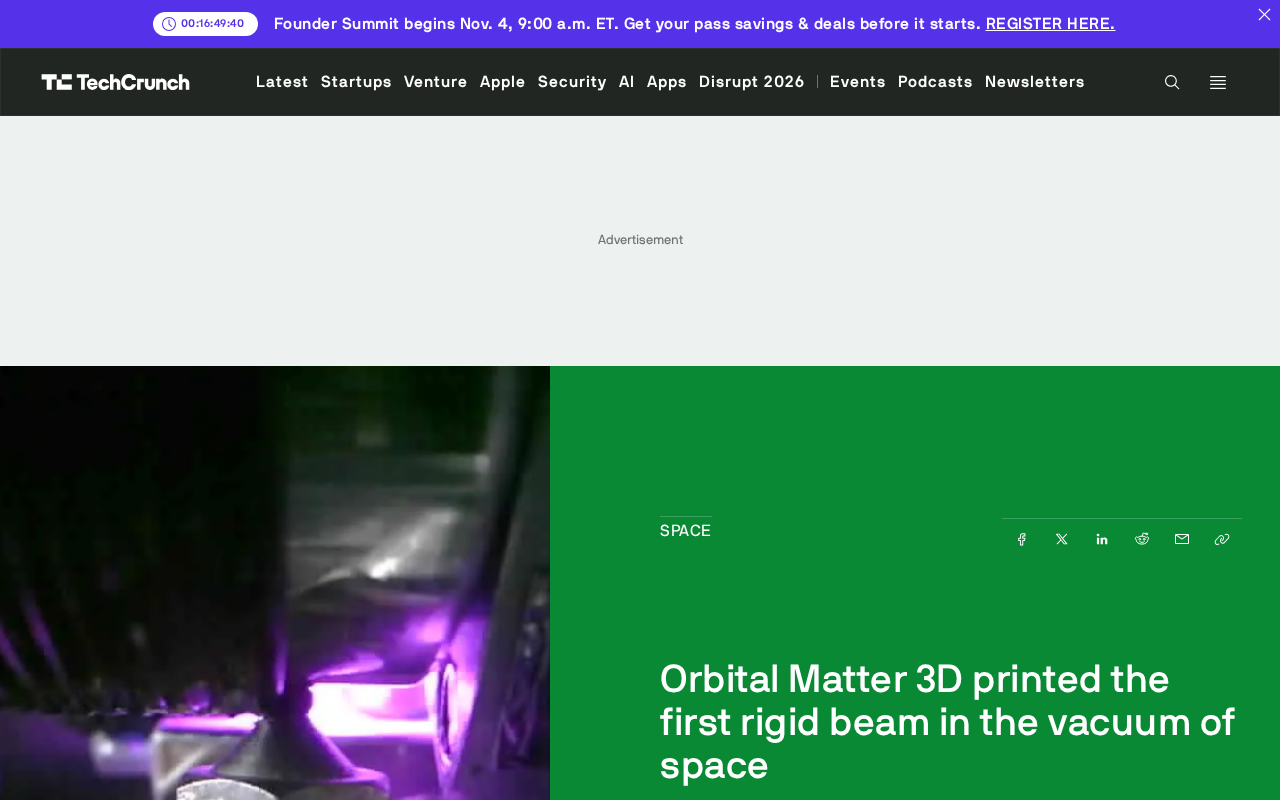
Directly manufacturing load-bearing structures under microgravity and vacuum conditions has long been constrained by challenges in material extrusion, interlayer adhesion, and thermal management. Orbital Matter's demonstration validates the feasibility of in-orbit additive manufacturing making the leap from "small parts" to "structural components." Although public details are limited, the "rigid beam" form factor implies the printed part must possess sufficient mechanical strength and dimensional stability—not merely a simple non-load-bearing sample.
Why a Rigid Beam Is a "Watershed" for Space Infrastructure
Space manufacturing is not a new concept; the International Space Station conducted plastic extrusion printing experiments years ago. But past results have mostly been low-load components such as tool handles and small replacement parts. A rigid beam points directly toward primary structures such as large trusses, antenna mounts, and solar panel supports.
If Orbital Matter's approach proves reproducible, it will change spacecraft design logic: launch only raw materials and printing equipment, then build large structures on demand after reaching orbit, thereby escaping the size constraints of rocket fairings. For facilities like space data centers that require large-area heat dissipation panels and structural frames, in-situ manufacturing could significantly reduce launch mass and volume costs.
In-Space Additive Manufacturing differs critically from the plastic extrusion printing experiments already conducted on the International Space Station. The printers used on the ISS (such as Made In Space's "Additive Manufacturing Facility") are essentially microgravity-adapted versions of ground-based FDM processes, with printing materials mostly thermoplastic polymers, and the print chamber is at ambient pressure—not the vacuum of space. True "vacuum environment printing" requires addressing issues such as outgassing of molten materials, anomalous cooling rates, and changes in interlayer adhesion mechanisms. Moreover, primary spacecraft structures typically require metals or continuous fiber-reinforced composites, whose printing temperatures, energy input, and thermal stress control are far more demanding than polymers. Therefore, the leap from ISS polymer small parts to a rigid load-bearing beam in vacuum is not just about size but a fundamental upgrade of material systems and process windows.
Space Data Centers: The Named Next Scenario
The original report explicitly links "the future of space data centers" to this printing achievement. This connection is no coincidence: the orbital data center concept has regained attention in recent years due to surging AI computing demand and ground-based energy constraints, and one of its core challenges is precisely how to assemble large-area, high-stiffness structures in orbit.
Vacuum 3D printing of rigid beams offers one possibility—rather than transporting complete trusses from the ground, load-bearing skeletons could be "grown" in orbit. However, going from a single beam to a complete data center structure still requires solving engineering problems such as multi-material printing, structural connections, thermal control integration, and long-term reliability verification. Orbital Matter's demonstration is a starting point, not an endpoint.
The core engineering constraint of an orbital data center lies in thermal management: in vacuum, convection cooling is impossible, and heat can only be rejected to deep space through large-area radiative panels. The power density of AI computing clusters dramatically inflates the required heat dissipation area. This directly increases dependence on large rigid trusses and panel support structures. At the same time, orbital data centers are typically envisioned in sun-synchronous or dawn-dusk orbits to obtain stable illumination and lower thermal environment fluctuations, but this also means the structures must withstand frequent day-night thermal cycles, imposing stringent requirements on thermal expansion matching and fatigue life of materials. If vacuum 3D printing can directly form these load-bearing skeletons, it could circumvent the size limitations of rocket fairings on deployable structures, but in-orbit integration of structural connection nodes and thermal control loops remains an unsolved challenge.
A Sober View: A Gap Remains Between Verification and Scale-Up
A brief note: currently, public information only confirms the fact of "the first rigid beam printed" and does not disclose the material system, printing speed, structure dimensions, or mechanical test data. Evaluation criteria for space additive manufacturing should include interlayer bonding strength, vacuum outgassing characteristics, and process stability under microgravity—metrics that still await third-party verification.
Furthermore, the economics of in-orbit manufacturing depend on the raw material supply chain and equipment reuse rates. If each print still requires dedicated consumables shipped from the ground, the cost advantage will be greatly diminished. Orbital Matter's achievement opens up imaginative possibilities, but the industrialization of space infrastructure still requires coordinated advances in materials science, robotics, and the in-orbit servicing ecosystem.
(This article is based on limited information from RSS sources; more technical details await official disclosure.)
Vacuum outgassing is an underappreciated metric in space additive manufacturing. Polymers or composites in vacuum release volatile organic molecules that can condense on optical lenses, thermal control coatings, or solar cell surfaces, causing contamination. NASA and ESA impose standards such as ASTM E595 on the outgassing characteristics of space materials, requiring total mass loss and collected volatile condensable materials to be below specified thresholds. For 3D-printed parts, their porous interlayer structure and large specific surface area exacerbate outgassing risks, and incompletely melted powder or filament during printing may become additional gas sources. Therefore, even if mechanical tests pass, the long-term in-orbit outgassing behavior of materials still needs to be verified through ground thermal vacuum tests and in-orbit exposure experiments—this is one of the key thresholds for determining whether the technology can be used in long-life facilities such as data centers.
One-line Summary
Orbital Matter 3D-printed a rigid beam for the first time in the vacuum of space, pointing toward space data center infrastructure.
Paragraph Summary
Orbital Matter announced the successful 3D printing of the first rigid beam structure in the vacuum of space, described as a first in space construction. Unlike previous printing of small plastic parts on the International Space Station, a rigid beam implies the printed part must have load-bearing capability and dimensional stability—a leap from non-load-bearing samples to primary structural components. The technology is explicitly linked as an enabler for future space data centers: building large trusses directly in orbit could escape rocket fairing size constraints and reduce launch mass and volume costs. However, public information does not disclose the material system, printing speed, structure dimensions, or mechanical data; vacuum outgassing characteristics, interlayer bonding strength, and in-orbit economics remain to be verified, and scaled application still requires coordinated advances in materials science, robotics, and the in-orbit servicing ecosystem.
Related articles
 Tech Frontiers
Stylome Bot Slammed as Useless Junk: Why Do AI Detection Tools Keep Failing?
Reddit users test the Stylome AI detection bot: Gemini-rewritten text judged human-written, consistently low confidence. An analysis of AI text detection's technical dilemmas, privacy concerns, and credibility crisis in community governance.
 Tech Frontiers
When AI Becomes a Productivity Divide: Clarity or "AI Psychosis"?
A civil engineer's deep use of agentic AI boosted efficiency but bred contempt for peers who refuse to learn. Is this clarity or AI psychosis? An analysis of the cognitive and psychological challenges behind the AI productivity divide.
 Tech Frontiers
Opus 5.5 Benchmark Scores Climb, Community Says Its "Weights Are Blessed"
Reddit community discusses Opus 5.5's rising scores on the Benchmaxxing Bench, with users describing its performance as "weights are blessed." This article interprets the community reaction and cautions against conflating benchmark scores with real capability.