First Vera Rubin Chips Delivered to Microsoft Data Centers: A New Milestone in the AI Computing Race

Microsoft deploys first NVIDIA Vera Rubin production chips, launching the next AI computing upgrade cycle.
Microsoft has officially received the first production-grade NVIDIA Vera Rubin chips in its data centers, marking a major milestone in the AI computing race. As NVIDIA's post-Blackwell architecture, Vera Rubin addresses critical challenges in memory bandwidth, high-speed interconnects, and energy efficiency for trillion-parameter model training. Microsoft's early deployment reinforces its priority partnership with NVIDIA and its role as OpenAI's exclusive cloud provider.
Microsoft Data Centers Receive First Vera Rubin Chips: The AI Computing Race Enters a New Phase
Microsoft recently announced that the first production-grade NVIDIA Vera Rubin chips have been officially deployed in its data centers. In its announcement, Microsoft specifically thanked its partners at NVIDIA and the Azure hardware and data center teams, calling it a significant milestone in their collaboration.
Behind this development lies a critical signal in the cloud computing and AI infrastructure race. As NVIDIA's next-generation GPU architecture, Vera Rubin's entry into hyperscale cloud provider production environments marks the official start of a new computing power upgrade cycle.

Vera Rubin Chip: NVIDIA's Next-Generation AI Computing Platform
Architectural Innovation and Technical Features
Vera Rubin is NVIDIA's new-generation computing platform following Blackwell, named after the American astronomer Vera Rubin who discovered key evidence for dark matter — continuing NVIDIA's tradition of naming architectures after scientists.
Background on GPU Architecture Generational Evolution: GPUs (Graphics Processing Units) were originally designed for graphics rendering, but their parallel computing capabilities made them ideal hardware for AI training. After AlexNet used GPUs to achieve a breakthrough in the ImageNet competition in 2012, NVIDIA progressively optimized its GPU architecture for deep learning. From Pascal (2016) to Volta (2017), which introduced dedicated Tensor Core units, then to Ampere (2020) and Hopper (2022) with enhanced Transformer architecture support — each generation was designed around the characteristics of mainstream AI models at the time. Blackwell (2024) succeeded Hopper, and Vera Rubin represents the latest generation for 2025, purpose-built for trillion-parameter-scale models and multimodal computing.
The platform features a newly designed GPU paired with NVIDIA's custom Arm-based CPU, forming a complete superchip solution. The Superchip architecture is a heterogeneous computing approach that packages CPU and GPU within the same module, enabling ultra-high bandwidth communication between processors through high-speed interconnects (such as NVLink-C2C). In traditional setups, the CPU handles scheduling while the GPU handles computation, connected via the PCIe bus — creating latency and bandwidth bottlenecks. NVIDIA packages its custom Grace CPU (based on the Arm Neoverse architecture) with its GPU into Grace Hopper or Grace Blackwell superchips, allowing the CPU to directly access GPU memory and eliminating data transfer overhead. Vera Rubin continues this design, dramatically improving the efficiency of memory-intensive operations such as KV Cache management and long-context processing in large model inference. This deeply integrated CPU+GPU design is optimized specifically for large-scale AI training and inference scenarios, delivering significant improvements in energy efficiency and overall throughput.
Addressing Hyperscale AI Computing Demands
As large language model parameter counts continue to grow, multimodal models and reasoning systems drive exponential growth in computing demand. Large Language Model Parameter Scale Evolution: From GPT-1's 117 million parameters in 2018, to GPT-3's 175 billion parameters in 2020, to today's mainstream models commonly reaching hundreds of billions to trillions of parameters. Parameter growth directly drives computing demand: training GPT-3 required approximately 3,640 PetaFLOP/s-days of compute, while pre-training even larger models may require tens of thousands to hundreds of thousands of GPUs working in concert for months. Inference also presents challenges: serving a trillion-parameter model requires TB-scale memory and extremely high bandwidth — precisely the problems that new architectures like Vera Rubin aim to solve. The continued scaling of model sizes follows Scaling Laws, whereby model capabilities grow as a power law with parameter count, data volume, and compute.
Cloud providers' demand for next-generation hardware has reached unprecedented levels. Vera Rubin addresses these challenges by targeting compute bottlenecks, memory bandwidth limitations, and high-speed interconnect issues in ultra-large model training.
Memory bandwidth bottleneck refers to the amount of data a processor can read from or write to memory per unit of time, typically measured in TB/s. During large model inference, each token generated requires loading the model's entire weight parameters. When models reach hundreds of billions of parameters, weight data can amount to hundreds of gigabytes. If memory bandwidth is insufficient, GPU compute units sit idle waiting, creating a so-called 'memory-bound' bottleneck. NVIDIA addresses this on Vera Rubin by adopting advanced memory technologies such as HBM3e (High Bandwidth Memory 3 Enhanced) to achieve higher memory bandwidth (expected to exceed 5TB/s), while also optimizing the memory hierarchy — including larger on-chip caches and improved memory controller scheduling algorithms — to alleviate this critical bottleneck.
On the high-speed interconnect technology front, large model training requires thousands of GPUs working collaboratively, and the efficiency of inter-GPU data communication directly impacts overall training speed. NVLink is NVIDIA's proprietary high-speed GPU interconnect technology. The fifth-generation NVLink (used in Blackwell/Vera Rubin) achieves unidirectional bandwidth of 112.5 GB/s, far exceeding PCIe 5.0's 64 GB/s. At larger cluster scales, inter-node communication relies on InfiniBand or Ethernet. InfiniBand provides ultra-low latency (sub-microsecond) and high bandwidth (400Gbps or higher), supporting RDMA (Remote Direct Memory Access) technology that allows GPUs to bypass the CPU and directly access remote node memory. When cloud providers like Microsoft deploy Vera Rubin, they need to simultaneously upgrade the entire network topology, adopting high-performance network architectures such as Fat-Tree or Dragonfly.
Strategic Value of Microsoft's Early Deployment
Intensifying Competition Among Cloud Providers
Microsoft becoming the first cloud provider to deploy production Vera Rubin chips highlights its priority status within NVIDIA's partnership ecosystem. In the current AI wave, whoever can deploy the latest computing power earliest gains a first-mover advantage in serving key customers like OpenAI and advancing proprietary AI capabilities.
As OpenAI's exclusive cloud infrastructure provider, Azure carries the core computing demands of ChatGPT and the GPT model series. The exclusive cloud partnership between OpenAI and Microsoft began in 2019 when Microsoft invested $1 billion in OpenAI and established a strategic collaboration, with follow-on investments reaching approximately $10 billion by 2023. The core agreement stipulates that OpenAI exclusively uses Azure cloud infrastructure for model training and service deployment, while Microsoft receives commercial licensing rights for OpenAI's models. This means ChatGPT, GPT-4, and all other OpenAI products run entirely on Azure data centers, including training clusters composed of hundreds of thousands of GPUs. This deep integration requires Microsoft to maintain the most advanced AI computing supply: any hardware iteration delay could impact OpenAI's product roadmap, thereby threatening Microsoft's leading position in the generative AI market. Securing priority access to the latest hardware is vital for Microsoft to maintain its leadership in generative AI. Receiving Vera Rubin chips first is a concrete manifestation of this strategic partnership.
Coordinated Data Center Infrastructure Upgrades
Microsoft's mention of the "Azure hardware and data center team" in its statement reveals the complexity of deploying new chips. Putting Vera Rubin into production involves a series of engineering challenges spanning power systems, cooling solutions, network interconnects, and system integration.
The power consumption and cooling requirements of next-generation AI chips far exceed those of previous generations. Data center liquid cooling technology innovation has become inevitable: next-generation AI chips have surpassed 1000W per card, pushing traditional air cooling to its thermal limits. Liquid cooling technology, through direct-contact or immersion cooling, offers 10 to 100 times greater cooling efficiency than air cooling. Major approaches include: Cold Plate liquid cooling, which routes coolant tubing in direct contact with chips and is currently the mainstream solution; and Immersion Cooling, which submerges entire servers in insulating coolant and can handle higher power densities. Cloud providers like Microsoft and Meta have already deployed liquid cooling systems at scale in newly built data centers. Deploying high-power chips like Vera Rubin requires data centers to simultaneously upgrade cooling infrastructure, strengthen power systems (requiring per-rack power capacity of 100kW or more), and optimize facility layouts to accommodate liquid cooling pipe distribution. This is driving concurrent innovation in liquid cooling technology and power architecture across hyperscale data centers. The successful deployment of the first Vera Rubin chips is, in fact, the result of deep coordination across software, hardware, and infrastructure.
In-Depth Analysis of AI Industry Impact
Driving Continuous Computing Power Upgrades
Leading cloud providers deploying next-generation chips means that top-tier computing supply will increase significantly in the near future. This will directly benefit enterprises and developers training and deploying models on the Azure platform, potentially catalyzing a new wave of model capability breakthroughs.
AI Model Scaling Laws and Computing Demand: Scaling Laws were systematically articulated by OpenAI in 2020, revealing the power-law relationship between model performance and three factors: model parameter count (N), training data volume (D), and compute investment (C). The core finding is that under optimal configuration, model capabilities follow a predictable improvement curve with compute. Based on these laws, the industry estimates that achieving the next order-of-magnitude capability breakthrough requires 10 to 100 times more compute. Current top-tier model training already consumes on the order of 10^25 FLOPs, and future models may require 10^26 to 10^27 FLOPs. This explains why cloud providers and AI labs are so eager for next-generation hardware like Vera Rubin: computing supply directly determines how large a model can be trained, which in turn defines the ceiling of model capabilities. Hardware iteration is the critical path for breaking through compute bottlenecks and continuing to climb the Scaling Law curve.
Further Consolidation of NVIDIA's Ecosystem Position
From Hopper to Blackwell to Vera Rubin, NVIDIA has maintained an annual-cadence architecture update rhythm, firmly controlling dominance in the AI chip market. Continued procurement by cloud giants like Microsoft further reinforces NVIDIA's core position in AI infrastructure.
Although major cloud providers are all advancing custom AI chips (such as Microsoft's Maia, Google's TPU, and Amazon's Trainium), NVIDIA GPUs maintain a formidable position in the most cutting-edge large model training scenarios. Cloud providers' custom AI chip strategies: Facing NVIDIA's market dominance and steep procurement costs, major cloud providers are investing heavily in custom AI chips. Microsoft's Maia series is optimized specifically for Azure cloud, focusing on inference workloads; Google's TPU (Tensor Processing Unit) has iterated to its fifth generation since 2016, designed specifically for the TensorFlow ecosystem; Amazon has launched Trainium training chips and Inferentia inference chips; Meta is developing MTIA (Meta Training and Inference Accelerator). The advantages of these custom chips lie in deep customization for proprietary workloads, reduced dependence on a single supplier, and improved cost structures. However, challenges are equally significant: insufficient ecosystem maturity, continuous software stack investment requirements, and difficulty supporting customers' diverse framework needs. Consequently, in the most cutting-edge large model training scenarios, NVIDIA GPUs maintain their dominant position thanks to the CUDA ecosystem and mature toolchain.
Outlook: New Opportunities from Computing Power Upgrades
The deployment of the first Vera Rubin chips to Microsoft data centers marks another critical milestone in the AI computing race. It validates NVIDIA's new architecture production capability while demonstrating Microsoft's strategic commitment to next-generation AI infrastructure.
For AI practitioners, hardware-level developments like these are often leading indicators for anticipating future model capability ceilings. With more powerful computing infrastructure in place, we have every reason to expect innovative breakthroughs from the next generation of AI applications and models.
Related articles

OpenAI Declares the AGI Era Has Arrived: Conceptual Controversies and Technical Realities
OpenAI launches GPT-6 Astra claiming the AGI era has arrived, sparking controversy. Deep analysis of AGI definition ambiguity, technical progress realities, industry standards battle, and practical impacts on users and developers.
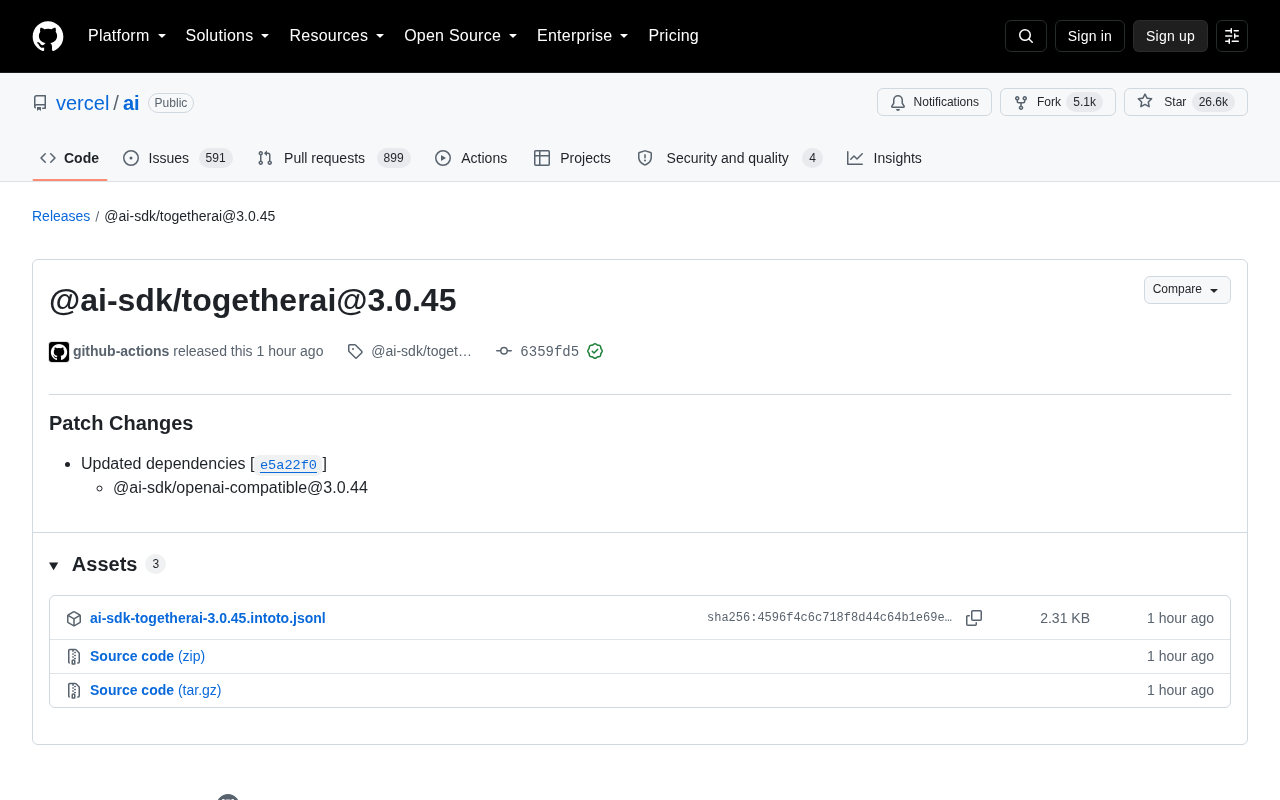
Vercel AI SDK TogetherAI Adapter 3.0.45 Update Analysis
Analysis of @ai-sdk/togetherai 3.0.45 patch update covering dependency sync, OpenAI compatibility layer architecture, and semantic versioning strategy in Vercel AI SDK.
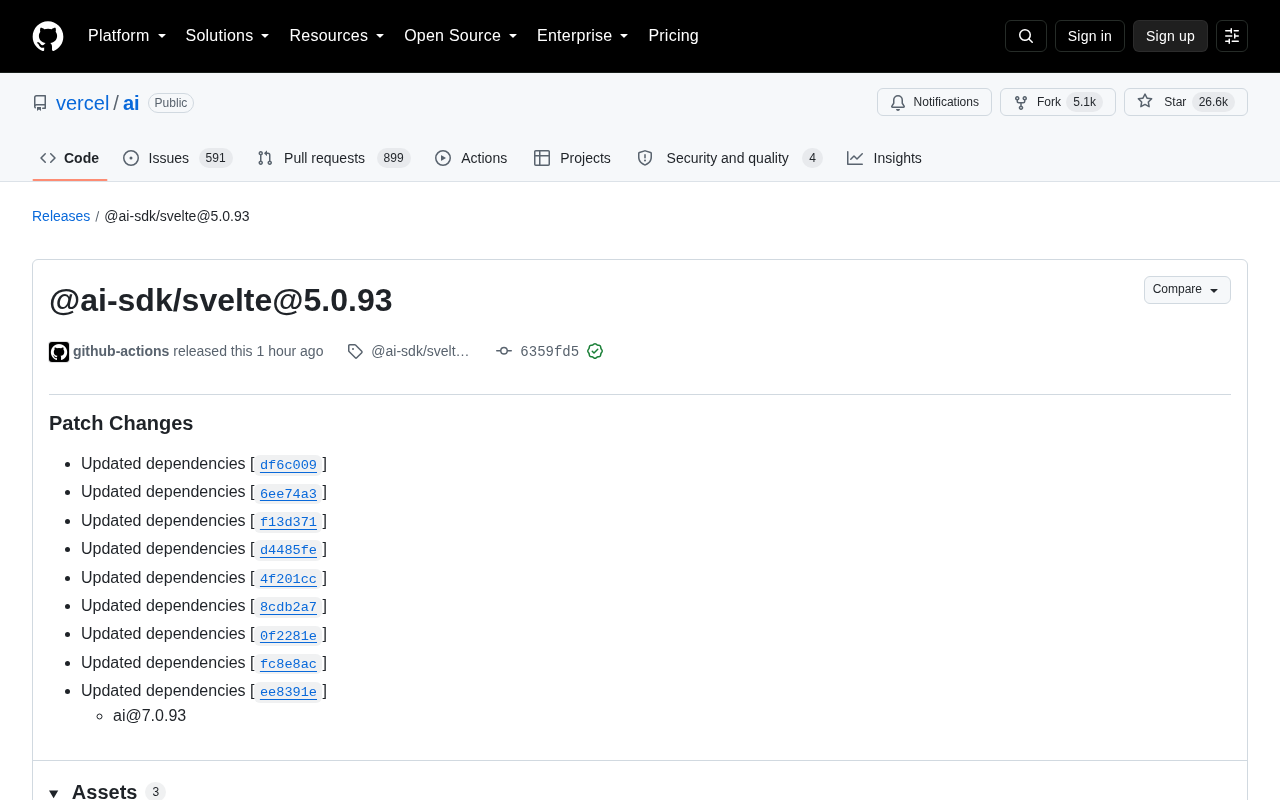
Deep Dive into Vercel AI SDK Svelte 5.0.93 Release Update
In-depth analysis of Vercel AI SDK Svelte 5.0.93 patch update, covering multi-framework adaptation, dependency sync, and automated release pipelines for Svelte AI app development.