Fisher Geometry Reshapes Adversarial Training: Breaking Through the Pseudo-Attack Dilemma
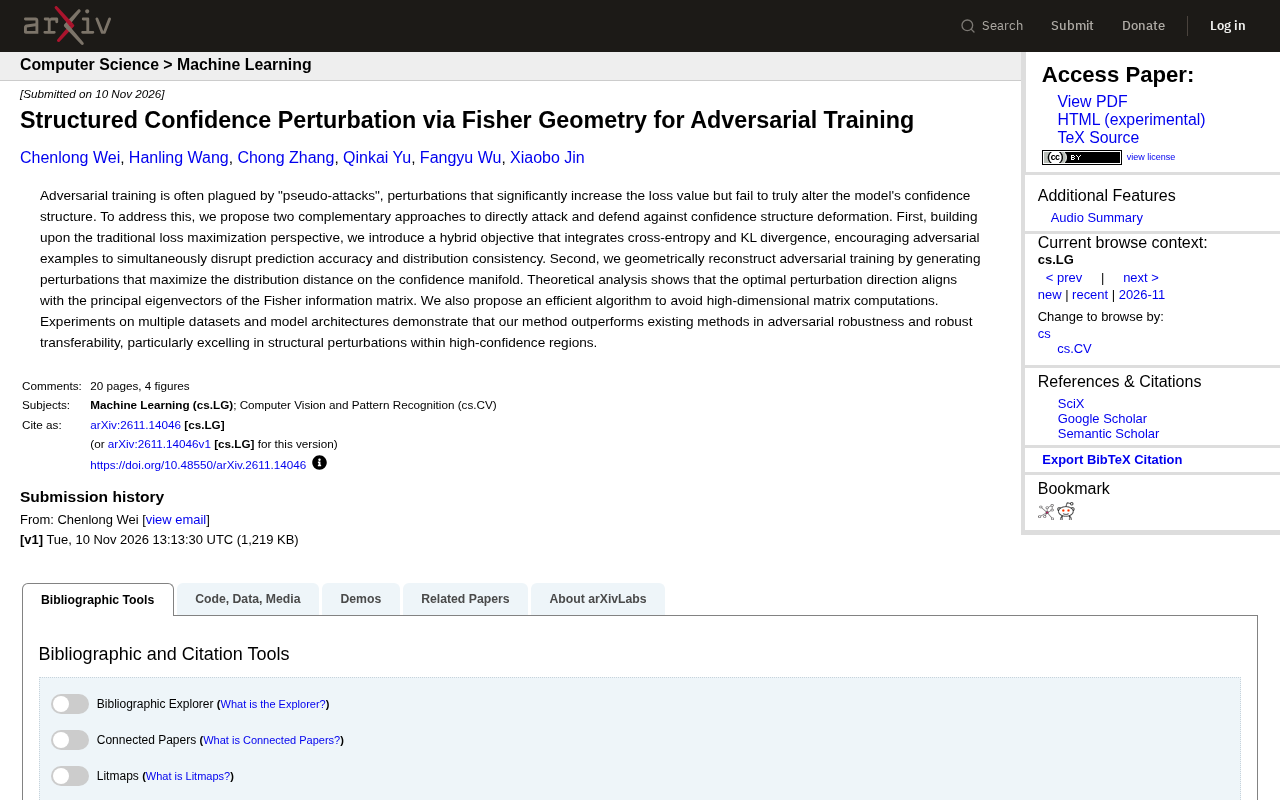
The paper uses Fisher information geometry to reshape adversarial training, solving the pseudo-attack dilemma where loss rises but confidence structure stays unchanged.
Traditional adversarial training generates adversarial examples by maximizing loss, but suffers from "pseudo-attacks": perturbations significantly raise loss while barely changing the model's relative output confidence distribution—the model is scared rather than convinced. The paper re-examines this from a confidence-structure perspective and proposes two complementary solutions. First, a hybrid objective combining cross-entropy with KL divergence forces adversarial examples to break both accuracy and distribution consistency. Second, a geometric reconstruction treats confidence distributions as a manifold and proves the optimal perturbation direction aligns with the principal eigenvector of the Fisher information matrix, using power iteration to avoid high-dimensional matrix decomposition at standard adversarial training cost. Experiments show improved robustness and robust transferability, especially in high-confidence regions.
Fisher Geometry Reshapes Adversarial Training: Breaking Through the Pseudo-Attack Dilemma
Adversarial training is the mainstream method for improving model robustness, but it has long been plagued by the "pseudo-attack" problem: many adversarial perturbations significantly raise the loss value yet fail to genuinely alter the model's confidence structure. In other words, the model may simply be "scared" rather than "convinced." A recent paper proposes re-examining adversarial training from the perspective of confidence structure and offers two complementary solutions grounded in Fisher information geometry.
Pseudo-Attacks: The Hidden Trap in Adversarial Training
Traditional adversarial training generates adversarial examples by maximizing the loss function, forcing the model to still classify correctly under perturbation. However, a rise in loss value does not equate to a breakdown of decision logic. The paper points out that there exists a class of perturbations that can send the loss soaring while barely changing the model's relative confidence distribution across classes—this is the "pseudo-attack."
The danger of pseudo-attacks is that they make adversarial training appear effective while failing to touch the model's fragile essence. The model may learn to "tough out" the loss under specific perturbation patterns, but its confidence structure remains fragile and will still fail when facing genuinely semantically destructive attacks.
Confidence structure refers to the shape of the model's output probability distribution across classes, not merely the class label with the highest probability. If a perturbation only lowers the correct class's probability from 0.9 to 0.8 while the incorrect class stays around 0.05, the model's relative judgment logic has barely changed—only the overall confidence has been compressed. This "structure unchanged, magnitude shifted" perturbation is the typical form of a pseudo-attack. Understanding this requires distinguishing two levels: first, the scalar loss value, which aggregates information across all classes; second, the vectorized probability distribution, which preserves the relative relationships among classes. The original intent of adversarial training is to destroy the latter, but the optimizer only "sees" the former, creating a misalignment between objective and effect.
Hybrid Objective: Simultaneously Breaking Accuracy and Distribution Consistency
The first solution continues the loss-maximization approach but introduces a richer objective. The paper proposes a hybrid objective function that combines cross-entropy loss with KL divergence, encouraging adversarial examples to simultaneously undermine prediction accuracy and output distribution consistency.
Cross-entropy is responsible for lowering the correct class's probability, while KL divergence forces the model's output distribution to deviate from that of the original clean sample. Combined, the generated adversarial examples no longer merely "make the model err" but "make the model err in a different way"—the confidence structure is forced to undergo substantive deformation.
This design is simple yet effective. It partially alleviates the pseudo-attack problem at the loss level, because perturbations that merely raise the loss while maintaining distribution consistency will be penalized by the KL term.
KL divergence (Kullback-Leibler divergence) measures the difference between two probability distributions and is defined as $D_{KL}(p | q) = \sum_i p_i \log(p_i/q_i)$. It is non-negative and zero only when the two distributions are identical. In adversarial example generation, the clean sample's output distribution is typically used as the reference distribution $p$, and the adversarial sample's output distribution as $q$. A larger KL term indicates a greater deviation in confidence structure between the two. Unlike cross-entropy, KL divergence is sensitive to the "shape" of the distribution: even if the two distributions share the same top class, the KL value will rise as long as the relative proportions of class probabilities differ. Therefore it is well suited to penalizing pseudo-attack perturbations that "only lower fidelity without changing relative relationships among classes." Note that KL divergence is asymmetric; in practice, the direction of the reference distribution must be specified.
Geometric Reconstruction: Maximizing Distribution Distance on the Confidence Manifold
The second solution is more fundamental. The paper reconstructs adversarial training from a geometric perspective: the model's output confidence distribution is treated as a manifold, and the goal of the adversarial perturbation is to maximize the distribution distance on that manifold.
Theoretical analysis reveals an elegant conclusion: the optimal perturbation direction aligns with the principal eigenvector of the Fisher information matrix. The Fisher information matrix characterizes the sensitivity of the model's output distribution to the parameters, and its principal eigenvector points in the direction of greatest curvature on the confidence manifold. Perturbing along this direction yields the maximum distribution shift with the minimum perturbation magnitude.
This explains why traditional loss maximization is prone to pseudo-attacks: it does not account for the geometric structure of the manifold and may waste perturbation budget in flat directions.
The Fisher information matrix is a core quantity in statistical models that characterizes the precision of parameter estimation. It is defined as the covariance of the gradient of the log-likelihood function, equivalently the expectation of the Hessian of the log-likelihood. In deep learning, it describes how sensitive the model's output distribution is to parameter perturbations: the larger the eigenvalue of the Fisher matrix in a given direction, the more drastically fine-tuning parameters along that direction will change the output distribution. Hence its principal eigenvector corresponds to the "most sensitive" direction. From the perspective of information geometry, the Fisher matrix defines a Riemannian metric on parameter space, under which the KL divergence between distributions can be locally approximated as a quadratic form. This is precisely the theoretical foundation for using the principal eigenvector to guide perturbations—taking a step along the principal eigenvector is equivalent to traveling the farthest distance in distribution space.
Efficient Algorithm: Avoiding High-Dimensional Matrix Computation
Directly computing the principal eigenvector of the Fisher information matrix is infeasible in high-dimensional models. The paper proposes an efficient algorithm that uses approximation and iterative methods to avoid explicitly constructing and decomposing high-dimensional matrices.
Specifically, the algorithm exploits the relationship between the Fisher information matrix and the outer product of gradients, using power iteration on matrix-vector products to approximate the principal eigenvector, with computational cost comparable to standard adversarial training. This allows the method to be seamlessly integrated into existing training pipelines without significant overhead.
Power iteration is a classic iterative method for finding the principal eigenvector of a matrix: starting from a random vector, repeatedly multiplying the matrix by the vector and normalizing, the vector converges to the eigenvector corresponding to the eigenvalue of largest magnitude. Its advantage is that it requires only matrix-vector products, with no need to explicitly construct or decompose the matrix. In this paper's setting, the Fisher matrix can be written as the expectation of the outer product of gradients $F = \mathbb{E}[\nabla_\theta \log p(y|x) \nabla_\theta \log p(y|x)^\top]$, so $Fv$ can be efficiently estimated by "first computing the inner product of the gradient with $v$, then multiplying by the gradient and taking the expectation," with the cost of a single iteration comparable to one forward-backward pass. With a small number of iterations, the overall overhead can be kept at the same order as standard adversarial training.
Experimental Performance: Dual Improvement in Robustness and Transferability
The paper conducts experiments on multiple datasets and model architectures. Results show that the method outperforms existing approaches in both adversarial robustness and robust transferability.
In particular—something you may not have noticed—the method excels at structural perturbations in high-confidence regions. High-confidence regions are where the model is most "confident," and traditional attacks struggle to shake their confidence structure, whereas Fisher-geometry-guided perturbations can effectively destroy this structure and expose deeper vulnerabilities.
Implications: From "Loss Adversarial" to "Structural Adversarial"
The core contribution of this work is shifting the focus of adversarial training from loss values to confidence structure. The root of the pseudo-attack problem lies in the misalignment between the objective function and true vulnerability, and Fisher geometry provides a principled way to align the two.
For practitioners, the hybrid objective solution is easy to implement and can serve as a plug-and-play improvement to existing adversarial training pipelines; the geometric solution offers a deeper theoretical perspective and is expected to inspire further robustness research based on information geometry. Together they point to a trend: adversarial training is moving from crude loss maximization toward refined structural perturbation.
One-line Summary
This paper uses Fisher information geometry to reshape adversarial training, solving the pseudo-attack dilemma where loss rises but confidence structure remains unchanged.
Paragraph Summary
Traditional adversarial training generates adversarial examples by maximizing loss, but suffers from the "pseudo-attack" problem: perturbations significantly raise the loss yet barely change the model's relative output confidence distribution—the model is merely "scared" rather than "convinced." The paper re-examines this problem from the perspective of confidence structure and proposes two complementary solutions. The first is a hybrid objective combining cross-entropy with KL divergence, forcing adversarial examples to simultaneously undermine accuracy and distribution consistency. The second is geometric reconstruction, treating the confidence distribution as a manifold and proving that the optimal perturbation direction aligns with the principal eigenvector of the Fisher information matrix, while using approximation methods such as power iteration to avoid high-dimensional matrix decomposition, keeping computational cost comparable to standard adversarial training. Experiments show the method outperforms existing approaches in both robustness and robust transferability, effectively destroying structural vulnerabilities especially in high-confidence regions.
Related articles

Snapchat Opens AI Assistant Lens Building: Supports Claude Code and Cursor
Snapchat lets Lens creators describe AR filters in natural language, with AI assistants like Claude Code and Cursor handling the full build process, greatly lowering the AR creation barrier.
Is the Planck Length the Smallest Distance? Why Physicists Are Skeptical
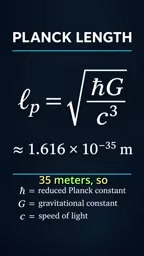
The Planck length is often called the smallest distance in the universe, but science videos point out this claim has never been experimentally confirmed. This article explains the origins of the Planck length, the obstacles of microscope thought experiments, and what it really tells us—the scale at which quantum gravity becomes unavoidable, not spacetime pixels.

AI Agents Drive Spend Management: Payhawk Raises $280M
Payhawk raises $280M at a $2B valuation. The 2018-founded enterprise finance platform uses AI agents to track and manage expenses and procurement. This article analyzes its product evolution, valuation signals, and impact on the spend management space.