Fitting Neural Textures and PBR Materials with Evolution Strategies: A Backprop-Free Approach
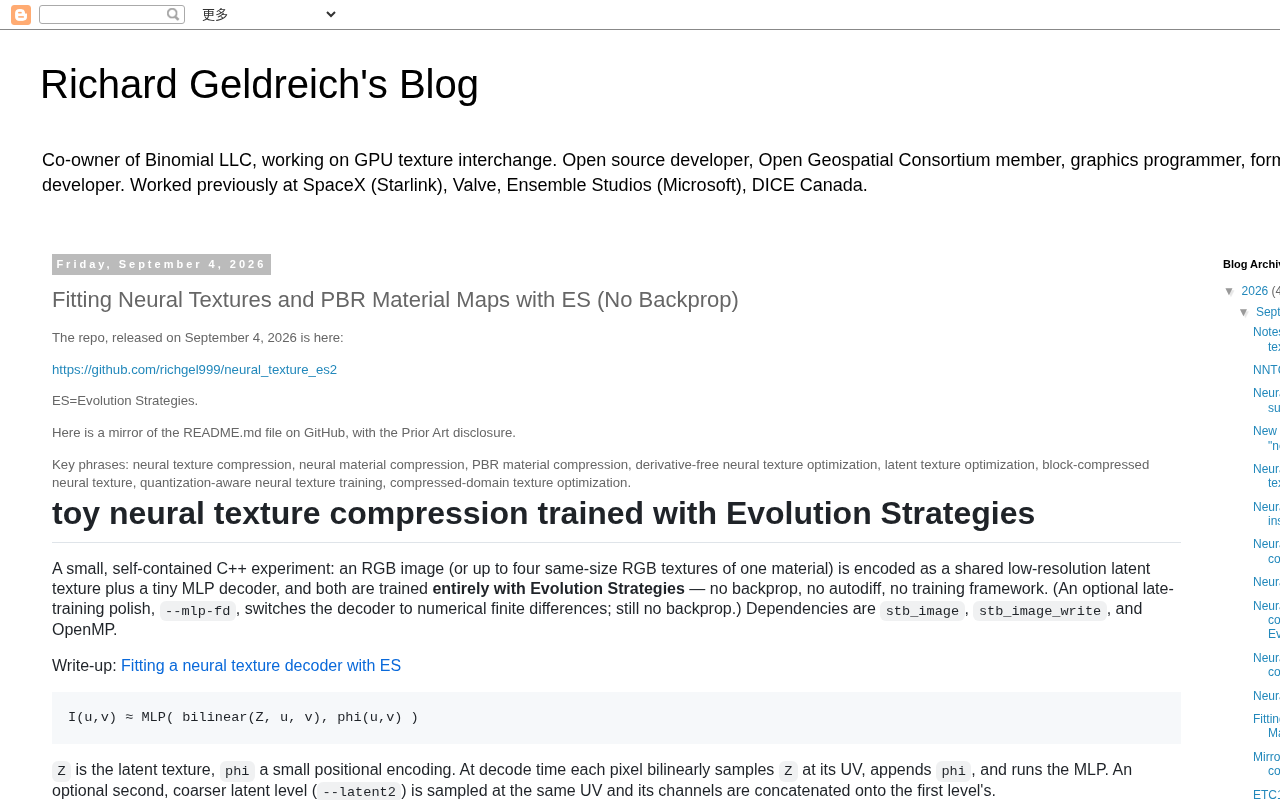
Using Evolution Strategies instead of backpropagation to fit neural textures and PBR materials, bypassing differentiable rendering complexity.
This technical post proposes a counterintuitive idea: using Evolution Strategies (ES), a black-box optimization method, to fit neural textures and PBR material maps — with no backpropagation or differentiable rendering pipeline required. The core logic is that ES only needs forward evaluation of parameters without computing gradients, making it applicable to any non-differentiable black-box renderer. This appeals to engineering teams doing material inversion on existing non-differentiable pipelines. The trade-off is that ES has lower sample efficiency in high-dimensional spaces and typically converges slower with less accuracy than gradient methods. The original source has minimal community engagement and lacks experimental data, so the approach is best treated as an idea to reference rather than a production-ready solution.
Overview: A Texture Fitting Method That Bypasses Backpropagation
This technical post from Hacker News proposes a counterintuitive idea: using Evolution Strategies (ES) to fit Neural Textures and PBR (Physically Based Rendering) material maps — entirely without backpropagation (No Backprop).
In today's deep learning landscape, gradient descent and backpropagation are virtually the default choice for training neural networks. This work takes the opposite approach, exploring whether viable gradient-free alternatives exist for texture and material fitting tasks. The angle offers some inspiration for researchers working at the intersection of computer graphics and machine learning.
What Are Neural Textures and PBR Material Maps
Neural Textures
Neural textures encode traditional texture information into a neural network — typically a small MLP or feature grid. Compared to conventional bitmap textures, neural textures offer advantages in compressed storage, continuous sampling, and detail representation. They've attracted increasing attention in real-time rendering and neural rendering in recent years.
PBR Material Maps
PBR is a material standard widely adopted by modern game engines and film rendering pipelines. It uses a set of maps — such as Albedo, Normal, Roughness, and Metallic — to physically describe how a material responds to lighting. Fitting these material properties to a target appearance typically requires an optimization process that relies on differentiable rendering and backpropagation.
Why Choose Evolution Strategies Over Backpropagation
While backpropagation is efficient, it requires the entire rendering or fitting pipeline to be differentiable. In real-world graphics scenarios, many rendering steps aren't naturally differentiable, and building a differentiable renderer is itself a complex engineering undertaking.
Evolution Strategies, as a class of black-box optimization methods, only require the ability to evaluate how good a given set of parameters is — i.e., a loss or fitness function — without computing any gradients. ES works by randomly perturbing parameters, evaluating performance, and updating toward better configurations. This brings several potential advantages:
- No differentiable pipeline required: The renderer can be an arbitrary black box, bypassing the engineering complexity of differentiable rendering.
- More robust to discontinuous or noisy objectives: ES doesn't rely on gradient smoothness assumptions.
- Naturally parallelizable: Population-based evaluation is well-suited for large-scale parallel computation.
The trade-offs are equally clear: ES typically has far lower sample efficiency than gradient-based methods in high-dimensional parameter spaces, and convergence speed and final accuracy may be limited. This has been a long-standing point of contention for such approaches.
Potential Applications and Significance
The most immediate value of applying ES to texture and material fitting is reducing dependence on differentiable rendering. For teams looking to perform material inversion or texture compression within existing non-differentiable rendering pipelines, this offers a path forward without having to rewrite an entire differentiable renderer.
From a broader perspective, this is also a re-validation of gradient-free optimization in the deep learning era. ES has previously been shown to be a competitive alternative to backpropagation in areas like reinforcement learning. Migrating it to the highly specialized domain of graphics rendering is itself an experiment worth documenting.
Limitations to Keep in Mind
It's worth noting that this Hacker News post currently has very low traction (4 points, 0 comments), meaning the community has not yet provided substantial discussion or validation of the method's actual effectiveness and performance. The original material provides no specific experimental data, comparison baselines, or convergence curves, so it's impossible to assess how this approach stacks up against backpropagation in real engineering contexts.
For readers following neural rendering, this is better treated as a conceptual reference: when facing non-differentiable rendering pipelines, black-box optimization methods like ES are options worth keeping in your toolbox. Whether to adopt them still depends on the specific task's dimensionality, accuracy requirements, and computational budget.
Summary
Using Evolution Strategies to fit neural textures and PBR materials demonstrates a technical path that bypasses backpropagation. Its core appeal isn't about outperforming gradient-based methods in accuracy — it's about breaking free from hard dependency on differentiable rendering, offering greater flexibility for engineering practice. Until the method has been more thoroughly vetted by the community, staying curious while remaining cautiously skeptical is the right attitude.
Related articles

iOS 27, iPadOS 27, and macOS 27: The Information Gap Behind a Discussion
A Hacker News post about iOS 27, iPadOS 27, and macOS 27 sparked speculation about Apple unifying its version numbering. Here's how to read it with limited info.
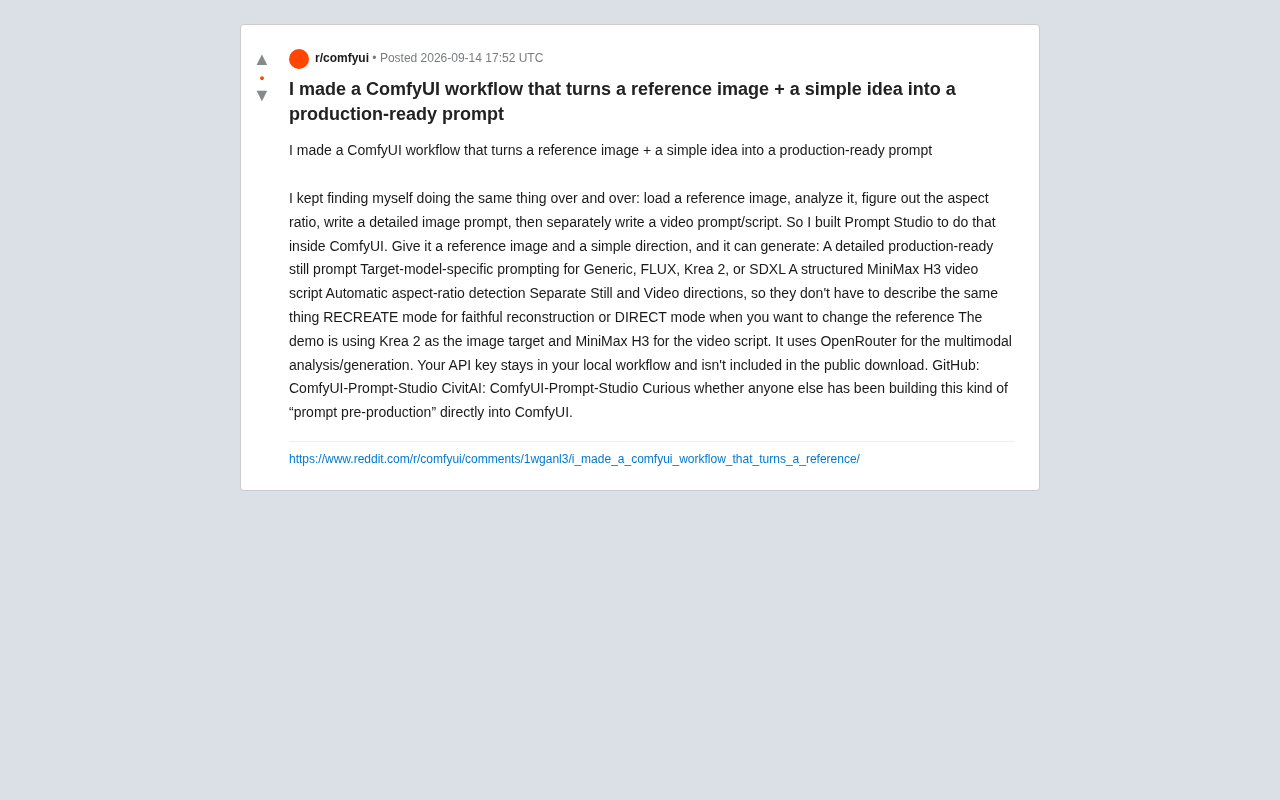
ComfyUI Prompt Studio: A Workflow for Turning Reference Images into Production-Ready Prompts
ComfyUI Prompt Studio is an open-source workflow that auto-generates production-ready image prompts, multi-model custom prompts, and MiniMax video scripts from reference images.
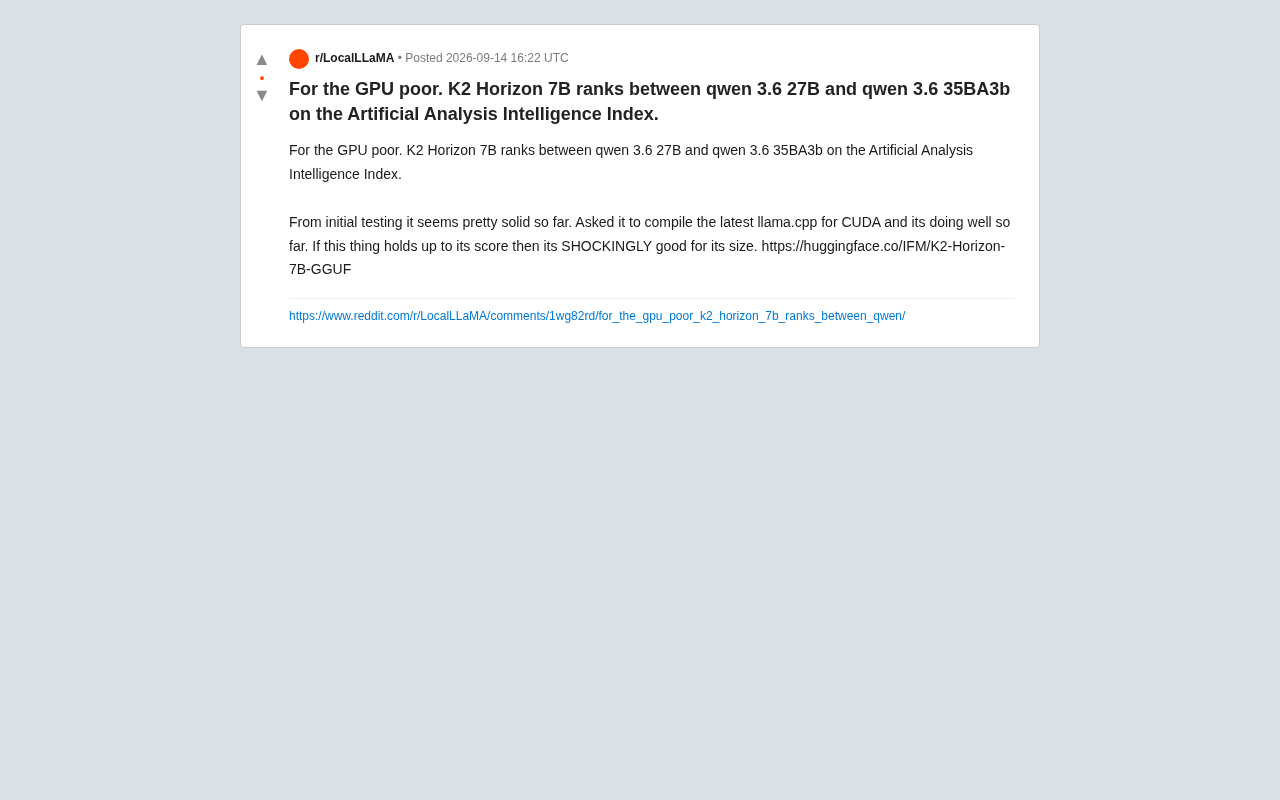
K2 Horizon 7B: A Small Model Punching Above Its Weight
K2 Horizon 7B ranks between Qwen 3.6 27B and 35BA3b on the Artificial Analysis Intelligence Index, delivering near-mid-tier intelligence at 7B parameters — a strong local deployment option.