Fix Bundles in 30 Seconds: Neens Lets Claude Code, Cursor, and Codex Auto-Fix Bugs

Neens launches fix bundles that generate root cause, fix code, and verification evals in 30 seconds, handed off to coding agents for execution.
Neens has launched a "Fix Bundle" feature that claims to automatically generate a complete fix plan within 30 seconds, including root cause analysis, fix code grounded in real traces, and verification evals. Developers copy the fix bundle into coding agents like Claude Code, Cursor, or Codex, which then complete changes in the local repo and run verification. The generation phase does not read the repository or carry credentials, and final merging is done by humans.
From "Knowing the Problem" to "Getting a Fix Bundle"
Developers often find themselves stuck in this predicament: they know there's a bug in the project, but they have to spend a lot of time analyzing the root cause, designing a fix, and writing verification logic. Neens' "Fix Bundle" aims to compress this process into 30 seconds. According to its official short video, Neens can automatically generate a complete fix bundle that includes root cause analysis, fix code grounded in real traces, and evals, and developers only need to copy it into Claude Code, Cursor, or Codex, where the coding agent will automatically make the changes in the repository and run the verification.
The Three Core Elements of a Fix Bundle
A fix bundle is not a simple code snippet but consists of three parts: first, the root cause, i.e., the fundamental reason the problem occurs; second, the fix grounded in real traces, ensuring the fix comes from actual runtime data rather than guesswork; and finally, evals that prove it. This structure gives the fix process a basis in evidence and makes subsequent verification easier.
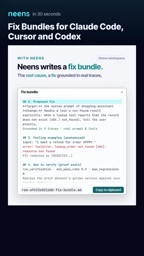
This design approach aligns with the current direction of AI coding assistants—not only generating code but also providing verifiable evidence. For developers using Claude Code, Cursor, or Codex, a fix bundle is essentially a "construction blueprint" that the coding agent can follow to complete the specific operations.
Root Cause Analysis in software engineering refers to a systematic method for locating the fundamental cause of a problem rather than merely addressing surface symptoms. Common techniques include the "5 Whys" questioning method, fault tree analysis (FTA), and causal diagrams. In AI-assisted coding scenarios, the quality of root cause analysis directly determines whether the fix addresses the right problem—if only the error line is fixed while upstream data contamination is ignored, the problem often recurs in another form. By making the root cause the first element of a fix bundle, Neens effectively front-loads and structures the most time-consuming diagnostic step in traditional debugging.
Evals is a term from the field of large models and AI agents, originally referring to using a set of standardized test cases to measure model output quality. In the context of fix bundles, evals refers to verification logic generated specifically for this fix, which may include unit tests, regression cases, or replay checks against trace data. Unlike general test suites, evals emphasize "proving this fix works" and are therefore usually more focused and lightweight. This mechanism draws on the practice of "driving improvement through evaluation" in AI engineering, giving code changes quantifiable acceptance criteria.
Workflow: Copy, Edit, Verify
The workflow is very straightforward: the developer copies the fix bundle into a supported coding agent, the agent performs editing operations in the local repository, and then runs the evals built into the fix bundle to verify whether the changes take effect. The entire process requires no manual writing of fix code or test cases.
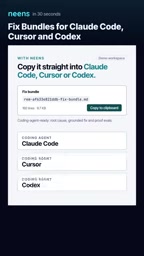
You may not have noticed that Neens emphasizes that the fix bundle generation process does not read your repository and does not carry credentials. This means that during the generation phase, code security and privacy are protected. The final merge operation is always performed by a human, preserving critical control.
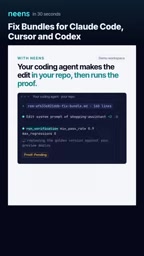
Claude Code, Cursor, and Codex mentioned in the article represent the three mainstream forms of AI coding agents today. Claude Code is Anthropic's command-line agent tool that can directly read and write files and execute commands in the terminal; Cursor is an AI-first editor deeply reworked from VS Code, emphasizing conversational programming within the editor; Codex is OpenAI's early code generation model and its derived agent capabilities, often appearing as an API or integration. Although the three have different interaction forms, they share the commonality that they can accept natural language or structured instructions and perform multi-step editing operations in a local repository. The reason fix bundles emphasize "portability" is precisely because the instruction interfaces of these agents are gradually converging, and a clearly described fix plan can be reused across different tools without rewriting prompts for each agent.
Security Boundaries and Human Control
Against the backdrop of increasingly widespread AI-assisted coding tools, security boundaries have become a focus of attention. Neens clarifies two principles: when generating a fix bundle, it does not access repository contents or carry any credentials; and merging fixes must be performed by a human. This avoids the risk of automated tools directly modifying production code and aligns with the industry's current positioning of AI agents as "assistive rather than replacement."
Neens calls itself a "self-improving agentic harness," and its fix bundle feature is a concrete implementation of this philosophy. By packaging root cause analysis, fixes, and verification into standardized units, Neens attempts to play the role of "problem diagnosis and solution generation" in the coding agent workflow while leaving execution and decision-making to the developer and the agent itself.
The term Agentic harness borrows from the concept of a "test harness"—the latter refers to an automated execution environment built around the code under test. In the AI agent field, a harness refers to the engineering layer wrapped around a large model, responsible for tool invocation, context management, error recovery, and security constraints. Neens calling itself a "self-improving agentic harness" means that it does not just call a model once but builds a runtime framework that can iteratively optimize its own behavior based on feedback. The fix bundle feature is precisely the output of this framework: the harness is responsible for diagnosis and solution generation, while the actual code execution is handed off to downstream coding agents. Understanding this layering helps grasp Neens' positioning—it is closer to a "diagnosis and planning layer" than an "execution layer."
Potential Impact on Development Workflows
The value of the fix bundle model lies in standardization and portability. The same fix bundle can be used with different coding agents (Claude Code, Cursor, Codex), reducing the cost of switching tools. At the same time, the built-in eval mechanism gives fix quality a measurable standard, reducing the risk of "introducing new problems after a fix."
However, this model also depends on the quality of fix bundle generation. If the root cause analysis is inaccurate or the trace data is insufficient, subsequent fixes and evals may deviate from reality. Neens' short video does not show specific cases or performance data, and its actual effectiveness still needs to be tested by developers in practice.
For developers who routinely maintain multiple projects, the process of generating a fix bundle in 30 seconds and handing it to an agent for execution is expected to significantly reduce the time overhead of debugging and fixing. But review of the core logic and final merging still require human intervention, which also reminds us: AI agents are efficiency tools, not responsible parties.
One-line Summary
Neens launches fix bundles that generate root cause, fix code, and verification evals in 30 seconds, handed off to coding agents for execution.
Paragraph Summary
Neens has launched a "Fix Bundle" feature that claims to automatically generate a complete fix plan within 30 seconds, including root cause analysis, fix code grounded in real traces, and verification evals. Developers only need to copy the fix bundle into coding agents such as Claude Code, Cursor, or Codex, and the agent will automatically complete the changes in the local repository and run verification. This model emphasizes security boundaries: the generation phase does not read the repository or carry credentials, and the final merge is performed by a human. Fix bundles standardize the repair process, offer cross-agent portability, and the built-in eval mechanism provides a measurable standard for fix quality. However, its actual effectiveness still depends on the quality of root cause analysis and trace data and awaits practical testing by developers.
Related articles

A 19-Year-Old's Rental Horror Story: Ceiling Collapse, Bug Infestation, and the Lessons It Taught Me
At 19, my first off-campus rental brought bug infestations, no heat, a collapsed ceiling, and a ruined laptop with no renter's insurance. Here are the hard-won lessons for first-time student renters.

Veda Nurse's Cranial Nerve Exam: Why ASMR Role-Play Is Going Viral
Bilibili creator Veda's cranial nerve exam ASMR video goes viral, blending humor and sensory triggers through nurse role-play. This article analyzes its unique appeal and the audience psychology behind ASMR role-play.

LG Cinebeam AI Review: 120-Inch Giant Screen + 3000 Lumens, a New Choice for the Living Room Theater
LG Cinebeam AI projector review: 3000 ANSI lumens, 4K, 100 inches from about 8 cm and 120 inches from about 18 cm. Built-in webOS, AI Concierge voice recommendations, AI Sound Pro 11.1.2 virtual surround, and Game Optimizer—positioned for fixed living room installation, complementing the portable Cinebeam S.