Fixing a Retro Console with GPT-6 Astra: A Non-Programmer's Hardware Rescue Story
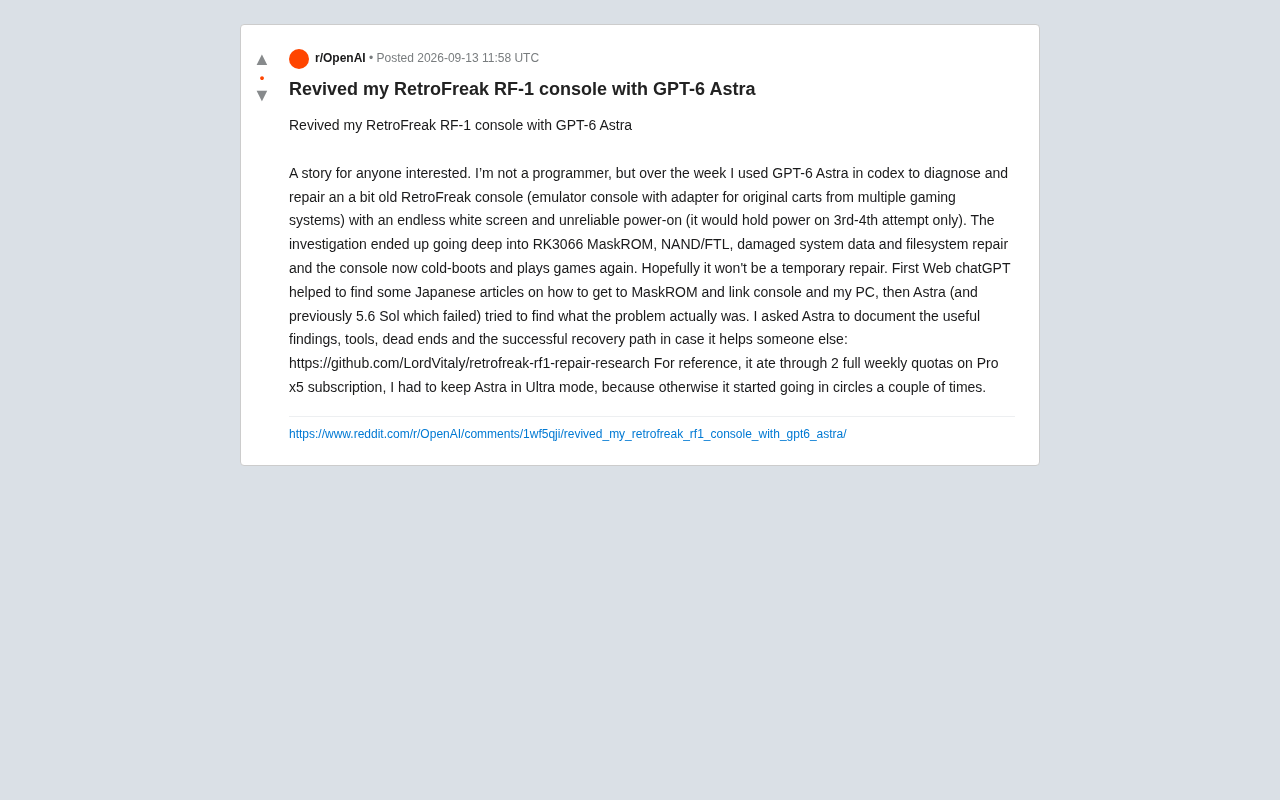
A non-programmer fixed a white-screened RetroFreak RF-1 console using GPT-6 Astra and open-sourced the entire repair process.
A Reddit user with no coding background successfully repaired a RetroFreak RF-1 retro console — stuck in a white screen loop with unstable power — using GPT-6 Astra. The process went deep into RK3066 MaskROM mode, NAND flash, FTL, and filesystem repair. It required Astra's Ultra compute mode throughout and consumed two full weekly Pro subscription quotas. The user then had Astra document all findings, dead ends, and successful steps, publishing everything to a GitHub repository — showing how AI can serve as both a problem-solver and a structured knowledge-capture tool.
A Reddit user with no programming background spent a week using GPT-6 Astra (running in Codex) to successfully revive a broken RetroFreak RF-1 retro gaming console. The device had been stuck in an endless white screen loop with wildly unstable power behavior — requiring three or four attempts just to stay on — but ultimately regained the ability to cold boot and play games again. What makes this case worth examining isn't just that a broken machine got fixed, but what it reveals about how deep large language models can go as hardware troubleshooting assistants.
From White Screen to Cold Boot: A Deep-Dive Rescue
The RetroFreak RF-1 is an emulator console that reads original game cartridges through various adapters. The symptoms were frustrating: persistent white screen, and a power circuit that wouldn't stay stable. For someone without a technical background, this kind of problem typically means either sending it in for repair or writing it off as dead.
But this user brought in AI to handle the diagnosis. The troubleshooting process went all the way down to the hardware level — the RK3066 chip's MaskROM mode, NAND flash memory and FTL (Flash Translation Layer), corrupted system data, and filesystem repair. These are concepts that are essentially black boxes for most consumers. In this workflow, AI took on the roles of knowledge retrieval, solution reasoning, and step-by-step guidance.
Division of Labor: Different Models for Different Jobs
One detail worth noting is how different models were used at different stages. The user first turned to the ChatGPT web interface to find Japanese-language technical articles about entering MaskROM mode and connecting the console to a PC. This step solved the "entry point" problem — establishing an operable channel at the hardware level.
The actual fault diagnosis was then handed off to GPT-6 Astra. The user specifically noted that an earlier attempt with version 5.6 Sol failed to resolve the issue, and that Astra was what ultimately identified the root cause. This trial-and-error behavior across model versions reflects a real pattern in how people use AI tools today: different versions and models show meaningful capability gaps on complex tasks, and users have to find the right fit through experimentation.
Ultra Mode and Compute Costs: The Price of Avoiding Loops
This repair wasn't free. The user revealed that the entire process consumed two full weekly quotas under a Pro x5 subscription. More critically, Astra had to be kept in Ultra mode throughout — because whenever the mode was lowered, the model would "start going in circles," looping through the same reasoning without making progress.
This detail exposes how demanding long, deep technical tasks are on a model's reasoning capacity. In scenarios involving low-level firmware and filesystem repair — tasks that require maintaining extensive context and multi-step inference — a model's focus and coherence directly determines whether the job gets done. High-compute mode is expensive, but for tasks like this, it's a necessary investment.
Open-Sourcing the Hard-Won Knowledge
After the successful repair, the user did something genuinely valuable: he had Astra document the entire process — useful findings, tools used, dead ends, and the final successful recovery path — then published it to a GitHub repository (LordVitaly/retrofreak-rf1-repair-research) for anyone facing the same problem.
This approach itself reflects a new paradigm for AI collaboration. AI isn't just a problem-solver; it can also serve as a documentation generator, structuring and preserving the scattered insights from a troubleshooting process. For communities working on niche hardware repairs, a document that maps out "what doesn't work" can be just as valuable as the solution itself.
What This Case Tells Us
The significance of this story goes beyond one repaired console. It demonstrates that large language models are becoming genuine capability multipliers — allowing ordinary users without hardware engineering backgrounds to reach into domains like RK3066 MaskROM operations and NAND/FTL repair that were previously the exclusive territory of embedded engineers.
That said, some realism is warranted: the user himself admitted he hoped the fix "won't turn out to be just a temporary one." AI-generated solutions aren't guaranteed to be airtight. And the two-week quota burn combined with the mandatory Ultra mode requirement shows that the cost and trial-and-error threshold for this kind of task remains significant. But as a real, well-documented case — complete with an open-source repository — it provides a concrete reference point for what AI-assisted hardware diagnosis and repair can actually look like in practice.
Related articles

Can 'Your Mother' Make Us Forget Marvel's Blade Disaster?
Marvel's Blade reboot starring Mahershala Ali collapsed due to mismanagement. We explore why its failure may not be the worst outcome — and what 'Your Mother' has to do with it.
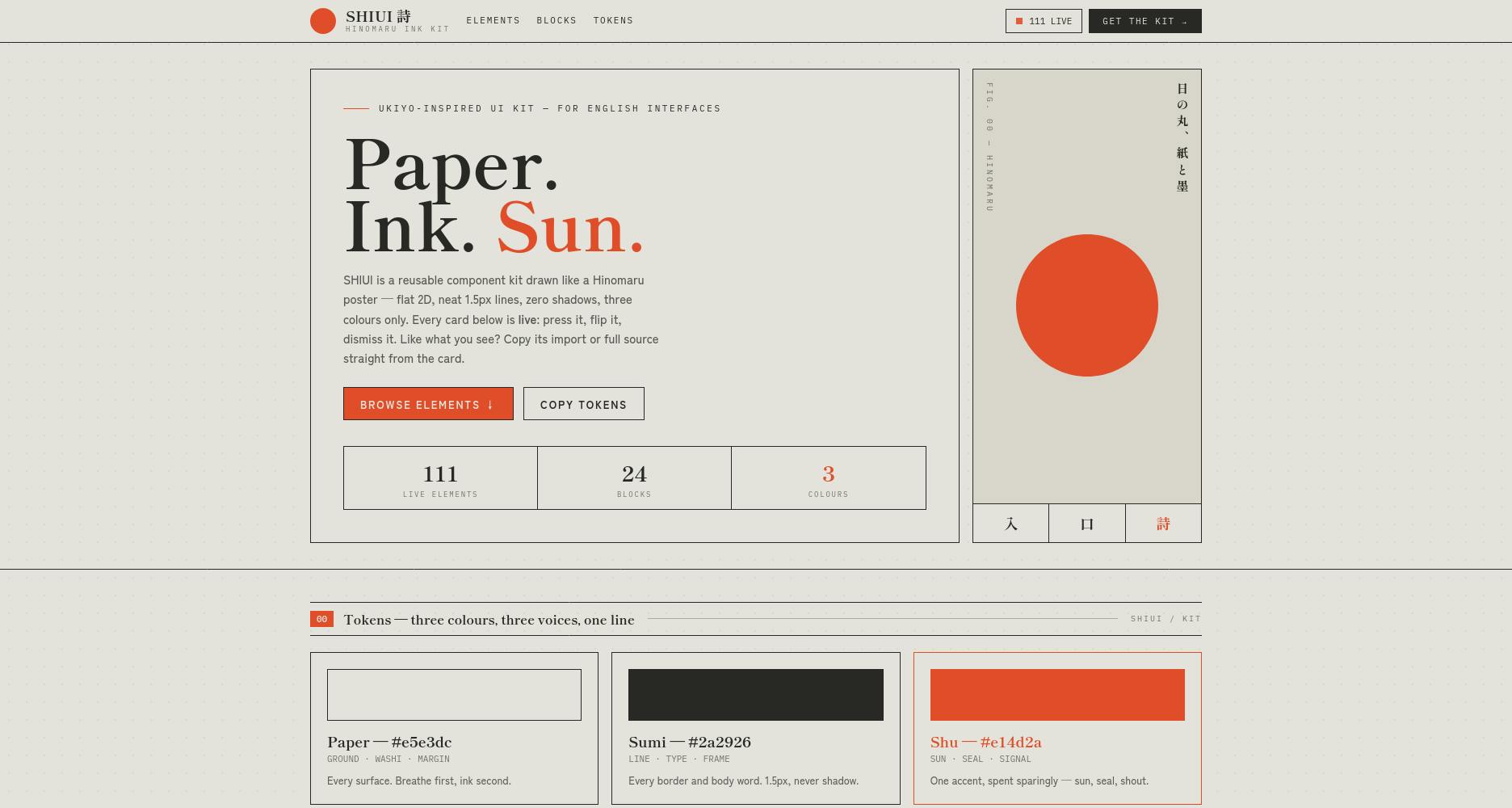
SHIUI: A Minimalist Ink-Wash UI Kit Inspired by Japanese Hinomaru Aesthetics
SHIUI is a flat ink-wash Web UI kit inspired by Japanese Hinomaru poster aesthetics, built around paper, sumi ink, and vermilion with zero shadows. A design breakdown.
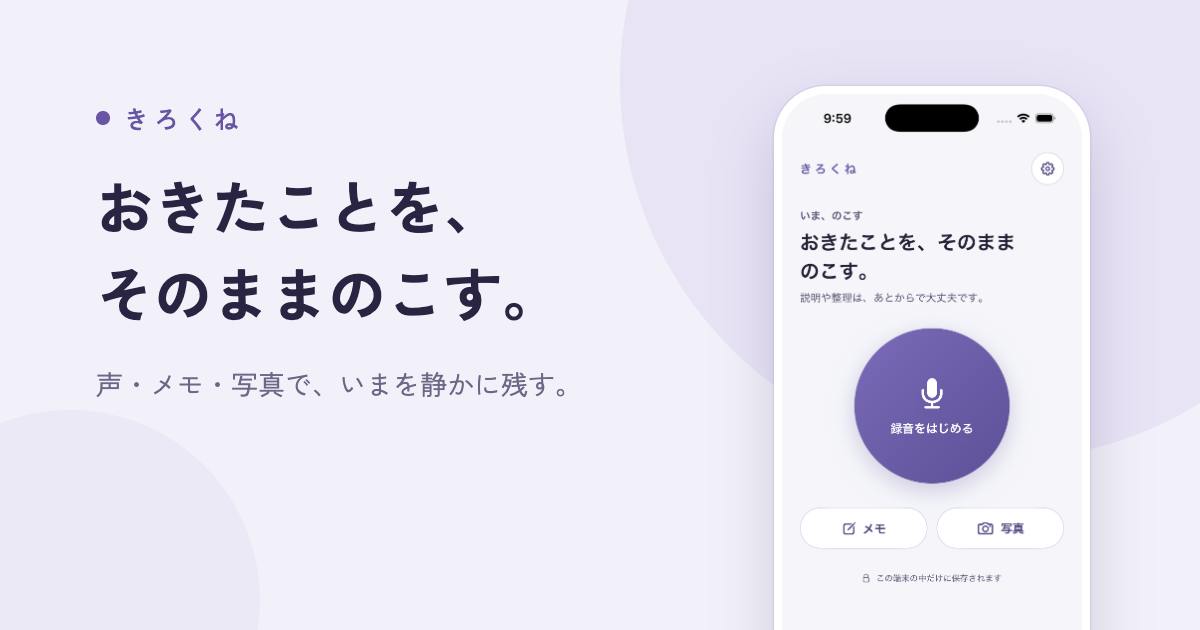
Kirokune: An iPhone Work Incident Logger That Requires No Account
Kirokune is an iPhone app for logging workplace incidents — no account required. Combines text, audio, and photos in a timeline. Ranked #9 on Product Hunt with 86 votes.