Flint: A Deep Dive into the Visualization Language Optimized for AI Generation

Flint is a new visualization language designed with AI generation as a first-class citizen, optimizing for LLM output.
Flint is an emerging visualization language that positions AI as a first-class citizen in its design. By leveraging declarative syntax, concise structure, and strong Schema constraints, it aims to make LLM-generated visualizations more reliable and verifiable. While it faces significant ecosystem cold-start challenges, Flint represents a forward-looking approach to toolchain design in the human-AI collaboration era.
The Evolution of Visualization Tools: From Handwritten Code to AI Generation
Data visualization has always been an indispensable part of data analysis, scientific research, and product development. From early Excel charts to matplotlib, D3.js, and then to Vega-Lite and Observable Plot, the evolution of visualization tools has consistently revolved around a core proposition: how to make data expression simpler, more powerful, and closer to human thinking.
This evolutionary journey spans several key stages. matplotlib was born in 2003, created by John Hunter, mimicking MATLAB's plotting interface with an imperative API—developers need to specify the properties and positions of each graphic element step by step. D3.js (Data-Driven Documents), released by Mike Bostock in 2011, binds data directly to DOM elements, offering tremendous flexibility but with an extremely steep learning curve. Vega-Lite represents the declarative visualization direction, where developers only need to describe data mappings and chart types in JSON, while the underlying engine automatically handles layout, axes, and legends. Observable Plot, released by the D3 team in 2021, is a higher-level abstraction that attempts to find a new balance between expressiveness and usability.
Recently, a project called Flint caught attention on Hacker News. It positions itself as "A Visualization Language for the AI Era," attempting to rethink visualization tool design philosophy in the new technological wave dominated by Large Language Models (LLMs). The direction it proposes—making visualization languages natively compatible with AI generation—deserves a deep exploration.
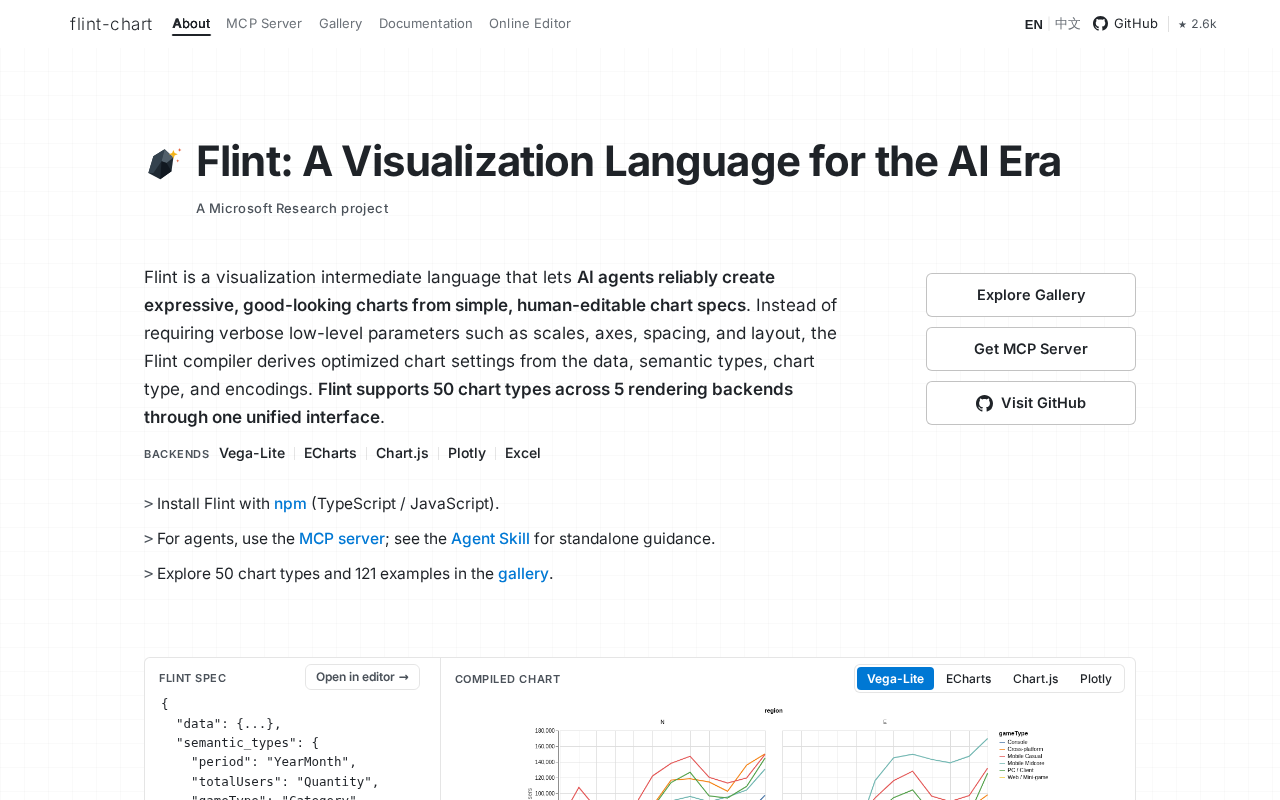
Flint's Core Positioning: AI as a First-Class Citizen
Limitations of Traditional Visualization Tools
Traditional visualization libraries are mostly designed for human developers writing code by hand. Whether it's imperative APIs (like matplotlib) or declarative syntax (like Vega-Lite), their original design intent is to be directly readable and writable by humans.
However, in today's workflows, an increasing number of charts are not typed out line by line by humans, but generated by LLMs from natural language descriptions into corresponding visualization code or configurations. This raises a critical question: What kind of visualization language is best suited for AI generation and comprehension?
Flint's Syntax Design Principles Optimized for LLMs
Flint's core design differentiation lies in treating AI as a first-class citizen in its language design considerations. A visualization language "suited for AI" typically needs the following characteristics:
-
Declarative rather than imperative: Declarative Programming and Imperative Programming are two fundamentally different programming paradigms. Imperative programming tells the computer "how to do it"—each step must be explicitly specified; declarative programming describes "what you want"—developers only need to declare the desired end state, and the system figures out the implementation. SQL is a classic declarative language: you describe the shape of data you want, and the query optimizer decides how to retrieve it. For LLMs, the advantage of declarative syntax is that the model only needs to generate a structured description (like a JSON object) rather than reason through a correct sequence of execution steps. Any single error in an execution sequence can cause the final result to fail, whereas errors in declarative descriptions are typically local and can be isolated for repair.
-
Concise syntax with consistent structure: Languages with fewer tokens and more consistent structures reduce the model's generation burden and hallucination risk. LLM "hallucination" in code generation manifests as the model generating seemingly plausible but actually non-existent API calls, parameter combinations, or library functions. The root cause is that language models fundamentally perform token prediction based on statistical probability rather than truly understanding API semantic constraints. The larger the API surface area of a target language, the more inconsistent its naming, and the more frequent its version changes, the higher the probability of model hallucination. Conversely, if a language's syntax space is finite and regular, each token prediction by the model is more likely to fall within a legal syntactic structure, dramatically reducing hallucination rates.
-
Strong constraints and verifiability: Clear Schemas make generated outputs easier to validate and correct, forming a "generate—validate—feedback" loop. Schema here refers to formal constraint definitions of language structure, similar to JSON Schema or XML Schema. When a visualization language has a clear Schema, any AI-generated output can be immediately checked by an automated validator for legality—whether fields are complete, types are correct, and values fall within valid ranges. An LLM generates a visualization description, the validator detects a field value out of range, feeds the error information back to the model, and the model corrects accordingly. This mechanism is known as "Constrained Generation" in software engineering and is one of the core technical approaches for improving LLM code generation reliability today. OpenAI's Function Calling and Structured Outputs features are essentially based on similar Schema constraint principles.
Flint follows this line of thinking, attempting to provide a visualization description language that is both human-readable and efficiently generated by AI.
Why Flint's Direction Deserves Attention
Solving Pain Points in LLM-Generated Visualization Code
Over the past few years, pain points in data visualization have persisted: steep learning curves, complex APIs, and high migration costs between different libraries. The emergence of LLMs has made "generating a chart with a single sentence" possible, but in practice, having general-purpose LLMs directly generate D3.js or complex matplotlib code often results in detail errors, styling chaos, and reproducibility issues.
The fundamental reason behind this is: existing visualization languages were not designed for machine generation. They carry too much historical baggage and assumptions about human-computer interaction. Explorations like Flint are essentially redesigning foundational tools for the "human-AI collaboration era," enabling AI to more reliably handle visualization generation tasks.
The Renaissance of Declarative Syntax in the AI Era
Flint's approach is a natural continuation of the rise of declarative visualization syntax like Vega-Lite. Declarative syntax is inherently suitable as an "intermediate representation layer"—humans can read it, machines can write it, and tools can render it. In the AI era, these characteristics of being "structured, verifiable, and semantically clear" have become core advantages.
It's foreseeable that more similar "AI-native" tool languages will emerge in the future, not limited to visualization but extending to data processing, UI construction, workflow orchestration, and other domains. In fact, this trend is already showing early signs across multiple fields: in UI construction, v0.dev uses structured component descriptions to let AI generate frontend interfaces; in data processing, query DSLs better suited for LLM generation are emerging; in infrastructure, some teams are exploring declarative configuration languages more AI-friendly than Terraform HCL. The underlying logic of this trend is: when the primary producer of code shifts from humans to AI, the optimization target of language design must also shift from "human readability and development efficiency" to "machine generation reliability and human auditability." This doesn't mean abandoning human readability, but rather finding a new Pareto optimum between the two.
Challenges Facing Flint and Industry Reflections
Ecosystem Building Is the Biggest Hurdle
Every new language faces a harsh reality: ecosystem determines survival. The reason matplotlib, D3, and Vega-Lite became mainstream is their massive communities, rich documentation, and countless code examples. And these code examples are also important sources of LLM training data—the more familiar a model is with a library, the higher its generation quality.
There's a "chicken-and-egg" paradox here: Flint wants to optimize for AI, but AI happens to be more proficient with mature tools that have massive existing data. A brand-new language, no matter how elegantly designed, needs sufficient adoption and public corpus to be truly "learned" by LLMs.
This paradox is extremely common in programming languages and tools, known as the "Cold Start Problem." LLM training data primarily comes from public code repositories, documentation, and technical forums on the internet. A new language's code volume on GitHub, Q&A count on Stack Overflow, and tutorial count in tech blogs directly determine how "familiar" LLMs are with it. It's estimated that Python-related visualization code snippets on GitHub number in the millions, while a new language may only have a few hundred examples in its early stages. This means that even if Flint's syntax design is better suited for AI generation, it barely exists in the model's training distribution, making it very difficult for the model to master it in a "zero-shot" manner. Possible paths to solving this problem include: injecting complete syntax specifications into the model's System Prompt, providing Few-shot examples, or specifically adapting through Fine-tuning.
The Dilemma of Abstraction Level Trade-offs
Another key issue is finding the right abstraction level. If the language is too low-level, it loses its conciseness advantage; if too high-level, it may sacrifice flexibility and expressiveness. Flint needs to find a balance between "easy for AI to generate" and "meeting complex visualization needs"—which is no easy task.
This trade-off is particularly pronounced in the visualization domain. A simple bar chart might need only a few parameters to describe, but a dashboard with multi-level interactions, custom animations, and complex layouts might require hundreds of lines of configuration. If the language can only elegantly handle simple scenarios, it will be confined to the narrow use cases of prototyping and quick exploration; if it tries to cover all complex scenarios, the explosion of syntax complexity will undermine its AI-friendliness. Historically, Vega-Lite chose a "common scenarios first" strategy—covering 80% of common chart types, with complex needs requiring a fallback to the lower-level Vega syntax. Flint will likely need to make similar layered design decisions.
Conclusion: The Starting Point of Toolchain Reconstruction
Although Flint is still in its early stages, the direction of thinking it represents carries forward-looking significance: When AI becomes the primary code producer, should our tools and languages evolve accordingly?
This isn't just a question for the visualization domain—it's a microcosm of the entire software engineering paradigm shift. From "designed for humans" to "designed for human-AI collaboration," the reconstruction of toolchains has only just begun. Whether Flint can become a winner in this space remains to be seen, but the questions it raises deserve serious consideration from every data visualization practitioner and AI developer.
From a broader perspective, we're at a tipping point for the comprehensive reconstruction of the software development toolchain. Just as the leap from assembly language to high-level languages changed how programmers work, the paradigm shift from "humans writing code" to "humans reviewing AI-written code" will inevitably give rise to an entire new generation of languages, frameworks, and tools. Flint's emergence is one ripple in this wave of transformation—it may not be the final answer, but the problem space it points toward will define the core issues in tool design for the next decade.
Note: This article is based on the project introduction on Hacker News. Flint is still in its early development stage; for specific features and design details, please refer to the official documentation.
Related articles
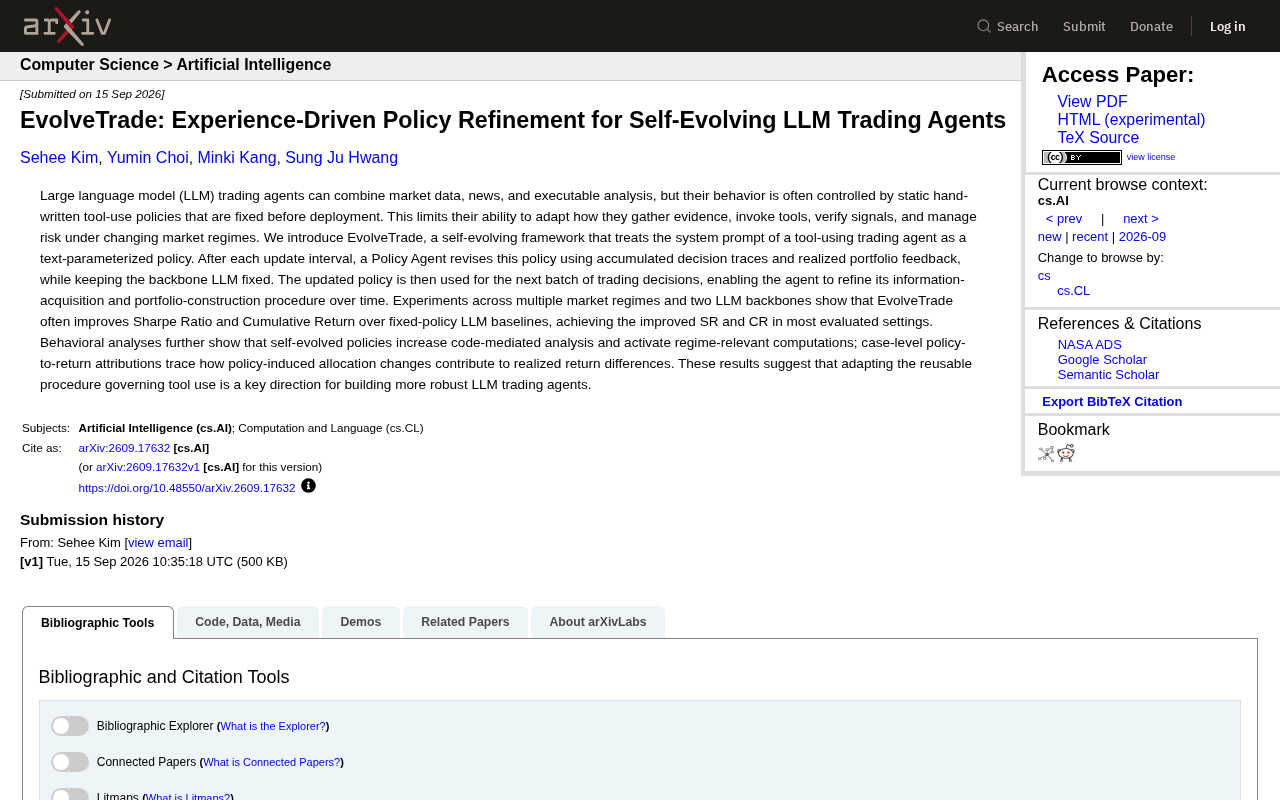
EvolveTrade: A Strategy Optimization Framework for Self-Evolving LLM Trading Agents
EvolveTrade is a self-evolving LLM trading agent framework that treats system prompts as optimizable strategies, iterating via decision traces and real portfolio feedback to improve Sharpe Ratio and cumulative returns across market regimes.
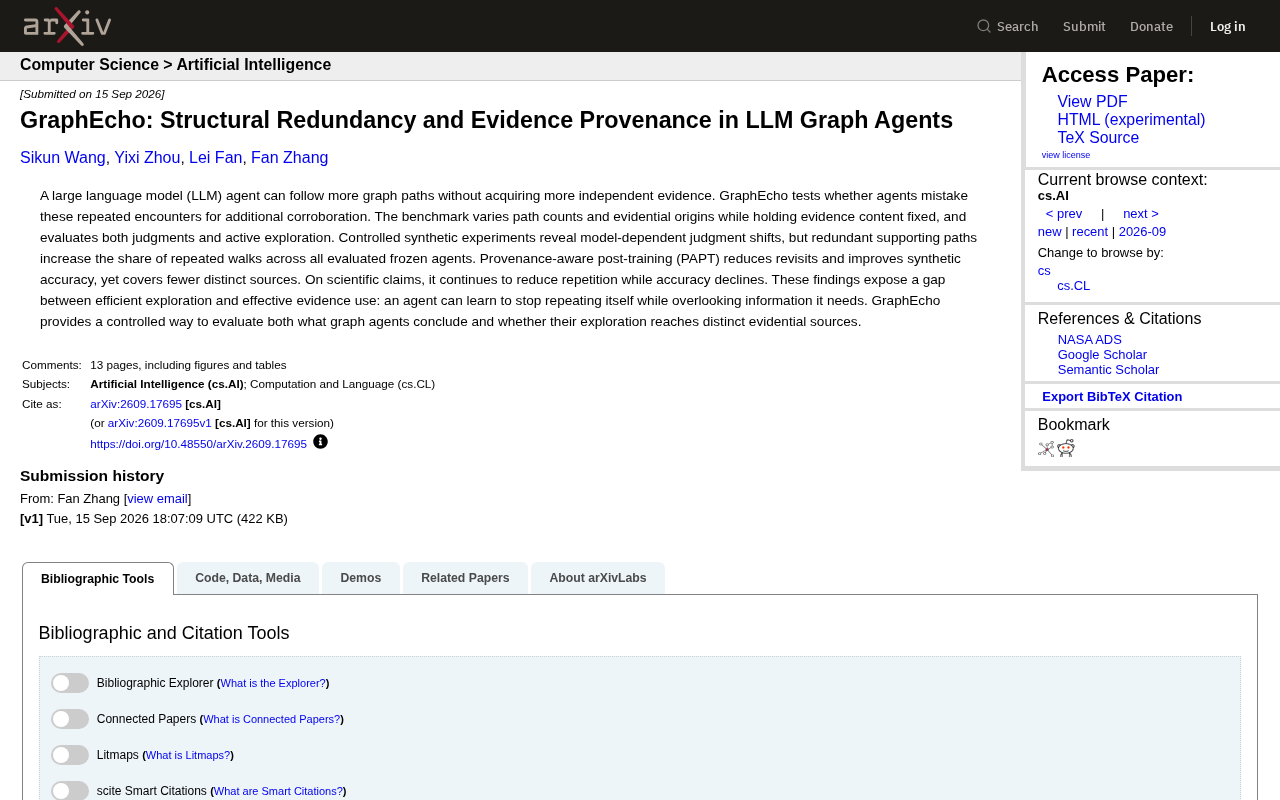
GraphEcho: Exposing the Evidence Redundancy Trap in LLM Graph Agents
GraphEcho benchmark reveals LLM graph agents mistake redundant paths for independent corroboration. New research evaluates PAPT's limits and the gap between efficient exploration and effective evidence use.
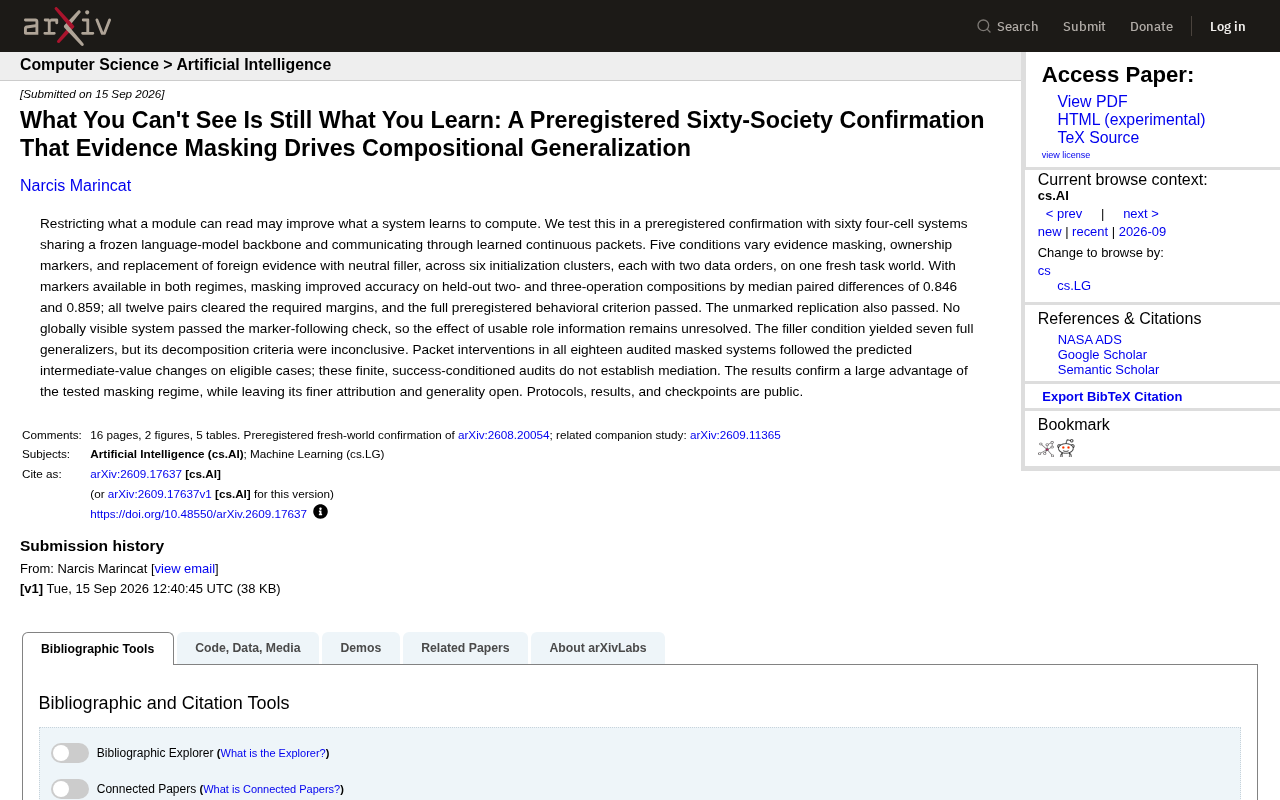
How Evidence Masking Improves Compositional Generalization in AI: Insights from 60 Preregistered Four-Cell System Experiments
A preregistered arXiv study using 60 four-cell systems shows that "evidence masking" — restricting module access to information — significantly boosts compositional generalization in AI, with accuracy gains of 0.846 and 0.859.