GraphEcho: Exposing the Evidence Redundancy Trap in LLM Graph Agents
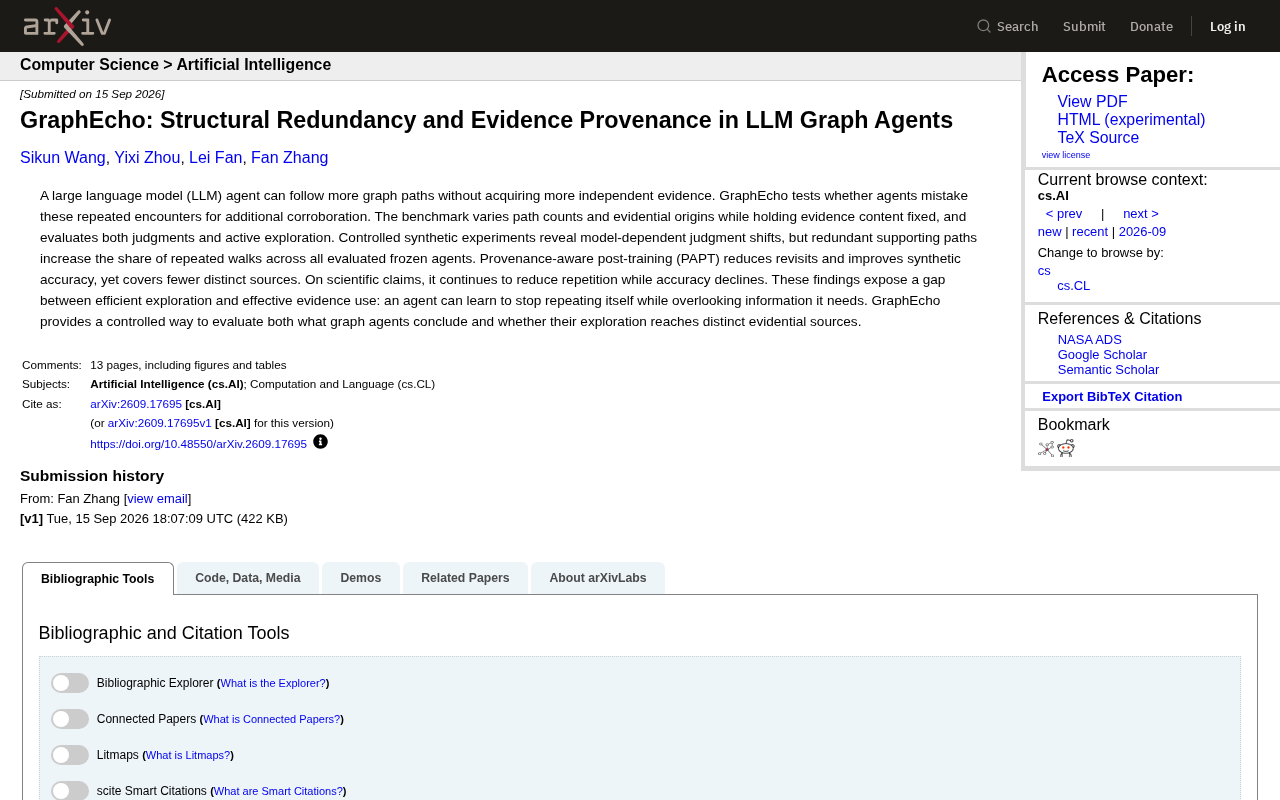
GraphEcho exposes how LLM graph agents confuse redundant paths with independent evidence, showing efficient exploration doesn't equal effective reasoning.
A new arXiv paper introduces the GraphEcho benchmark to test whether LLM-driven graph agents mistake redundant knowledge graph paths for independent corroboration. By fixing evidence content while varying path counts and source labels, experiments show redundant paths cause all tested agents to significantly increase repeated traversals. The proposed Provenance-Aware Post-Training (PAPT) reduces revisits but covers fewer distinct sources, and accuracy drops on real scientific claim tasks — revealing a deep gap between efficient exploration and effective evidence utilization with important implications for RAG and multi-hop reasoning applications.
When Graph Agents Mistake "Repetition" for "Corroboration"
LLM-powered graph agents are becoming increasingly important tools for knowledge reasoning. They traverse paths through knowledge graphs, gather evidence, and draw conclusions. But a subtle problem has long been overlooked: an agent can walk more graph paths without necessarily obtaining more independent evidence. In other words, it may repeatedly encounter different copies of the same information rather than genuinely new corroboration.
A new paper on arXiv introduces a benchmark called GraphEcho, specifically designed to test whether graph agents mistake these repeated pieces of information for additional corroboration. This question strikes at the heart of agent reasoning reliability: if an agent is simply going in circles over the same evidence while believing it has gathered abundant support, its conclusions rest on a false illusion of "evidence richness."
The Experimental Design Logic of GraphEcho
GraphEcho's elegance lies in its variable control. The benchmark holds evidence content fixed while systematically varying two dimensions: path counts and evidential origins. This means the same substantive evidence can be presented to an agent through different numbers of paths and with different source labels, allowing precise measurement of whether the agent is responding to the "substantive content of evidence" or being misled by "path repetition."
The evaluation covers two behavioral levels: the agent's judgments (its final conclusions) and its active exploration (how it chooses to traverse the graph). This dual assessment lets researchers see not only "what conclusions the agent reaches" but also "how it arrives at evidence sources" and whether it actually touches genuinely distinct information sources.
A knowledge graph (KG) is a structured data representation composed of nodes (entities) and edges (relations). When LLM graph agents reason over a graph, they typically use multi-hop traversal: starting from an initial entity, moving along edges to reach related entities, and collecting relational triples along the way as evidence. In real-world knowledge graphs, information redundancy is extremely common — the same fact may appear multiple times through different paths and intermediate nodes. For example, the fact "A is related to C" might be inferred via the path A→B→C and "discovered" again via A→D→C, yet both paths carry the same substantive information. GraphEcho's core contribution is transforming this structural redundancy from "background noise" into a controlled experimental variable, quantifying how agents respond differently to path count versus substantive evidence content.
How Redundant Paths Distort Exploration Behavior
Controlled synthetic experiments revealed several key findings. First, different models showed varying patterns in their judgments — judgment-level shifts are model-dependent, with no universal pattern. But a consistent problem emerged in exploration behavior: redundant supportive paths increased the proportion of repeated traversals across all evaluated frozen agents.
This is a structural flaw worth taking seriously. When a graph contains multiple paths pointing to the same evidence, agents tend to repeatedly walk these redundant paths rather than exploring directions that could yield new information. This "echo" effect is exactly what gives GraphEcho its name — the agent spins inside the evidence echoes it creates, mistaking echoes for new signals.
Provenance-Aware Training: Half a Remedy
To mitigate this problem, the paper proposes Provenance-Aware Post-Training (PAPT). As the name suggests, this approach makes agents aware of the "provenance" attribute of evidence during training, helping them learn to distinguish genuinely independent evidence from redundant copies.
On synthetic data, PAPT showed positive results: it reduced revisits and improved accuracy. Agents did learn to stop repeatedly walking the same paths. However, the flip side of this improvement is that it "covered fewer distinct sources" — in reducing repetition, agents actually ended up touching fewer independent evidence sources.
The harder challenge emerged on real scientific claims tasks. In this setting, PAPT consistently reduced revisit rates, but accuracy actually declined. This exposes the method's fragility when transferring from synthetic environments to genuinely complex real-world scenarios.
Post-Training refers to the further fine-tuning stage applied on top of a pre-trained large model for specific tasks or behavioral objectives, commonly taking the form of supervised fine-tuning (SFT) or reinforcement learning alignment (e.g., RLHF). The core idea of PAPT (Provenance-Aware Post-Training) is to incorporate "evidence provenance annotations" into training signals, teaching the model to recognize whether different paths point to the same underlying source, and thereby actively avoiding repeated exploration of already-visited sources during inference. "Frozen agents" refers to agents whose weights are no longer updated during the inference phase, relying entirely on capabilities acquired through pre-training or post-training — as opposed to agents that can learn online or dynamically adjust strategies through tool calls. PAPT's effectiveness on synthetic data versus its failure on real scientific claims reflects a pervasive problem: training signals designed for clean, controlled environments often fail to generalize to the intricate evidence networks found in real-world data.
Efficient Exploration ≠ Effective Evidence Use
GraphEcho's most profound insight is revealing the gap between efficient exploration and effective evidence utilization. The paper captures this dilemma precisely: an agent can learn to stop repeating itself while simultaneously ignoring the information it actually needs.
This has direct implications for current agent design. The field often uses "exploration efficiency" (fewer repeated paths, less compute consumed) as an optimization target for agents, but GraphEcho reminds us: reducing repetition is not the same as using evidence well. An agent that stops going in circles, but as a result misses critical independent sources, may actually produce worse reasoning. The true goal should be reaching diverse, independent evidence sources — not simply minimizing the number of steps taken.
Implications for Trustworthy AI Reasoning
GraphEcho provides a controlled evaluation framework capable of simultaneously testing both "what conclusions graph agents reach" and "whether their exploration actually reaches distinct evidence sources." This has real practical value as retrieval-augmented generation (RAG), multi-hop knowledge reasoning, and scientific fact-checking applications become increasingly widespread.
As LLM agents are increasingly deployed in high-stakes decision-making that requires evidentiary support, ensuring they are not making judgments based on a false illusion of "evidence richness" becomes a critical component of trustworthy AI. GraphEcho's contribution lies not in providing a perfect solution — PAPT clearly still has significant shortcomings — but in making "evidence provenance" an explicit dimension rather than a hidden one, providing a reproducible and controllable evaluation framework for subsequent research. It reminds the entire field: measuring a reasoning agent requires looking not just at how far it has traveled, but whether it has truly heard distinct voices.
Retrieval-Augmented Generation (RAG) is the dominant approach for injecting knowledge, supplementing a model's factual grounding by retrieving external documents or knowledge base fragments before generation. Multi-hop knowledge reasoning requires the model to cross multiple intermediate steps to answer a question — for example, "Which department of which university did X's founder graduate from?" requires first finding "Who is X's founder?" then looking up their educational background. Both application scenarios critically depend on the independence and diversity of evidence — if multiple retrieved documents substantively originate from the same source (e.g., the same article republished across multiple websites), RAG systems face the same "echo" problem GraphEcho reveals. As a result, GraphEcho's research framework is relevant not just to graph agents; its focus on "evidence provenance" has broader methodological value for the entire field of knowledge-intensive AI reasoning.
Related articles
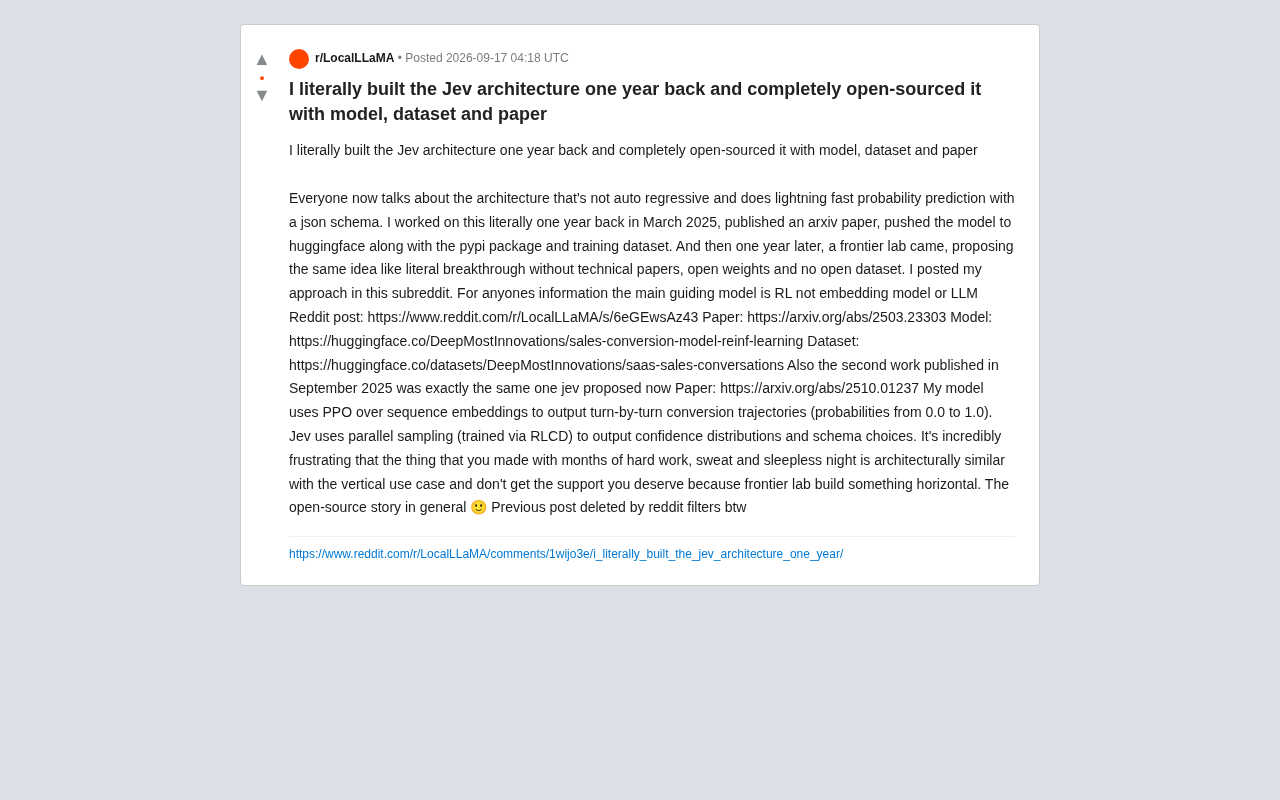
The Open Source Dilemma: A Non-Autoregressive Architecture Pioneer Overshadowed by Frontier Labs
An indie developer claims a frontier lab repackaged his year-old open-source non-autoregressive RL architecture as a breakthrough. We compare PPO sequence embeddings vs. RLCD parallel sampling and examine open source attribution gaps.
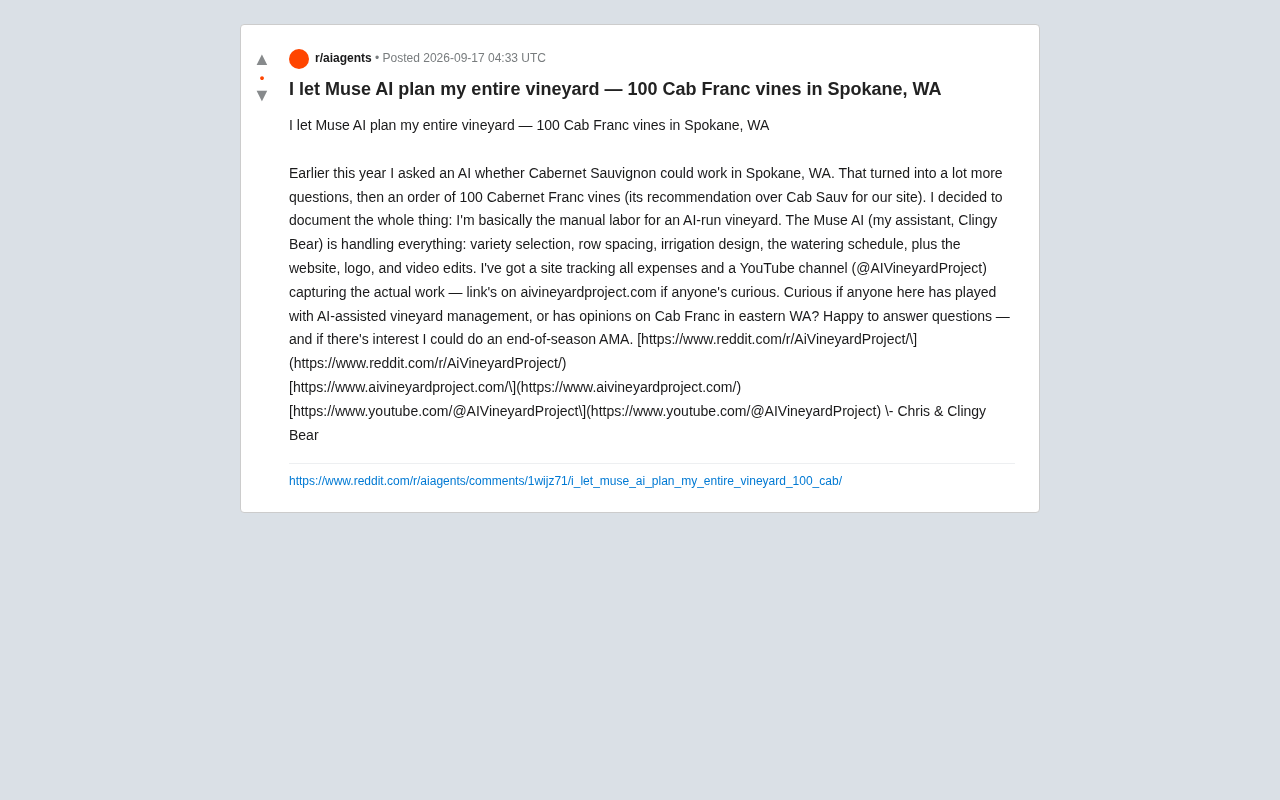
AI Plans an Entire Vineyard: A Real-World Experiment with 100 Grapevines
A Spokane hobbyist let Muse AI plan his entire vineyard — variety, spacing, irrigation, even the logo. He planted 100 Cabernet Franc vines and is documenting everything publicly.

Iceland's Treble Raises $18M to Bet on Voice Simulation Platform
Iceland-based voice simulation company Treble raises $18M. Its platform serves voice AI developers, AI wearables, and robotics firms. A deep dive into the technology and what the funding signals.