Flipcorder: Turn Your iPhone into a 1991 Retro Camcorder

Flipcorder uses 20-second clips and VHS style to bring the iPhone back to pure recording.
Flipcorder is an iOS app that turns your iPhone into a 1991 retro camcorder, with the core idea of "one tape a day": shoot only 20-second clips each time, accumulate them throughout the day, and review them in the evening like flipping through a family videotape. It offers VHS and DV styles, simulating grain, color shift, and date stamps—deliberate imperfection that contrasts with today's over-polished social media video culture. The business model is a one-time $4.99 purchase with no ads, no subscriptions, no watermarks, and no account required, with all content staying local. The app ranked 13th on Product Hunt for the day and No. 3 in the Paid Photo & Video category on the US App Store, reflecting some users' desire to escape the pressure of "shooting for others" and rediscover the joy of recording itself. Currently iPhone-only.
Why Do We Need an "Outdated" Camcorder?
In an era obsessed with 4K, 60fps, and perfect composition, an iOS app called Flipcorder goes the opposite direction, turning your iPhone into a 1991 home camcorder. It recently hit Product Hunt, earning 78 upvotes and ranking 13th for the day, and climbed to No. 3 in the Paid Photo & Video category on the US App Store. This raises the question: why would people pay $4.99 for a "degraded" shooting tool?
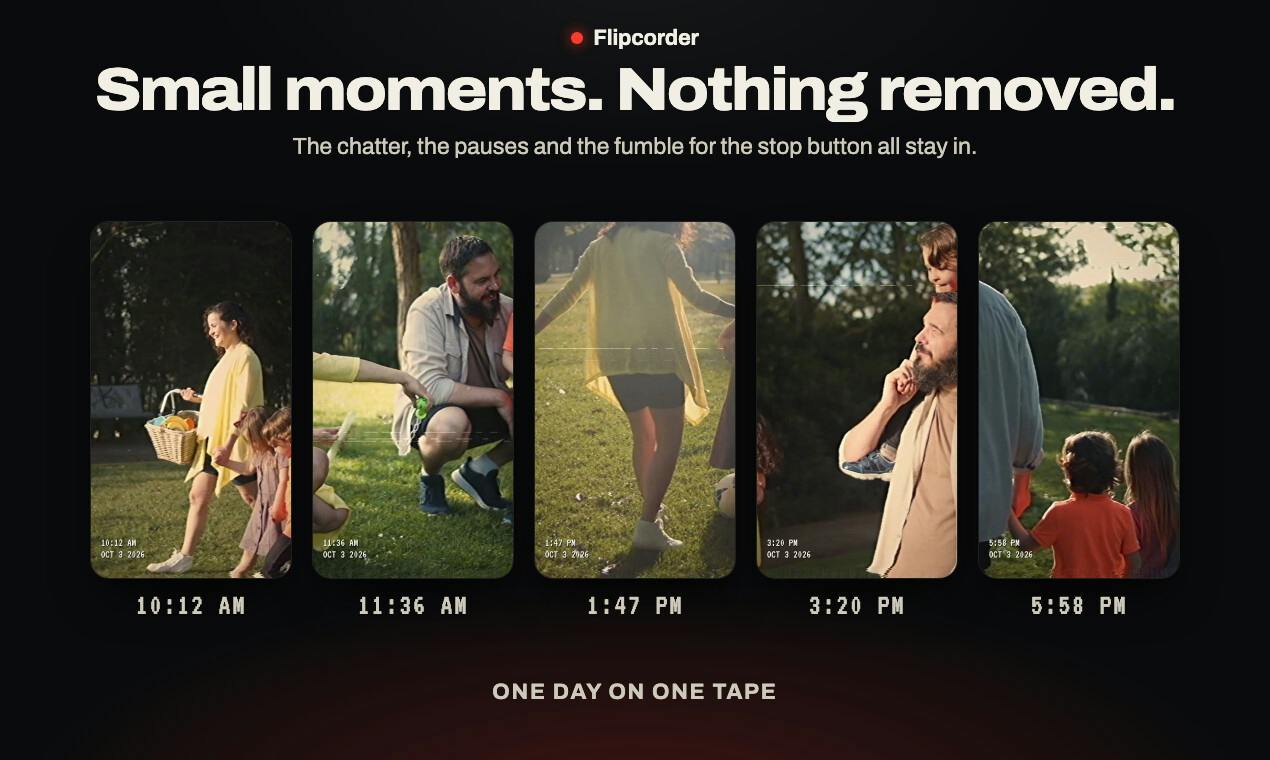
Core Experience: One "Tape" a Day, 20 Seconds per Clip
Flipcorder's core idea is "one tape a day." It encourages you to shoot only 20-second clips (called "flips") each time, accumulating them throughout the day, so that by evening you can review the day's footage like flipping through a family videotape. There's no editing interface, no filter stacking—just pure shooting and playback.
The app offers two retro styles, VHS or DV, simulating the grain, color shift, and date stamps of old magnetic tapes. This deliberate imperfection is precisely a rebuttal to today's over-polished social media video culture. As the developer puts it: "We've lost the original intent of making perfect videos. Flipcorder encourages you to capture brief snippets of your day and enjoy them as a home video in the evening."
VHS and DV are analog video formats from different eras, and understanding their differences helps you appreciate Flipcorder's retro layers. VHS is the cassette tape standard that emerged in the 1970s, dominating the home video market for nearly three decades, characterized by low resolution, obvious color noise and ghosting, and a date-time stamp in the corner of the screen. DV, on the other hand, is a digital video format that appeared in the mid-to-late 1990s, with clearer image quality and more stable colors, though early digital camcorders also carried a distinctive sharpened look and sensor noise. By offering both styles, Flipcorder lets users choose between the "imperfections" of different eras rather than simply applying a uniform filter.
Pricing and Privacy: One-Time Purchase, No Ads, No Subscription
In today's world of rampant subscriptions, Flipcorder's business model stands out as refreshingly clean: a one-time $4.99 purchase, no ads, no subscriptions, no watermarks, no account required. This means everything you shoot stays local and is never uploaded to any server. For privacy-conscious users, that's a significant plus.
The app is "built for iPhone Duo" but compatible with any iPhone. Given the Duo's foldable screen characteristics, Flipcorder may offer a more immersive viewfinder experience on the unfolded large screen, though the original text doesn't elaborate.
"iPhone Duo" is not an official Apple product name; here it likely refers to a foldable-screen iPhone form factor (or the developer's nickname for a foldable iPhone). Foldable devices have a screen ratio closer to square when unfolded, so a traditional portrait viewfinder would leave large black bars, requiring dedicated adaptation of the viewfinder and playback layout. Flipcorder's claim of being "built for iPhone Duo" suggests it may have adjusted the tape-style playback interface proportions for the unfolded large screen, making the simulated horizontal videotape frame more complete. However, since this model isn't yet widely available, this adaptation is more of a forward-looking design.
Returning to the Purity of "Shooting as Enjoyment"
Flipcorder's popularity reflects a subtle shift in needs: in a creative environment dominated by algorithmic recommendations and like counts, some users are beginning to crave escaping the pressure of "shooting for others" and rediscovering the joy of recording itself. The 20-second limit not only lowers the barrier to shooting but also forces you to focus on the moment rather than repeatedly adjusting parameters.
This "limitation as freedom" design philosophy has precedents in retro camera apps like Dispo and Hipstamatic. But Flipcorder goes further by introducing a time dimension—the concept of one tape a day naturally strings fragmented clips into a personal life history.
"Limitation as freedom" is a classic proposition in design: by artificially constraining options, you reduce decision burden and spark creativity. In photography apps, this manifests as fixed focal length, fixed aspect ratio, limited shooting duration or count. Dispo simulates the delayed gratification of film development with "you have to wait until the next day to see your shots," while Hipstamatic replicates the blind-shooting feel of film cameras with non-previewable lens combinations. Flipcorder inherits this lineage but expands the constraint from "a single photo" to "a day's time span," making the constraint itself part of the narrative structure.
Who Is Flipcorder For?
If you're tired of the thousands of photos on your phone that you never look back at, or want to leave your kids a uniquely styled growth record, Flipcorder offers a lightweight and fun alternative. It's not for professional users chasing image quality, nor for content creators needing precise editing. But for ordinary people wanting to rediscover the original joy of shooting, that $4.99 may be well spent.
Currently Flipcorder is iPhone-only, and developer Matt Brewer hasn't revealed plans for an Android version.
One-line Summary
Flipcorder uses 20-second clips and VHS style to bring the iPhone back to pure recording.
Paragraph Summary
Flipcorder is an iOS app that turns your iPhone into a 1991 retro camcorder, with the core idea of "one tape a day": shoot only 20-second clips each time, accumulate them throughout the day, and review them in the evening like flipping through a family videotape. It offers VHS and DV styles, simulating grain, color shift, and date stamps—deliberate imperfection that contrasts with today's over-polished social media video culture. The business model is a one-time $4.99 purchase with no ads, no subscriptions, no watermarks, and no account required, with all content staying local. The app ranked 13th on Product Hunt for the day and No. 3 in the Paid Photo & Video category on the US App Store, reflecting some users' desire to escape the pressure of "shooting for others" and rediscover the joy of recording itself. Currently iPhone-only.
Related articles

Qwen4 Architecture Preview Open-Sourced: 125B Parameters, 512 Experts, Designed for VRAM-Constrained Hardware
Qwen4 isn't released yet, but its architecture is previewed via open-source Qwen3.8 Flash Next: 125B params, 6B activated per token, 512 experts, 262K context, built for VRAM-limited hardware. This article covers official confirmations, key config.json metrics, and local deployment tests on 24G memory.

Run 8K Images on 6GB VRAM! Hands-On Test of Fudan's Open-Source MOSS-Image Model
Fudan OpenMouse team and Shanghai MOSS Intelligence open-source MOSS-Image, a 500M-parameter DT architecture text-to-image model that runs locally on 6GB VRAM with precise text rendering, structured layout control, and 4K Token prompt support—ideal for e-commerce posters and local deployment by individual creators.

Overseas Blogger Tests Local Deployment of 100B-Parameter MoE Model: Key Lessons on Quantization and Tool Calling
Overseas blogger tests local deployment of Alibaba's Qwen 3.8 Flash Next 100B MoE model on a Strix Halo mini PC and CUDA workstation, revealing how quantization precision affects tool-calling success and the real-world performance of the Strata and GUFO inference engines.