floci: A Free and Lightweight New Alternative for Local AWS Emulation

floci is a Java-based, lightweight, free AWS local emulator aiming to replace LocalStack.
floci is a Java-developed AWS local emulator with over 28,000 GitHub stars and 219 new stars in a single day, showing rapidly rising community attention. It emphasizes lightweight design and always being free, directly targeting LocalStack's recent strategy of moving advanced features behind a paywall. The article analyzes floci's positioning, technology stack, and differences from LocalStack, noting it suits local development, CI testing, and teaching, while its value ultimately depends on service coverage, API synchronization, and sustainable long-term maintenance. Developers are advised to trial it in non-critical projects first.
Why You Need a Local AWS Emulator
When developing applications based on AWS, connecting directly to cloud services not only incurs costs but is also subject to network latency and quota limits. Local emulators have emerged to let developers test code in an offline environment. For a long time, LocalStack has been the mainstream choice in this space, but its free tier has limited functionality, with advanced features requiring a paid subscription. Recently, the floci project has surged in popularity on GitHub, attempting to break this situation with a positioning of "lightweight, fluffy, and always free."
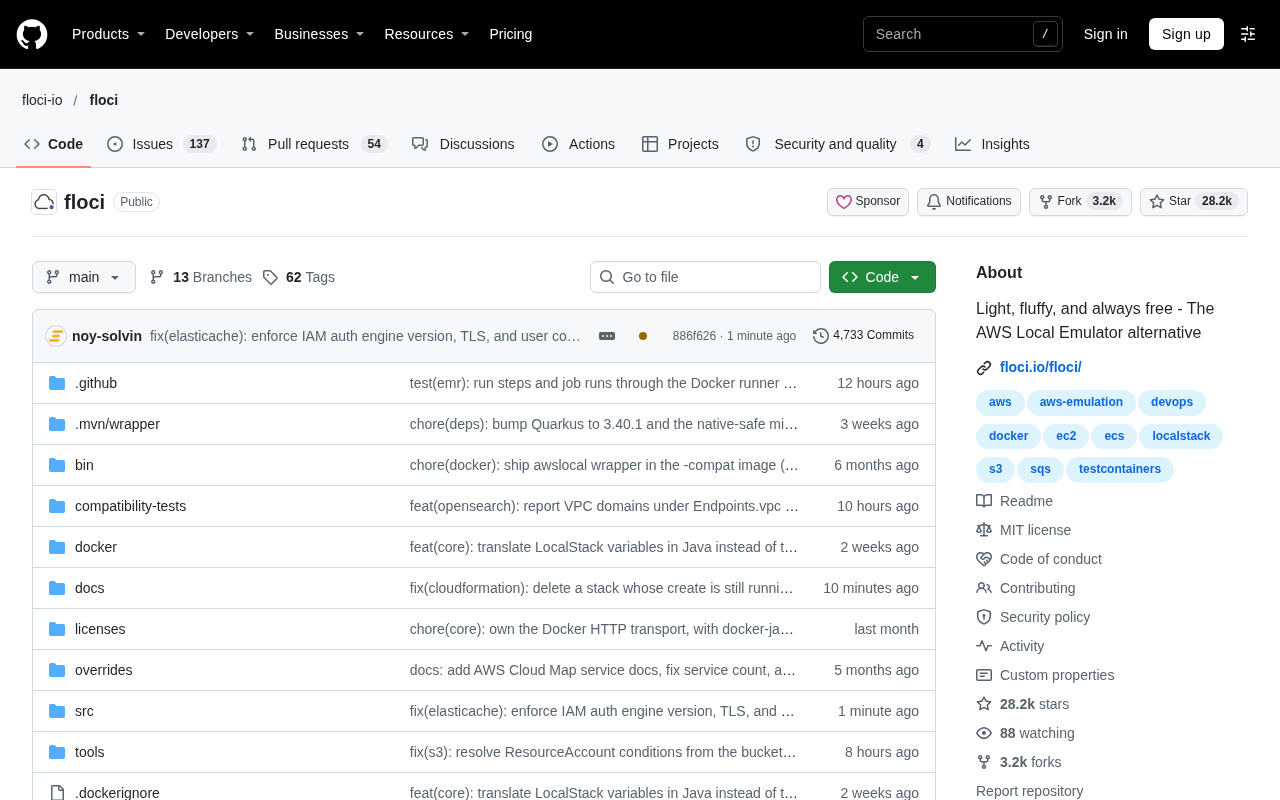
floci is developed in Java and currently has 28,142 stars and 3,158 forks on GitHub, with 219 new stars in a single day, showing strong community demand for a free alternative. Its core selling point is written right in its title—as an alternative to the AWS Local Emulator, emphasizing lightweight design and zero cost.
LocalStack is an open-source framework for local emulation of AWS cloud services. By running simulated AWS API endpoints in local containers, it lets developers test code without connecting to the real cloud. It initially became popular as an open-source free tool, covering a large number of services such as S3, SQS, SNS, Lambda, and DynamoDB. But in recent years, LocalStack has adopted an open-core plus paid professional edition model, placing some advanced services, team collaboration, and CI integration capabilities into commercial subscriptions, gradually narrowing the functional boundaries of the free community edition. For teams that rely on these advanced features or need full service coverage, usage costs have risen accordingly—this is exactly the market background behind the emergence of free alternatives like floci.
floci's Core Positioning and Features
According to the project description, floci emphasizes three keywords: Light, fluffy (implying low resource usage), and always free. This is clearly a differentiated competitive move aimed at LocalStack's paid model. For individual developers, students, or small teams with limited budgets, a completely free local emulator can significantly lower the development barrier.
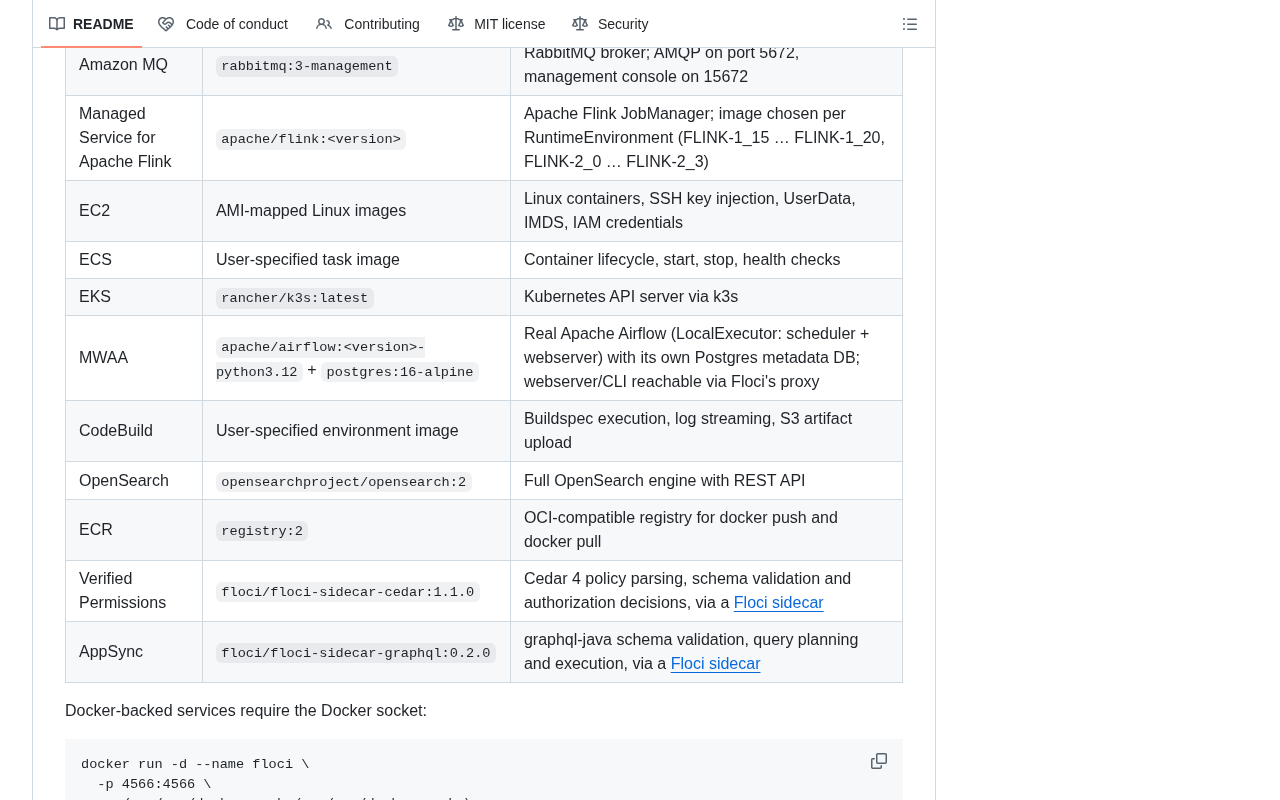
Choosing the Java technology stack means floci can run cross-platform and leverage the mature toolchain of the JVM ecosystem. However, the startup speed and memory usage of Java applications are usually a focus for developers, and whether floci truly achieves "lightweight" still requires practical testing to verify. Judging from the project's popularity, the community has already expressed preliminary recognition through its star count.
AWS service emulators typically need to implement HTTP API endpoints for each service, request signature verification, state storage, and event trigger logic, so their resource usage and feature coverage tend to be proportional. LocalStack was originally written in Python and later introduced a containerized architecture; it is comprehensive in functionality but relatively heavy to start. floci's choice of the Java/JVM technology stack theoretically allows it to be built with mature HTTP servers, serialization frameworks, and concurrency tools, but the cold start time and heap memory overhead of JVM applications may also become a challenge to its "lightweight" promise. To evaluate whether an emulator is lightweight, the key metrics include image size, startup time, idle memory usage, and stability under concurrent requests—all of which require benchmark testing to verify.
Comparison with LocalStack
LocalStack provides broad AWS service emulation, but the free community edition covers only some core services, and in recent years it has gradually placed more features behind a paywall. The emergence of floci gives developers another option: if it can cover commonly used services such as S3, SQS, and DynamoDB under a free model, that would be enough to satisfy many local development and CI testing scenarios.
It is important to note that an "always free" promise needs to be supported by a sustainable maintenance model. Open-source projects rely on community contributions and sponsorships, and long-term activity is key. floci's current high visibility is a positive signal, but whether it can continue iterating and stay in sync with AWS APIs remains to be seen.
"Always free" in open-source projects usually means adopting a permissive license (such as MIT or Apache 2.0) and sustaining operations through community contributions, GitHub Sponsors, corporate sponsorship, or accompanying commercial support services. The risk of this model lies in limited maintainer capacity, loss of core contributors, or unsustainable funding, which can lead to stalled project updates. For an AWS emulator, continuously tracking AWS API changes is a heavy task, because AWS service interfaces iterate frequently, and if the emulator does not update in sync, behavioral differences from the real environment will emerge. Therefore, when evaluating floci, in addition to its current star count, you should also pay attention to commit frequency, issue response speed, release cadence, and whether there is a clear governance and funding mechanism.
Use Cases and Getting Started Advice
floci is suitable for the following scenarios: local development and debugging, lightweight dependency emulation in continuous integration, teaching demonstrations, and offline environment testing. For teams already using LocalStack, migration cost depends on how compatible floci is with the target services. It is recommended to try it first in non-critical projects and evaluate its API coverage and stability.
The project is written in Java, so users need basic JVM environment configuration skills. The GitHub repository provides source code and documentation, and developers can build it themselves or contribute. As the star count grows rapidly, the community discussion and issue areas may accumulate more practical experience, which is worth following.
Using a local AWS emulator in continuous integration (CI) usually requires quickly starting the emulation service as a container or process and destroying it after testing to ensure environment isolation and repeatability. The advantage of a lightweight emulator in this scenario is fast startup and low resource usage, which can shorten pipeline waiting time. However, CI environments have high stability requirements, and the emulator needs to support capabilities such as health checks, fixed port mapping, data persistence toggles, and log output. Before migrating, it is advisable to first list the AWS APIs actually called by the project, check floci's compatibility one by one, and run the old and new emulators in parallel in the test pipeline to compare behavioral differences before deciding whether to switch.
Conclusion
With free and lightweight as its entry point, floci targets a gap in the AWS local emulator market. Its 28k+ stars show that it has hit a pain point for many developers. But the value of a tool ultimately depends on feature completeness and long-term maintenance. If you are looking for a free alternative to LocalStack, floci is worth adding to your candidate list.
One-line Summary
floci is a Java-based, lightweight, free AWS local emulator that aims to be an alternative to LocalStack.
Paragraph Summary
floci is an AWS local emulator developed in Java that has already gained more than 28,000 stars on GitHub, with 219 new stars in a single day, showing rapidly rising community attention. It emphasizes lightweight design and always being free, directly targeting LocalStack's strategy in recent years of placing advanced features behind a paywall. The article analyzes floci's positioning, technology stack choice, and differences from LocalStack, noting that it is suitable for scenarios such as local development, CI testing, and teaching, but that the tool's value ultimately depends on service coverage, API synchronization capability, and the sustainability of long-term maintenance. Developers are advised to try it first in non-critical projects for evaluation.
Related articles

Deleted Reddit Post Sparks Debate Over AI Content Moderation
A Reddit post removed with only a 'Removed by Reddit' notice highlights AI content moderation's transparency gaps, misjudgment risks, and appeal challenges for platforms and creators.

DSH + Ollama Local LLM Deployment in Practice: Free Chat with Da Fei Yu
Bilibili creator tests DSH + Ollama local LLM deployment end to end: Ollama install, Xunlei-accelerated downloads, ModelScope GGUF model import, DSH custom API address setup, and a comparison of Qwen 3.5 4B, 8B, Gemma, and other models on 8GB VRAM, with advice on choosing local deployment vs. API calls.

Tested: A $899 Mac Mini vs. a $200/Month AI Subscription
Real-world test of whether an M4 Mac mini can replace a $200 AI subscription: 16GB can't fit large models, and both speed and quality fall short—but privacy, no caps, and near-zero running costs make it an ideal host for an always-on agent. Includes buying advice per configuration and money-saving strategies.