Flux 3 Action Released: A Deep Dive into the 7B Action World Model

BFL launches Flux 3 Action, a 7B action world model extending FLUX's visual intelligence into robotic and simulator control.
Black Forest Labs has released Flux 3 Action, a 7-billion-parameter action world model designed to translate FLUX's visual understanding into executable actions for robots, simulators, and games. Unlike pure image generation, action world models predict how an environment changes under specific actions — a logic closely related to next-frame prediction, prompting community speculation about video generation potential. The simultaneous release of a base model has excited the open-source community, raising hopes for a full Flux 3 dev release and a rich ecosystem of downstream applications in robot learning and embodied intelligence.
Black Forest Labs (BFL) has recently launched Flux 3 Action, an action world model with 7 billion parameters. The release has sparked considerable discussion on Reddit, prompting a fresh look at how image generation models might extend into embodied intelligence and robotic control.
From Visual Intelligence to Action Control
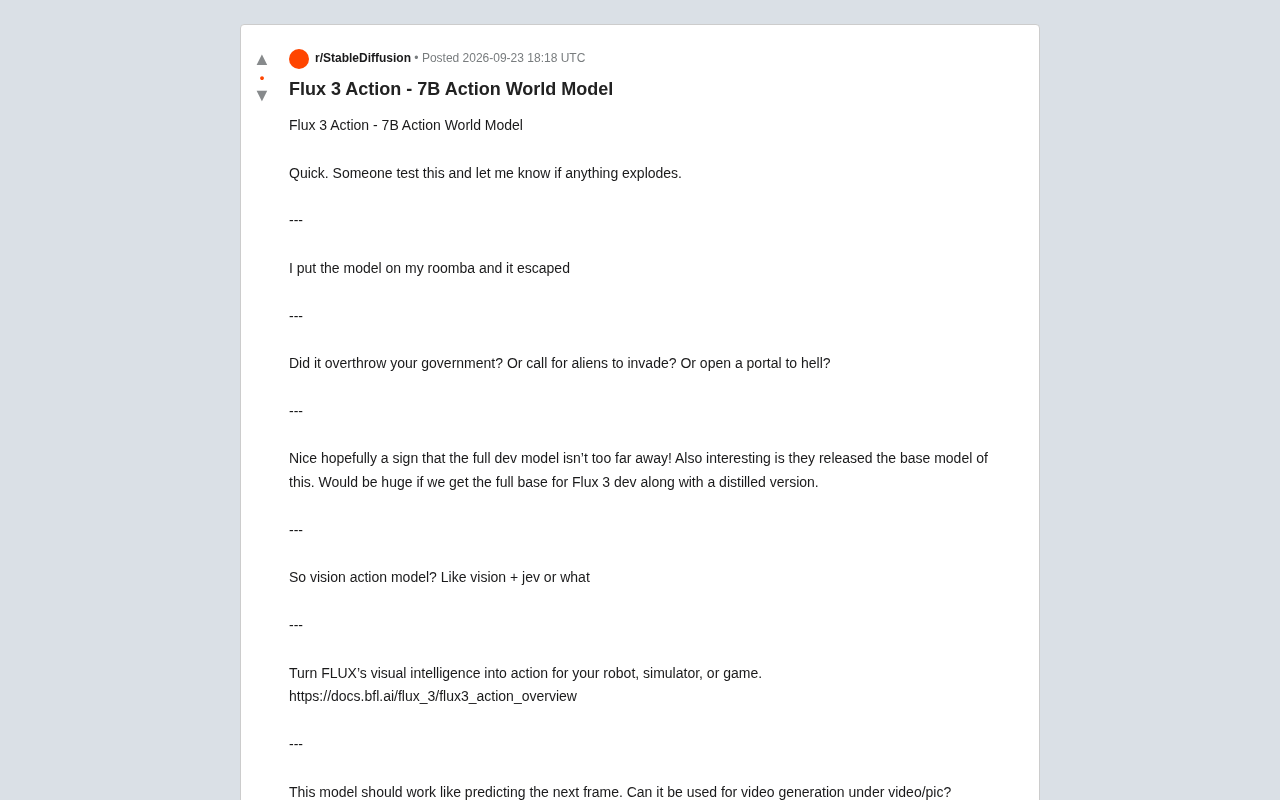
According to the official description, Flux 3 Action's core positioning is: "Turn FLUX's visual intelligence into action for your robot, simulator, or game."
In other words, this is no longer a model that simply generates static images. Instead, it attempts to map the visual understanding capabilities built up across the FLUX series into an executable action space. Models like this are typically called "world models" because they need to model the state of an environment and predict how it will change under specific actions.
In community discussions, some users directly described it as a "vision action model" — a combination of vision and action. This type of architecture isn't new to the robot learning field, but seeing it come from a team like FLUX, known primarily for image generation, still represents a notable shift in direction worth watching. More technical details can be found on the official documentation page (docs.bfl.ai) and the model homepage (bfl.ai/models/flux-3-action).
Action World Models are one of the core concepts in robot learning and embodied intelligence research in recent years. The fundamental idea is to train a model to predict the next state of an environment given a current observation (typically an image or video frame) and an action command. This is fundamentally different from traditional image classification or generation tasks — the model doesn't just need to "see" the world, it needs to understand "if I take a certain action, what will the world look like next?" Early landmark work in this space includes DeepMind's Dreamer series and the environment models used by OpenAI in Dota 2. More recently, with the rise of large-scale vision-language models, researchers have begun exploring the use of pretrained visual representations to initialize world models, reducing data requirements and improving generalization. Flux 3 Action's approach of building action prediction capabilities on top of FLUX's visual foundation follows exactly this line of thinking: leveraging visual representations already trained on massive image datasets to avoid learning the visual structure of environments from scratch, and instead focusing modeling effort on action-state transitions.
World Models and "Predicting the Next Frame"
One particularly interesting thread in community discussions came from users asking whether this model "works like predicting the next frame" and "whether it can be used for video generation."
This question cuts to the heart of what action world models are. An ideal world model is, at its core, a system that predicts the next state given a current state and an action — and that next state is often expressed as the next frame of a scene. This "next-frame prediction" capability has a natural overlap with video generation, which can itself be viewed as continuously predicting subsequent frames over time.
If Flux 3 Action does possess frame-by-frame prediction capabilities, it would theoretically have the potential to be applied to video generation and simulation environment construction. That said, it's worth emphasizing that this remains speculation at the community discussion level — the official team has not positioned it as a video generation tool. Its primary use cases remain focused on action decision-making for robots, simulators, and games.
The Promise of an Open Base Model
One of the most discussed points in the community was that BFL released the base model alongside the launch.
As one user put it: "Hoping this is a signal that the full dev model is coming soon! Also interesting that they released the base model for this. If we can get the full Flux 3 dev base model plus a distilled version, that would be huge."
This enthusiasm reflects a consistent demand from the open-source community: a base model means significantly more room for downstream development. Compared to providing only an inference API or a lightweight distilled version, releasing the base model allows researchers and developers to fine-tune it, transfer it to specific tasks, or build entirely new application pipelines on top of it. For the FLUX ecosystem, releasing a full Flux 3 dev base alongside a companion distilled version would undoubtedly expand its influence considerably.
In the large model ecosystem, the distinction between a base model and a distilled model has significant implications for developers. A base model is the raw pretrained version — trained on large-scale data but not yet fine-tuned for specific tasks. It preserves the most complete parameter space and generalization potential, making it well-suited for researchers who want to perform fine-tuning, LoRA training, or task adaptation. A distilled model uses knowledge distillation to compress the "knowledge" of a large model into a smaller student model, trading some flexibility for faster inference and lower deployment costs. For image and vision generation models like FLUX, the community typically wants both: the base model for deep secondary development and the distilled version for rapid product integration. The earlier Flux.1 series built a large community following precisely by releasing versions like dev and schnell, which were quickly adopted across ecosystems like ComfyUI and Diffusers. The release of the Flux 3 Action base model is therefore being seen by the community as a signal that a complete Flux 3 open-source ecosystem is on its way.
Community Reactions: From Jokes to Genuine Curiosity
The atmosphere in the Reddit thread was a mix of humor and substantive discussion. Some users joked "I put the model in my Roomba and it ran away," while others chimed in asking "did it overthrow your government, summon an alien invasion, or open a portal to hell?"
Beneath the jokes lies a genuine curiosity: once an action world model is connected to real hardware (like a Roomba), just how capable is it of real-time decision-making and environmental adaptation? Connecting the output of a visual model directly to physical actuators is an unavoidable challenge in bringing embodied intelligence to the real world — and the community is clearly eager to try.
Summary
Flux 3 Action, as a 7B-scale action world model, represents FLUX's expansion from pure image generation into embodied action control. Its core value lies in translating visual intelligence into executable actions, with potential applications spanning robotics, simulation, and gaming.
For now, the release of the base model is the most anticipated highlight, and it has the community brimming with excitement about a full Flux 3 dev release. Whether the model can handle video generation and how it performs on real hardware remain open questions that will require further real-world testing. Developers interested in exploring it can head to the official documentation and model homepage for more details.
Related articles

Chain of Thought Isn't Just for AI: How Humans Can Use CoT to Improve Thinking Quality
Chain of Thought isn't just a prompt trick for large models. Starting from a Hacker News discussion, this article analyzes why CoT works for human thinking too, breaks down actionable ways to transfer it, and highlights the key differences between human CoT and machine CoT.
Cloudflare Teams Up with OpenAI: Closi…
Cloudflare Teams Up with OpenAI: Closing the Loop from Vulnerability Discovery to Defense with AI
Cloudflare uses OpenAI Daybreak to investigate security vulnerabilities and generate reviewable remediation plans, while developers use Codex to boost coding efficiency and quality.

Orca Multi-Agent Orchestration in Practice: A Guide to Parallel Collaboration with Claude and Codex
Orca is Stable AI's free open-source agent workbench supporting 34 agents like Claude Code and Codex in parallel. Learn its Git worktree isolation, multi-model orchestration, and mobile management.