FoldScape: Predicting Protein Structures at Any Folding Stage from Sequence

FoldScape generates conformational ensembles at any folding stage conditioned on sequence and folding fraction.
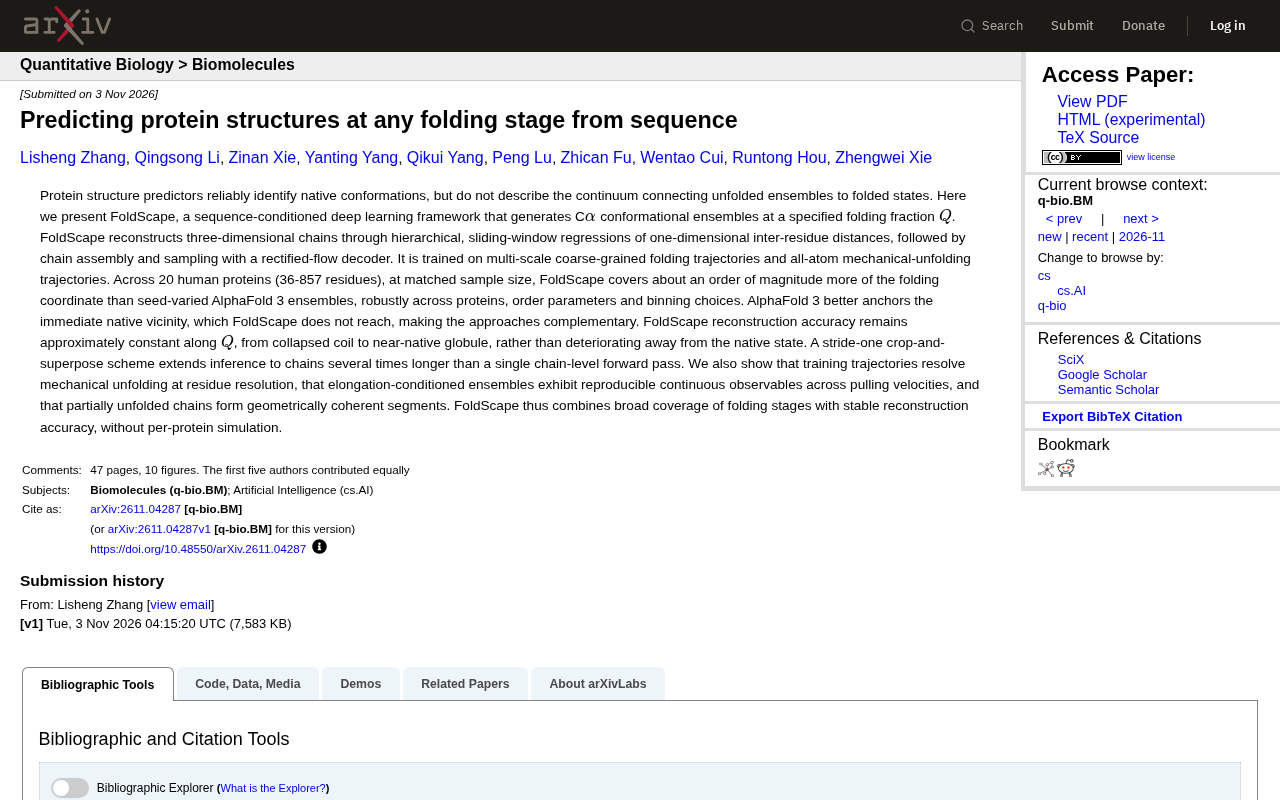
FoldScape is a deep learning framework conditioned on sequence and folding fraction Q that generates Cα conformational ensembles of proteins at any folding stage, filling the gap left by structure predictors such as AlphaFold that output only the native state. It reconstructs 3D chains via hierarchical sliding-window distance regression and uses a rectified-flow decoder for assembly and sampling; training data come from coarse-grained folding and all-atom mechanical unfolding trajectories. On 20 human proteins, it covers about an order of magnitude more folding coordinate range than seed-varied AlphaFold 3 ensembles, while the latter is more accurate near the native state, making them complementary. Accuracy is roughly constant along Q, and a crop-and-superpose scheme supports long-chain inference; training trajectories also enable mechanical unfolding analysis.
Protein structure prediction models typically answer just one question: what shape does this sequence eventually fold into? But proteins in cells are not always in their native conformation. The entire continuous process from random coil to molten globule to near-native structure is equally key to understanding function and disease mechanisms. A recent study proposes the FoldScape framework, which attempts to directly generate conformational ensembles at a specified folding degree from sequence, filling this gap.
From "Endpoint" to "Whole Process": The Blind Spot of Structure Prediction
Protein structure predictors represented by the AlphaFold series are already quite reliable at identifying native conformations. However, these models output a single static structure or limited structural sampling and cannot describe the continuous path between the unfolded ensemble and the folded state. In other words, we know what the endpoint looks like, but lack a systematic characterization of the scenery along the way.
This is exactly the starting point of FoldScape. It is a sequence-conditioned deep learning framework whose core capability is generating the corresponding Cα conformational ensemble given a folding fraction Q. The higher Q is, the closer the structure is to the native state; the lower Q is, the closer it is to collapsed or extended conformations. This allows researchers to "retrieve" protein conformations at any folding stage on demand, rather than getting only the single answer after folding is complete.
Folding fraction Q is a commonly used order parameter describing how close a protein conformation is to the native state, usually defined as the fraction of residue contacts overlapping between the current conformation and the native structure. Q=1 means fully consistent with the native state; lower Q means further deviation, passing through near-native molten globule, collapsed random coil, and finally fully extended. Because Q is a single scalar, it compresses the high-dimensional conformational space onto a one-dimensional coordinate, making it convenient to compare different folding stages, but it also cannot distinguish conformations with the same Q but different topologies. FoldScape uses Q as the conditioning variable, allowing the generative model to sample conformational ensembles at specified Q values, thereby achieving controllable generation along the folding coordinate.
Hierarchical Regression plus Rectified-Flow Decoding: How FoldScape Does It
FoldScape's generation strategy can be broken into two steps. The first is hierarchical, sliding-window one-dimensional inter-residue distance regression, using these distance constraints to reconstruct the three-dimensional chain; the second is chain assembly and sampling, using a rectified-flow decoder to output the final conformational ensemble. This "distances first, structure second" approach decomposes high-dimensional conformational generation into more controllable subproblems.
Training data cover two complementary trajectory sources: multiscale coarse-grained folding trajectories and all-atom mechanical unfolding trajectories. The former provides continuous information along the folding direction, while the latter supplements conformations along the unfolding pathway from the opposite direction. Combined, they give the model evidence at both ends of the folding coordinate.
In addition, the researchers designed a stride-one crop-and-superpose scheme that extends inference capability to chains several times longer than a single chain-level forward pass. This means FoldScape is not limited to short peptides or small proteins.
Rectified flow is a class of generative models based on ordinary differential equations, whose core idea is to learn a velocity field that transports a simple distribution (such as Gaussian noise) to the data distribution along approximately straight trajectories. Compared with diffusion models that require multi-step denoising, rectified flow can make trajectories straighter through "reflow" iterations, thereby completing generation with fewer sampling steps. In FoldScape, the rectified-flow decoder receives chain information reconstructed from distance regression and outputs a conformational ensemble consistent with the target Q condition. This design enables the model to reduce sampling overhead while maintaining generation quality, and also facilitates batch generation of diverse conformational samples during inference.
Multiscale coarse-grained folding trajectories and all-atom mechanical unfolding trajectories constitute two complementary sources of training data. Coarse-grained trajectories typically simplify each residue to a single bead and simulate the path from extended to folded using simplified potential energy models; they are computationally inexpensive and can cover many sequences, but lose atomic detail. All-atom mechanical unfolding trajectories use steered molecular dynamics to gradually pull the protein apart from the native state, providing atomic-level precision and mechanical response information, but are computationally expensive with limited samples. Combining the two gives the model continuous conformational supervision in both the folding and unfolding directions, avoiding overfitting to a single direction.
Coverage and Accuracy: Complementary to AlphaFold 3
In comparative tests on 20 human proteins (length 36 to 857 residues), with matched sample sizes, FoldScape covers a range of folding coordinates about an order of magnitude larger than AlphaFold 3 ensembles with seed variation, and performs robustly across proteins, order parameters, and bin selections.
However, this comparison is not a one-sided victory. The original text explicitly states that AlphaFold 3 anchors better in the local region immediately adjacent to the native state, and FoldScape does not reach that region. The two therefore form a complementary relationship: AlphaFold 3 excels at finely characterizing structures near the endpoint, while FoldScape excels at spreading out the entire folding pathway.
One noteworthy detail is the stability of reconstruction accuracy. FoldScape's accuracy remains roughly constant along Q, with no significant degradation from collapsed coil to near-native molten globule, rather than gradually deteriorating as it moves away from the native state like many methods. This "usable throughout" property is exactly what is needed to describe the folding continuum.
Mechanical Unfolding and Long-Chain Inference: The Method's Extended Value
Beyond the folding pathway itself, the paper also demonstrates additional uses of the training trajectories. The study shows that these trajectories can resolve mechanical unfolding processes at residue resolution; ensembles conditioned on extension exhibit reproducible continuous observables at different pulling speeds; and partially unfolded chains form geometrically coherent segments.
These results show that FoldScape's value lies not only in "predicting the structure at a certain folding stage," but also in providing a way to obtain conformational ensembles without per-protein molecular simulations. For scenarios requiring study of folding intermediates, mechanical response, or partial unfolding behavior, this simulation-free generative capability may be more practical than single-point structure prediction.
Limitations and Significance
It should be clear that FoldScape cannot cover the extremely near-native region immediately adjacent to the native state; this part still relies on models like AlphaFold 3. Its positioning is not to replace existing structure predictors, but to fill in the previously missing map of the folding continuum. Using the two together may be the more reasonable practical path.
From a broader perspective, this work suggests a directional shift in structure prediction: from outputting a single answer to outputting condition-controllable conformational distributions. When models can retrieve structures by folding degree and by mechanical condition, protein structure prediction is no longer just "guessing the endpoint" but begins to have the ability to describe processes.
One-line Summary
FoldScape generates conformational ensembles at any folding stage conditioned on sequence and folding fraction.
Paragraph Summary
FoldScape is a deep learning framework conditioned on sequence and folding fraction Q that can generate Cα conformational ensembles of proteins at any folding stage, filling the gap left by structure predictors such as AlphaFold that output only the native state. Methodologically, it first reconstructs the three-dimensional chain using hierarchical sliding-window inter-residue distance regression, then assembles and samples via a rectified-flow decoder; training data come from multiscale coarse-grained folding trajectories and all-atom mechanical unfolding trajectories. On 20 human proteins, the range of folding coordinates it covers is about an order of magnitude larger than seed-varied AlphaFold 3 ensembles, but the latter is more accurate in regions adjacent to the native state, making the two complementary. Reconstruction accuracy is roughly constant along Q, and the crop-and-superpose scheme supports long-chain inference; the training trajectories can also be used for mechanical unfolding analysis.
Related articles

AI SDK Workflow 2.0.95 Update: Stream Transform API Removed
AI SDK Workflow 2.0.95 removes the experimental_transform option from WorkflowAgent.stream() and the StreamTextTransform type export, as stream transforms cannot reliably cross workflow step boundaries. This article covers the reasons, migration points, and upgrade advice.

AI SDK Vue 4.0.163 Patch Released: Full Dependency Chain Update
AI SDK Vue releases patch 4.0.163, synchronously upgrading dependencies including ai@7.0.163 and @ai-sdk/provider-utils@5.0.75. This article analyzes the practical impact of this dependency chain update.

AI SDK Voyage 2.0.75 Patch Release: What the Dependency Chain Update Means
AI SDK's Voyage Provider releases patch version 2.0.75, syncing only @ai-sdk/provider and provider-utils deps. We analyze the impact and upgrade guidance.