For Everyday AI Use, You Actually Need the Strongest Models Most

Frontier models matter most for ordinary people's vague everyday instructions, not hard expert tasks.
The article challenges the popular view of using lightweight models for daily use and frontier models only for professional tasks. Frontier models' intelligence shines on vague, ambiguous instructions—the norm for ordinary users. Lightweight models also make confident errors that non-experts can't detect, so everyday use needs the strongest models most.
A Counterintuitive Judgment
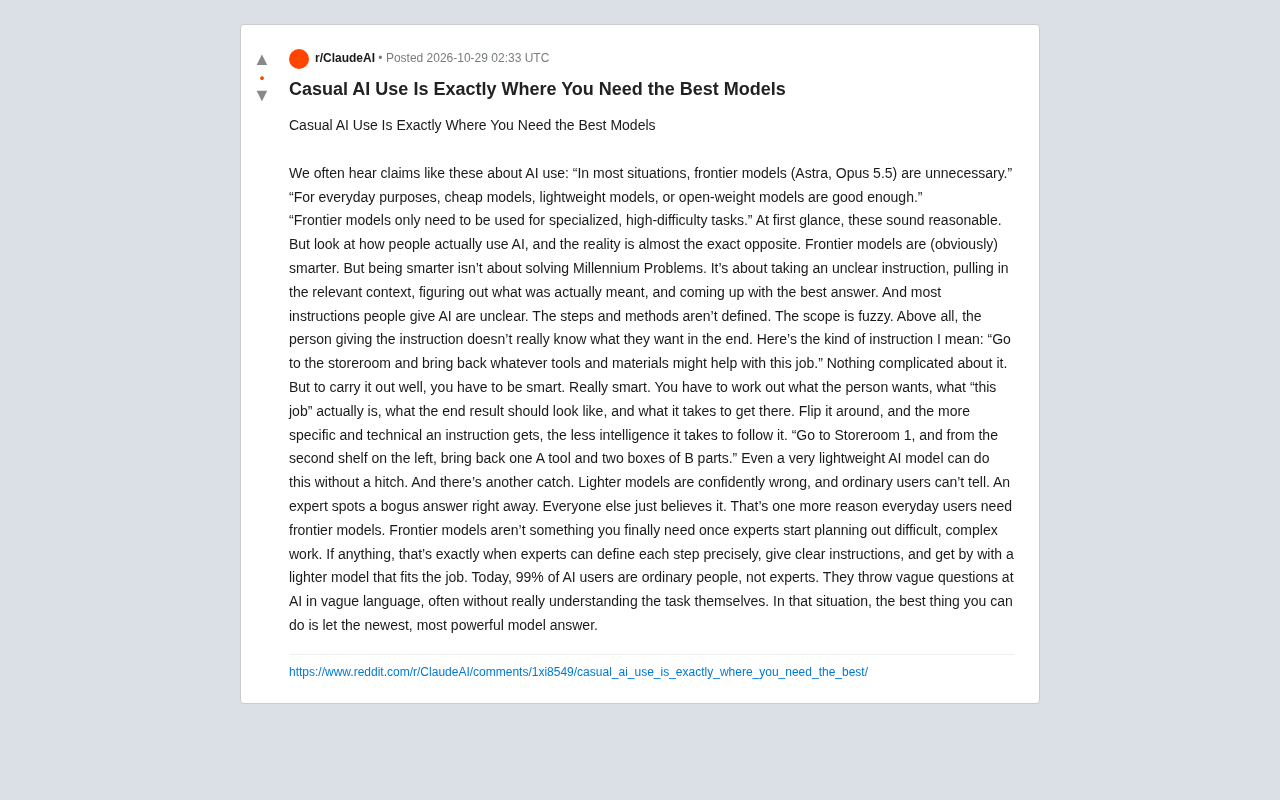
Several popular claims circulate about choosing AI models: frontier models aren't needed in most scenarios; cheap, lightweight, or open-weight models are sufficient for everyday use; frontier models should be reserved for high-difficulty professional tasks. These claims sound reasonable, but according to a discussion on Reddit, reality is almost the exact opposite. The author's core argument: frontier models are smarter, and being "smart" isn't about solving Millennium Prize Problems—it's about handling instructions that are vague, ambiguous, and not even fully thought through by the person making the request. And that is precisely the norm for ordinary people using AI.
Vague Instructions Are the Real Challenge
The original post uses a vivid example to illustrate the relationship between how vague an instruction is and how much intelligence it requires.
"Go to the storage room and bring back the tools and materials that might be useful for this job." The sentence itself isn't complex, but to do it well, the executor must be smart enough: they have to infer what the person actually wants, what "this job" specifically refers to, what the final result should look like, and how to achieve it.
Conversely, the more specific and technical the instruction, the less intelligence is needed to execute it. "Go to storage room #1, take tool A from the second shelf on the left and two boxes of part B." Even a very lightweight AI model can complete an instruction like this without any trouble.
This analogy reveals an overlooked fact: a task's "difficulty" and an instruction's "clarity" are two separate dimensions. Experts can use lightweight models precisely because they can define every step clearly and give explicit instructions; ordinary people, by contrast, tend to give requests with vague scope and unclear goals.
The analogy between "instruction clarity" and "intelligence requirements" in the original post actually touches on a core concept in natural language processing: instruction ambiguity. Ambiguity can appear at the lexical level (what does "tools" mean?), the syntactic level (what does "might be" modify?), and the pragmatic level (the speaker's true intent). When large language models handle such instructions, they need to rely on their internal world knowledge and contextual reasoning to "disambiguate." Frontier models, with larger parameter counts, broader training data, and more thorough alignment, perform more robustly on disambiguation tasks; lightweight models often can only do surface-level matching and are prone to outputs that deviate from the user's true intent. This also explains why, in open-domain dialogue and vague-request scenarios, the capability gap driven by model scale gets significantly amplified.
The "Confident Errors" of Lightweight Models Are More Dangerous
The original post also points out another key issue: lightweight models confidently give wrong answers, and ordinary users simply can't tell. Experts can spot a fabricated answer at a glance; everyone else tends to believe it outright.
This constitutes the second reason everyday users need frontier models even more. The capability gap between models isn't just about "whether they can get it right"—it's also about "whether a wrong answer is easy to spot." For ordinary users lacking domain judgment, an answer that sounds confident but is factually wrong is more harmful than one that clearly fails to answer.
"Confident errors" are often referred to in AI research as hallucination, specifically when a model generates content that seems plausible but is factually wrong or unfounded. Hallucination isn't exclusive to small models, but lightweight models—with limited knowledge capacity and shorter reasoning chains—are more likely to "make up" answers when they lack sufficient information, and their tone is often just as confident. Expert users can quickly identify hallucinations through cross-validation or domain knowledge; ordinary users lack that verification ability and easily mistake fluent, confident output for a reliable answer. Therefore, in everyday applications aimed at the general public, reducing hallucination rates and improving the ability to express uncertainty (e.g., "I'm not sure") matters more than simply pursuing low cost—and that is exactly the direction frontier models continue to optimize.
99% of Users Are Ordinary People
The original post offers this judgment: today, 99% of AI users are ordinary people, not experts. They throw vague questions at AI in vague language, often without fully understanding the task themselves. In this situation, the best approach is to let the newest, strongest model answer.
This perspective deserves attention because it upends the usual cost logic. The common advice is "use cheap models for simple tasks to save money," but the original post argues that everyday "simple" is only superficially simple—the intent behind the instruction isn't simple, and judging whether an answer is right or wrong is even less simple.
Implications for Model Selection Strategy
This discussion doesn't deny the value of lightweight models. In scenarios where instructions can be precisely decomposed—data extraction with fixed pipelines, format conversion, operations with clear rules—lightweight models are entirely sufficient, and even more economical.
What it really challenges is a default assumption: equating "everyday" with "simple." For most non-expert users, everyday AI use is precisely where intent is vaguest and where the model most needs to fill in context. This is also where the gap between frontier and lightweight models is most easily felt.
The criterion for choosing a model probably shouldn't be whether the task sounds "professional," but rather how vague the instruction itself is and how capable the user is of verifying the answer. On both counts, ordinary users' everyday scenarios fall on the side that needs stronger models.
One-line Summary
The real value of frontier models lies in handling ordinary people's vague everyday instructions, not high-difficulty professional tasks.
Paragraph Summary
The article challenges the popular view of "lightweight models for everyday use, frontier models for professional tasks." The author points out that frontier models' "smartness" shows in handling vague, ambiguous instructions—which is exactly the norm for ordinary people using AI. The more specific the instruction, the less intelligence required; experts can use lightweight models because they can precisely define every step. More critically, lightweight models confidently give wrong answers that ordinary users struggle to distinguish. Since 99% of AI users are ordinary people who ask vague questions and lack verification ability, everyday scenarios actually need the strongest models most. Model selection should be based on instruction vagueness and the user's ability to verify answers, not on whether the task sounds professional.
Related articles

Qwen4 Architecture Preview Open-Sourced: 125B Parameters, 512 Experts, Designed for VRAM-Constrained Hardware
Qwen4 isn't released yet, but its architecture is previewed via open-source Qwen3.8 Flash Next: 125B params, 6B activated per token, 512 experts, 262K context, built for VRAM-limited hardware. This article covers official confirmations, key config.json metrics, and local deployment tests on 24G memory.

Run 8K Images on 6GB VRAM! Hands-On Test of Fudan's Open-Source MOSS-Image Model
Fudan OpenMouse team and Shanghai MOSS Intelligence open-source MOSS-Image, a 500M-parameter DT architecture text-to-image model that runs locally on 6GB VRAM with precise text rendering, structured layout control, and 4K Token prompt support—ideal for e-commerce posters and local deployment by individual creators.

Overseas Blogger Tests Local Deployment of 100B-Parameter MoE Model: Key Lessons on Quantization and Tool Calling
Overseas blogger tests local deployment of Alibaba's Qwen 3.8 Flash Next 100B MoE model on a Strix Halo mini PC and CUDA workstation, revealing how quantization precision affects tool-calling success and the real-world performance of the Strata and GUFO inference engines.