Former Google CEO Funds Khipu AI and DeepIndaba to Advance AI Research in South America and Africa
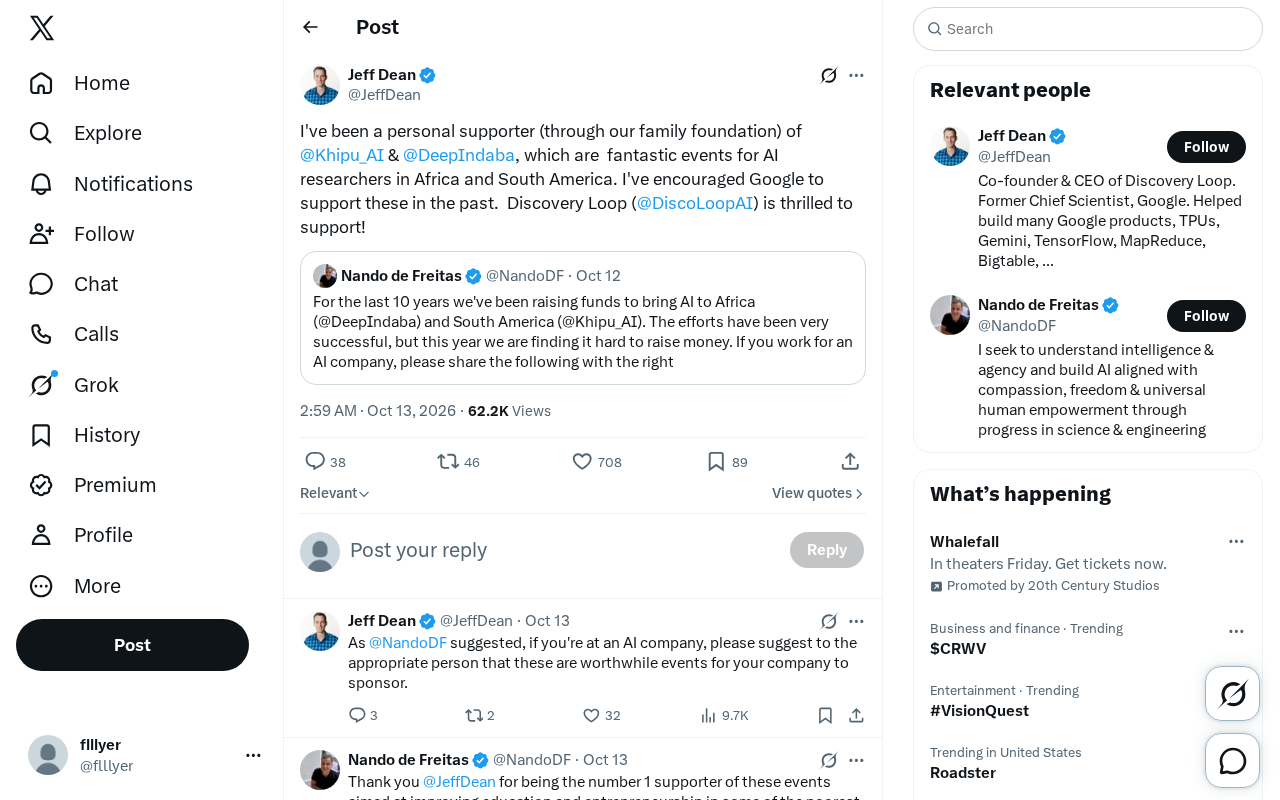
A single tweet reveals the AI research landscape is extending from traditional hubs like Silicon Valley toward Latin America and Africa, with individual funding as a key driver.
Using a Twitter post as a starting point, this article reveals that the global AI research landscape is extending from traditional centers like Silicon Valley, Beijing, and London toward Latin America and Africa. Khipu AI focuses on the South American AI community with Spanish and Portuguese as primary languages; DeepIndaba is rooted in Africa, cultivating young researchers through training, presentations, and mentorship. Both are infrastructure for regional AI ecosystems, not just conferences. The poster emphasizes personal support through a family foundation — a model more stable than corporate sponsorship. Discovery Loop's involvement signals a shift from individual philanthropy to institutional support. Structural challenges like computing power, visas, language, and brain drain remain, but the local community model shows early results.
The AI Geopolitical Shift Behind a Single Tweet
Recently, a tweet from Twitter drew attention in AI research circles. The poster revealed that he has long supported two AI academic initiatives, Khipu AI and DeepIndaba, in a personal capacity through his family foundation, and had once encouraged Google to participate in funding them. Now, his organization Discovery Loop (@DiscoLoopAI) has also announced it is joining the effort.
This information-rich tweet reveals a fact often overlooked by mainstream tech media: the map of global AI research is extending from traditional centers like Silicon Valley, Beijing, and London toward Latin America and Africa. And what's driving this change isn't just the commercial expansion of tech companies, but also long-term investment from individuals and foundations.
Khipu AI and DeepIndaba: Two Key Nodes in the Global South
For readers unfamiliar with the global AI academic ecosystem, these two names may seem obscure. But within their respective regions, they have already built considerable influence.
Khipu AI focuses on the AI research community in Latin America, particularly South America. With Spanish and Portuguese as its primary languages of communication, it brings together researchers from Brazil, Argentina, Chile, Colombia, and other countries. Unlike English-dominated international conferences like NeurIPS and ICML, Khipu provides South American researchers with a platform for in-depth exchange in their native languages, lowering the barrier to participation.
DeepIndaba, on the other hand, is rooted in Africa and is one of the largest deep learning academic events on the continent. Through intensive training, research presentations, and mentorship programs, it helps students and young researchers across Africa enter the AI field. A distinctive feature of DeepIndaba is its emphasis on practical orientation — many participants have gained access to the international research community through this platform.
What both share is this: they are not merely academic conferences, but infrastructure for regional AI ecosystems.
NeurIPS (Conference on Neural Information Processing Systems) and ICML (International Conference on Machine Learning) are widely recognized as the two premier academic conferences in global AI research today. Since its founding in 1987, NeurIPS has grown from a small workshop into a massive academic gathering attracting over 20,000 participants annually, with a paper acceptance rate that has long hovered around 20% to 25%, making it an important benchmark for AI research quality. ICML focuses on machine learning theory and methods and enjoys equally high academic prestige. Both conferences use English as their official language — submissions, reviews, and presentations are all conducted in English — and are mostly held in North America and Europe. For researchers who are non-native English speakers with limited funding, the barriers to participation go beyond language to include visas, long-distance travel costs, and cultural adaptation. This is precisely why regional, local-language academic communities are so crucial.
Why Individual Funding Deserves More Attention Than Corporate Sponsorship
There's a detail in the tweet worth noting — the poster emphasized that he provides support "in a personal capacity through our family foundation," rather than representing a company. This funding model is rare in AI research, yet it may offer more long-term value than corporate sponsorship.
Corporate sponsorship often carries clear commercial objectives or PR considerations, with budgets fluctuating based on company strategy. By contrast, support from individuals or family foundations tends to be more stable, with fewer strings attached, and can cover directions that show no short-term commercial return but have long-term academic value.
The tweet also mentions having "encouraged Google to support these initiatives," which shows that individual advocacy can influence how big companies allocate resources to some degree. When influential individuals consistently speak up for a region, tech giants' attention can be directed there. Discovery Loop's involvement represents a new generation of AI organizations beginning to pay attention to these regions as well.
The Challenges and Breakthroughs of AI Research in the Global South
AI research in South America and Africa faces structural challenges: limited computing resources, few international exchange opportunities, and severe talent drain. An AI doctoral student from Brazil or Nigeria wanting to attend a NeurIPS conference may face multiple obstacles including visas, travel costs, and language.
The value of Khipu AI and DeepIndaba lies precisely in putting the philosophy of "decentralization" into practice — rather than having Global South researchers strive to integrate into the Northern Hemisphere's system, they build high-quality academic communities locally.
This model has already begun to show results. In recent years, AI papers from South America and Africa have appeared more frequently at international conferences, and some researchers have begun to take on important roles at top institutions. Although the overall scale remains limited, the direction is clear.
Brain drain is one of the deeper challenges facing AI research in the Global South. When top researchers continuously flow to countries with better salaries, more abundant computing power, and more mature academic networks, the source countries not only lose intellectual resources but also lose the continuity needed to build local research traditions. This phenomenon is especially pronounced in AI, as the field depends far more on computing infrastructure, data resources, and industry application scenarios than traditional disciplines. In recent years, academia has proposed the concept of "brain circulation" as an alternative framework: after going abroad for further study or work, researchers return knowledge and network resources through remote collaboration, short-term returns home, and co-supervising doctoral students. The local communities built by Khipu AI and DeepIndaba are important nodes in brain circulation — they keep Global South researchers abroad connected to their home academic circles and provide international visibility for those who stay.
The Next Step for Regional AI Ecosystems
Discovery Loop's involvement adds a new dimension to this narrative. As a relatively new AI organization, its participation signals that support for Global South AI research is expanding from "individual philanthropy" to a broader institutional level.
However, these initiatives still rely heavily on the contributions of a small number of funders and volunteers. To achieve truly sustainable development, more diversified funding sources, stronger local institutional capacity, and closer connections with industry are needed.
The future of AI research should not belong to just a few countries. What Khipu AI and DeepIndaba represent is a more inclusive, more distributed possibility. And this tweet reminds us that the realization of such possibilities often begins with seemingly small individual actions.
Discovery Loop, as the emerging AI organization mentioned in the tweet, is still in its early stages, but its participation carries symbolic significance. In the AI funding ecosystem, the transition from individual philanthropy to institutional support often faces a key bottleneck: the lack of intermediary organizations to receive and distribute funds. Traditionally, large tech companies support academic activities through corporate social responsibility departments or direct research grants, but such funding often comes with implicit expectations like brand exposure or talent recruitment. Independent organizations like Discovery Loop, if they can establish transparent governance structures and measurable impact assessment mechanisms, could fill the institutional gap between individual funders and recipient communities, making funding flows more professional and sustainable.
One-line Summary
A single tweet reveals that the AI research landscape is extending from traditional centers like Silicon Valley toward Latin America and Africa, with individual funding models becoming a key driving force.
Paragraph Summary
Using a Twitter post as a starting point, this article reveals that the global AI research landscape is extending from traditional centers like Silicon Valley, Beijing, and London toward Latin America and Africa. Khipu AI focuses on the South American AI community, using Spanish and Portuguese as its primary languages; DeepIndaba is rooted in Africa, cultivating young researchers through training, presentations, and mentorship. Both are not merely academic conferences but infrastructure for regional AI ecosystems. The poster emphasizes providing support in a personal capacity through a family foundation — a model more stable and with fewer strings attached than corporate sponsorship, capable of covering directions with no short-term commercial return but long-term value. Discovery Loop's involvement shows support is expanding from individual philanthropy to the institutional level. The article also notes that AI research in South America and Africa still faces structural obstacles including computing power, visas, language, and brain drain, but the local academic community model has already shown initial results.
Related articles

uGAP: An AI Platform Unifying 100+ African Geospatial Datasets
uGAP is an African geospatial AI platform by a University of Cape Town team, unifying 120+ African datasets with a Python SDK for discovery, processing, and model training, already used in cyclone flood mapping.

Cursor Can Now Control Your Computer: AI Agents Can Drive Desktop Apps for Testing
Cursor adds desktop control: AI agents can drive desktop apps like the iOS Simulator to test their own features. We analyze the impact on dev workflows, possible technical approaches, and reliability concerns.

Vibecoding a Custom Inference Engine: High Hopes, Harsh Reality
A Reddit developer shares the real experience of vibecoding a custom inference engine: running GGUF Q4 models in the browser with WebGL2 and GLSL, only to fall into tokenizer debugging hell. This article analyzes the engineering challenges of browser-side LLM inference and why cloning llama.cpp is the more rational choice.